
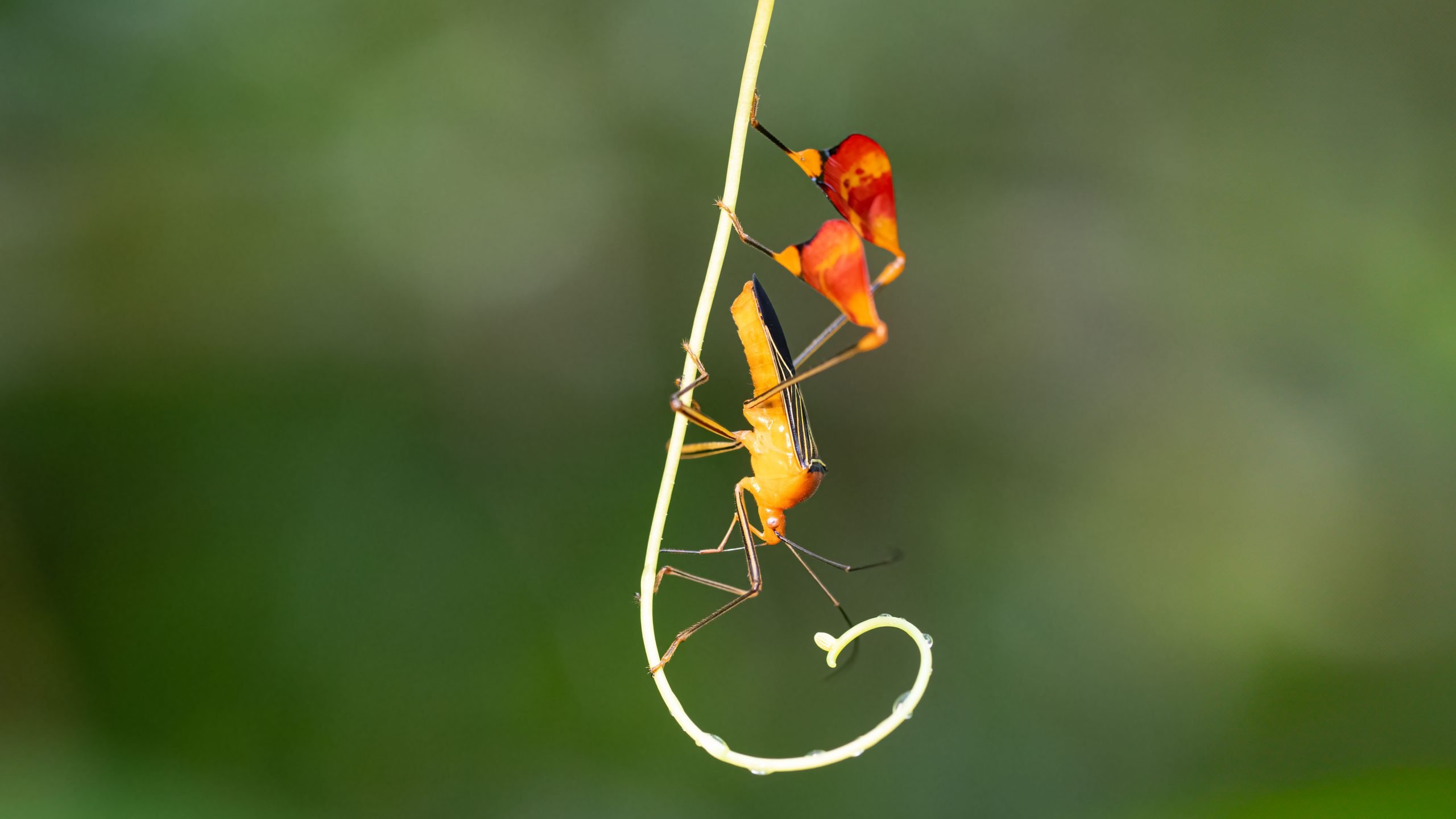
The matador bug’s flashy leg-waving isn’t a mating ritual but a predator deterrent, revealing a surprising defense strategy shared by multiple insect species and hinting at broader evolutionary patterns.
Walk through the forests of Panama and you might spot an insect that appears to wave at you. Scientists at the Smithsonian Tropical Research Institute (STRI) have been examining this behavior for some time. The matador bug (Bitta alipes) carries vivid reddish “flags” on its hind legs and puts on a complex leg-waving display. Why it does this has remained unclear — until now.
An early idea focused on sexual selection: males might wave their flags to attract females. Tests did not support that view. Both males and females waved, and the display did not accompany courtship or competition. That raised a deeper question: if it is not a mating signal, why would such a conspicuous and apparently costly behavior evolve?
Scientists at the Smithsonian Tropical Research Institute in Panama discovered that the matador bug’s hind leg-waving display is more than just a show — it helps protect it from predators. Credit: Smithsonian Tropical Research Institute
A new study published in Current Zoology by STRI researchers Connor Evans-Blake, Juliette Rubin and Ummat Somjee offers an answer. These colorful “flags” appear not to attract mates, but to deter predators. The team exposed matador bugs to two different arthropods: predatory praying mantids and harmless katydids. They recorded nearly 3,000 leg waves. The results were striking: on average, bugs increased their waving behavior seven-fold in the presence of mantids, but barely responded to katydids. Even more telling, mantids never attacked bugs that were actively waving.
An Evolutionary Strategy Beyond One Species
The findings show that waving is an anti-predator behavior, deployed specifically when danger looms. To document whether similar flag-waving behavior occurs in other species within the family, researchers used direct observations in Panama and searched for videos online. They found that at least five related flag-legged species display similar waving behaviors, hinting at a broader evolutionary strategy among these plant-feeding insects.
Matador bug, Bitta alipes performing the flag-waving behavior in the presence of a predatory mantis. Credit: Connor Evans-Blake
All these flag-waving insects feed on passionflower vines, known to carry toxins, and may thus be advertising their own chemical defenses with these bold movements. But how does waving reduce predatory attacks? The precise mechanism remains a mystery. Is the waving communicating the bugs’ likely toxicity, confusing predators’ vision, or intimidating attackers with exaggerated motion?
“We’re left with more questions than answers,” said senior author Ummat Somjee. “But that’s the beauty of studying insects — there are hundreds of thousands of species, most of them completely unstudied, and every time we look closely we uncover behaviors that change the way we think about evolution.”
Research like this goes beyond solving quirky puzzles. Insects make up the majority of Earth’s biodiversity and are foundational to terrestrial ecosystems worldwide, yet most of their behaviors remain undocumented. Understanding how prey defend themselves provides insight into how animals evolve and diversify into the many forms, sometimes bizarre, that make up complex ecosystems.
Reference: “Flag-waving behavior in matador bugs is an antipredatory strategy” by Connor Evans-Blake, Juliette J Rubin and Ummat Somjee, 1 August 2025, Current Zoology.
DOI: 10.1093/cz/zoaf047
Never miss a breakthrough: Join the SciTechDaily newsletter.
Follow us on Google and Google News.