
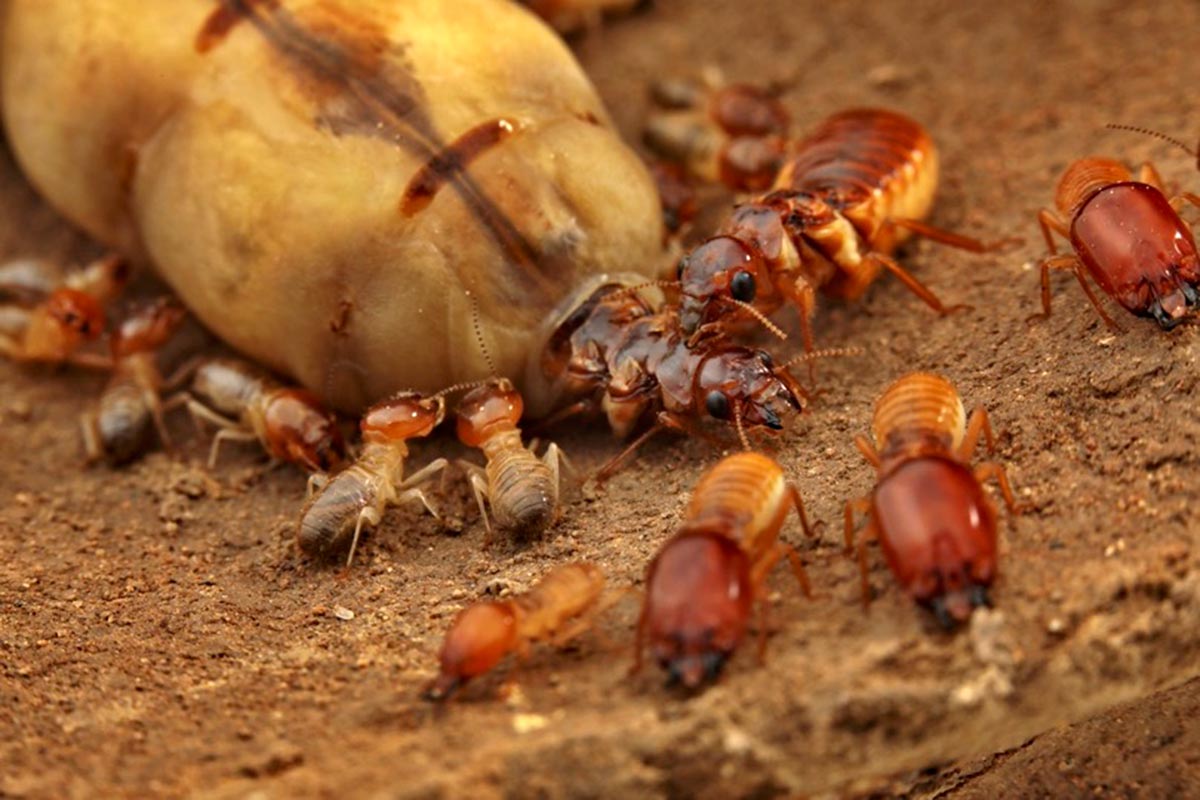
Termites became social powerhouses by stripping away genes tied to competition and independence.
This genetic shedding locked in monogamy, boosted cooperation, and paved the way for their astonishingly complex colonies.
Termites, Cockroaches, and a Big Evolutionary Puzzle
Termites rank among the most successful animals on the planet, building huge colonies that can reach into the millions. That success raises a basic mystery: how did insects with such sophisticated social lives evolve from solitary ancestors that resembled modern cockroaches?
Gene Loss, Not Gene Gains, Helped Build Termite Societies
A new University of Sydney study points to an unexpected explanation. Termites did not become more socially advanced by adding new genes. Instead, they became more socially complex by losing genes, including genes tied to sperm competition. The results add fresh evidence to the long-running debate over whether monogamy is a key ingredient in the rise of complex insect societies.
The international research, published today (January 29) in Science, traces termites back to ordinary cockroaches, including ancestors of modern ’domestic’ cockroaches, that began eating dead wood. Once this feeding behavior took hold, it set off a chain of genetic and social shifts that ultimately led to termites and their highly organized colonies.
The project was an international collaboration involving researchers from China, Denmark, and Colombia.
“Termites evolved from cockroach ancestors that started living inside and eating wood,” said Professor Nathan Lo from the University of Sydney’s School of Life and Environmental Sciences, a senior author on the paper. “Our study shows how their DNA changed first as they specialized on this poor-quality diet and then changed again as they became social insects.”

Comparing Genomes Across Cockroaches, Woodroaches, and Termites
To track how these changes unfolded, the team sequenced and compared high-quality genomes from cockroaches, woodroaches – a closely related group that lives in small family units – and multiple termite species representing different levels of social complexity.
One standout finding was that termite and woodroach genomes are smaller and less complex than cockroach genomes. As termite lineages increasingly relied on cooperation and food sharing inside the colony, they lost many genes related to metabolism, digestion, and reproduction.
“The surprising result is that termites increased their social complexity by losing genetic complexity,” Professor Lo said. “That goes against a common assumption that more complex animal societies require more complex genomes.”
The Clue Hidden in Termite Sperm
Among the most revealing gene losses were those involved in building the sperm tail, or flagellum. Unlike cockroaches and most other animals, termite sperm do not have tails and cannot swim.
“This loss doesn’t cause monogamy,” Professor Lo said. “Instead, it’s a strong indicator that monogamy had already evolved.”
In many animals, including cockroaches, females mate with multiple males. That pattern creates sperm competition, which favors fast-moving, tail-equipped sperm. But once termite ancestors shifted to monogamy, sperm competition faded. With no advantage to maintaining sperm tails, the genes supporting sperm movement were no longer needed.
“Our results indicate that the ancestors of termites were strictly monogamous,” Professor Lo said. “Once monogamy was locked in, there was no longer any evolutionary pressure to maintain genes involved in sperm motility.”
This conclusion connects to a broader scientific debate about whether close genetic relatedness is necessary for complex social systems to evolve. Some researchers have argued that high relatedness is not required. These findings suggest that for termites, monogamy and high relatedness played a crucial role.
How Colonies Decide Who Works and Who Reproduces
The study also sheds light on how termite colonies organize themselves. Experiments showed that a young termite’s path toward becoming a worker or a future king or queen depends strongly on nutrition early in development.
Larvae that receive plenty of food from older siblings develop high energy metabolism and become workers, which do not reproduce. Larvae that receive less food grow more slowly at first and keep the ability to become reproductives later, meaning kings or queens.
“These food-sharing feedback loops allow colonies to fine-tune their workforce,” Professor Lo said. “They help explain how termites maintain stable, highly efficient societies over long periods.”
When a termite king or queen dies, monogamy typically continues. In many cases, one of their offspring takes over the role, which leads to widespread inbreeding within colonies.
“From an evolutionary perspective, that reinforces relatedness even further,” said Professor Lo, who is part of a dynamic and growing insect research group in the School of Life and Environmental Sciences at the University of Sydney.
A Comprehensive Picture of Termite Social Evolution
By bringing together genomics, physiology, and behavior, the researchers offer one of the clearest explanations so far for how termites made the transition from solitary cockroach ancestors to some of the most socially complex organisms on Earth.
“This work shows that understanding social evolution isn’t just about adding new traits,” Professor Lo said. “Sometimes, it’s about what evolution chooses to let go.”
Reference: “Nutritional specialization and social evolution in woodroaches and termites” by Yingying Cui, Fangfang Liu, Dongwei Yuan, Mingtao Liao, Zhaoxin Li, Yun-Xia Luan, Shuxin Yu, Kesen Zhu, Qian Gao, Yunlong Cheng, Gangqi Fang, Zongqing Wang, Shiming Zhu, Jinlan Xu, Shuai Wang, Melissa Sánchez Herrera, Qiuying Huang, Xiaohong Su, Zhang Wang, Hui Xiang, Nathan Lo, Jacobus J. Boomsma, Shuai Zhan and Sheng Li, 29 January 2026, Science.
DOI: 10.1126/science.adt2178
Never miss a breakthrough: Join the SciTechDaily newsletter.
Follow us on Google and Google News.
1 Comment
That is totally not true, many species of termites has many kings and queens within the same colony. Fungus growing termites occasionally will have several kings and queens. Dampwood termites particularly almost invariably have numerous kings and queens. Though these are considered as pseudergates.
Also in many species of termites when either the king or queen dies, a new one from one of the larvae or workers will replace the one that died.
Monogrammy is a human preference and practice (often for religious reasons among other social reasons) and should not be applied to animals which have adaptation reasons behind their pairing.
While the things mentioned in this article are generally true, there are too many cases of exceptions to have them declared as the rule.