
A survey measuring the ethanol levels in fruits consumed by chimpanzees suggests that these animals are regularly exposed to alcohol.
Researchers from the University of California, Berkeley, conducted the first direct measurements of ethanol in fruits naturally available to chimpanzees across their African habitats. The findings suggest that the animals could ingest the equivalent of more than two standard alcoholic drinks per day through their fruit-based diet.
While it remains uncertain whether chimpanzees intentionally seek out fruits with higher ethanol levels, typically those that are riper and richer in sugar, the presence of alcohol in many of the fruits they routinely consume implies that ethanol has long been a natural component of their diet. This pattern likely mirrors the dietary habits of early human ancestors as well.
Calculating daily alcohol intake in chimpanzees
“Across all sites, male and female chimpanzees are consuming about 14 grams of pure ethanol per day in their diet, which is the equivalent to one standard American drink,” said UC Berkeley graduate student Aleksey Maro of the Department of Integrative Biology. “When you adjust for body mass, because chimps weigh about 40 kilos versus a typical human at 70 kilos, it goes up to nearly two drinks.”
In the U.S., a “standard drink” contains 14 grams of ethanol, regardless of the drinker’s size, while in much of Europe, the standard measurement is 10 grams.
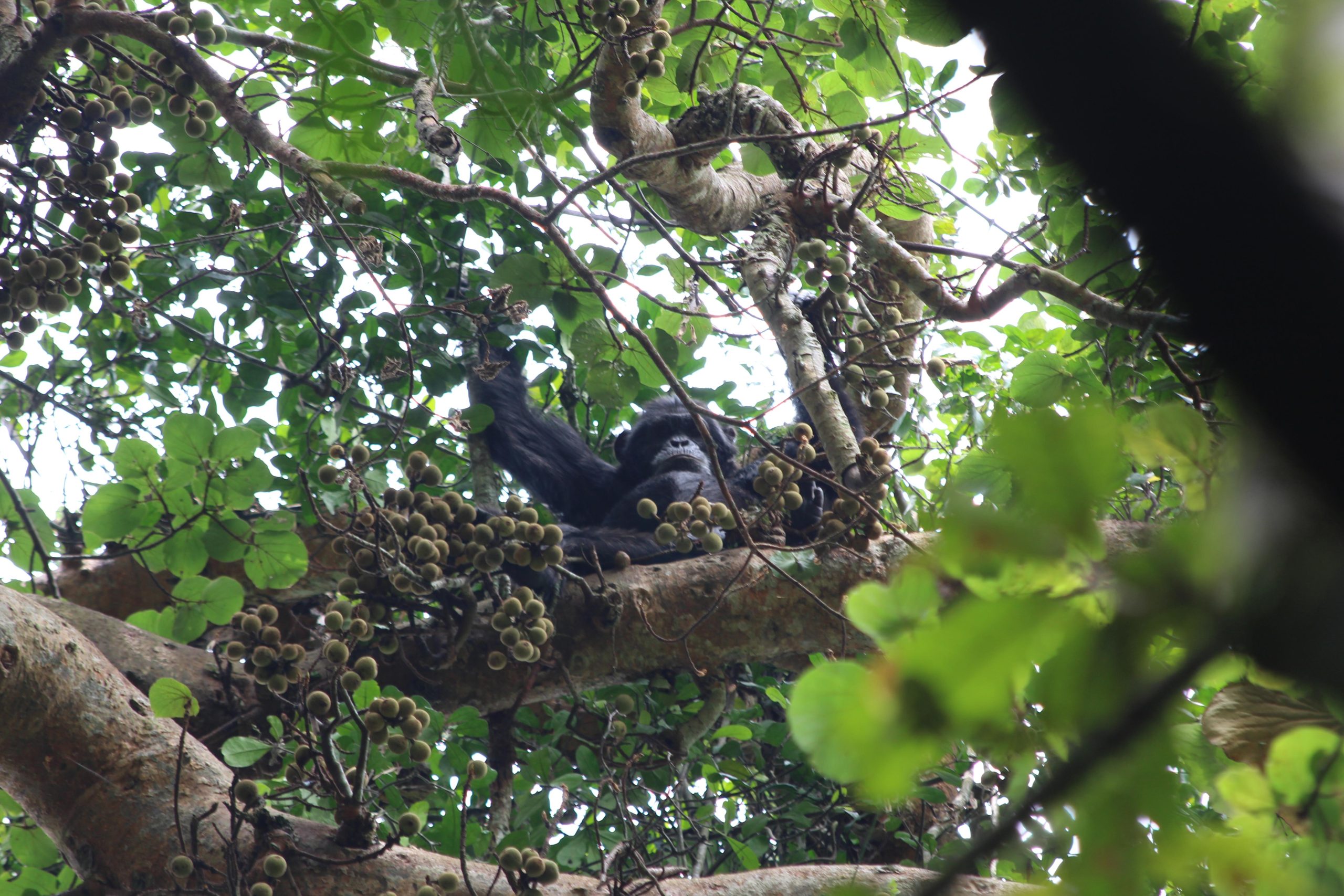
Maro sampled 21 fruit species at two long-term chimpanzee research sites—Ngogo in Uganda and Taï in Ivory Coast—and found that the fruits contained an average alcohol concentration of 0.26% by weight. Primatologists estimate that chimpanzees at these locations consume roughly 10 pounds (4.5 kilograms) of fruit daily, with fruit making up about 75% of their diet. By combining these dietary estimates with the alcohol measurements, the researchers were able to calculate an approximate daily intake of ethanol for wild chimpanzees.
“The chimps are eating 5 to 10% of their body weight a day in ripe fruit, so even low concentrations yield a high daily total — a substantial dosage of alcohol,” said Robert Dudley, UC Berkeley professor of integrative biology. “If the chimps are randomly sampling ripe fruit as did Aleksey, then that’s going to be their average consumption rate, independent of any preference for ethanol. But if they are preferring riper and/or more sugar-rich fruits, then this is a conservative lower limit for the likely rate of ethanol ingestion.”
Dietary patterns and evolutionary implications
According to Maro, the chimpanzees feed throughout the day and show no visible signs of intoxication. To actually become inebriated, a chimp would need to eat such large quantities of fruit that its stomach would become distended. However, this pattern of steady, low-level ethanol exposure suggests that alcohol ingestion was also a routine part of the diet of early human ancestors, our closest evolutionary relatives. Unlike their wild counterparts, captive chimpanzees and many modern humans consume little to no naturally fermented food today, potentially missing a nutrient that once played a consistent role in primate diets.
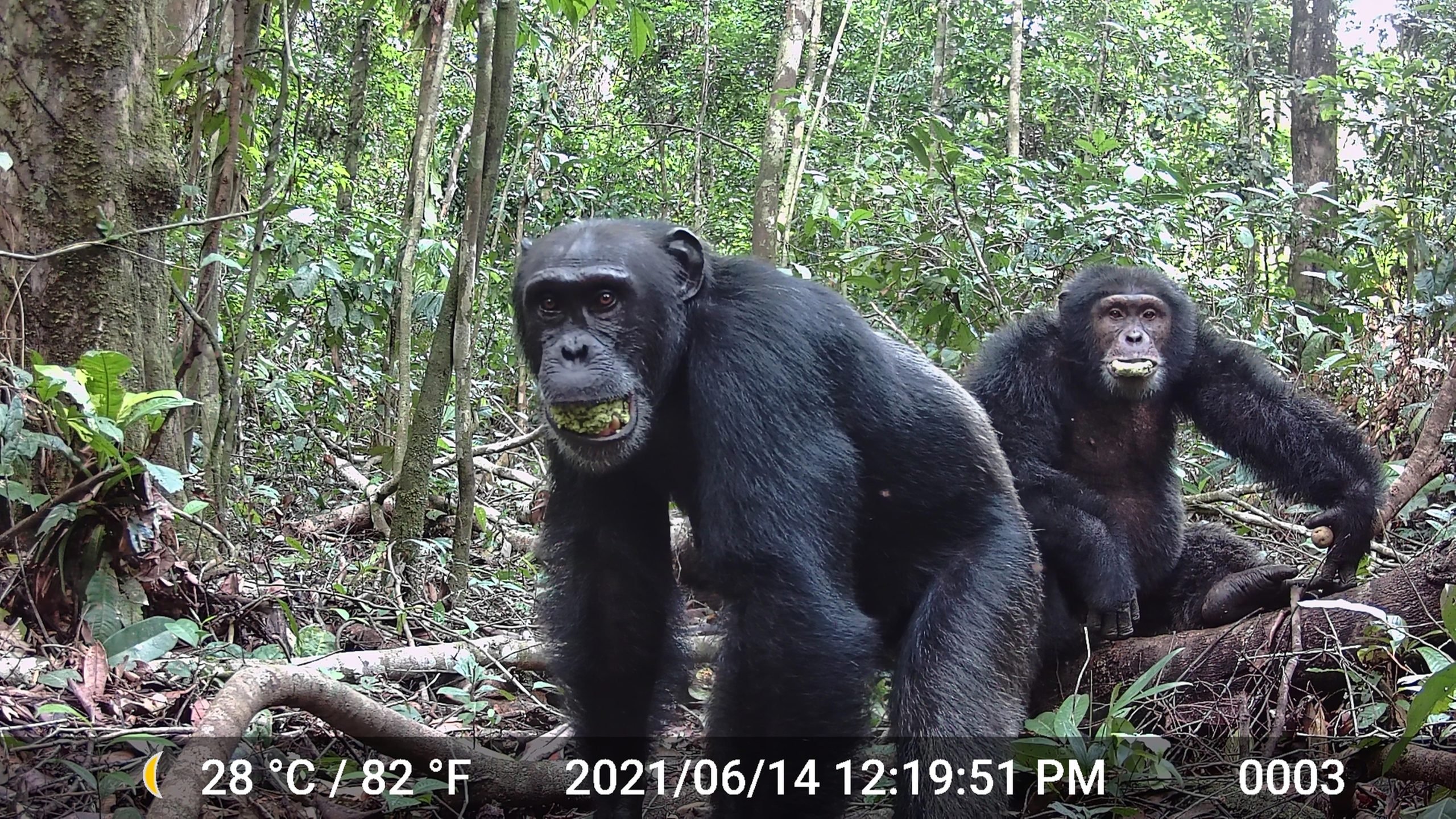
Time-lapse video from a camera trap set up in Taï National Park in the Ivory Coast in 2021. A chimpanzee dubbed Porthos stuffs his mouth with the plum-like fruit of the evergreen tree Parinari excelsa. Among chimps at Taï, this is the most popular food and has the highest alcohol content of all the fruit species sampled. Credit: Aleksey Maro/UC Berkeley and Taï Chimpanzee Project
“Chimpanzees consume a similar amount of alcohol to what we might if we ate fermented food daily,” Maro said. “Human attraction to alcohol probably arose from this dietary heritage of our common ancestor with chimpanzees.”
Maro is first author and Dudley is senior author of a paper that was recently published in the journal Science Advances.
The ‘drunken monkey’ hypothesis
Dudley first began to suspect more than 20 years ago that the human appetite for alcohol was inherited from our primate ancestors, and wrote a 2014 book about his theory: The Drunken Monkey: Why We Drink and Abuse Alcohol. This “drunken monkey” hypothesis drew skepticism from many scientists — particularly those who study primates — who told him that chimps and other primates don’t eat fermented fruit or nectar. These nutrients typically contain alcohol produced by yeast metabolizing sugar, just as yeast ferments sugary grape juice into wine.
But over the years, Dudley’s theory has gained an increasing number of adherents. More primatologists now report seeing monkeys and apes eating fermented fruit, a practice that was recorded earlier this year among chimps in Guinea-Bissau. Researchers also have published papers about captive primates’ preferences for alcohol. Dartmouth University researchers in 2016 reported that when captive aye-ayes and slow lorises were offered nectar with varying percentages of alcohol, they finished off nectar with the highest alcohol content first — and then repeatedly revisited the empty high-alcohol containers as if they wanted more. In 2022, Dudley collaborated with researchers in Panama to document that spider monkeys consume alcohol-laden fermented fruit in the wild and express alcohol metabolites in their urine.
It’s not only mammals that get a daily dose of alcohol from their diet. In a paper published earlier this year, Dudley and his Berkeley colleagues reported that the feathers from 10 of 17 bird species tested contained secondary metabolites of alcohol, indicating that their diet — nectar, grain, insects, and even other vertebrates — included substantial amounts of ethanol.
“The consumption of ethanol is not limited to primates,” Dudley said. “It’s more characteristic of all fruit-eating animals and, in some cases, nectar-feeding animals.”
He said that one theory about why animals seek out ethanol is that its odor helps animals find food with a higher sugar content, providing greater energy returns over time. Alcohol also may increase the pleasure of eating, similar to sipping wine with dinner. It’s also possible that sharing alcohol-infused fruit plays a role in social bonding among primates or other animals.
“It just points to the need for additional federal funding for research into alcohol attraction and abuse by modern humans. It likely has a deep evolutionary background,” Dudley said.
Collecting urine samples — with an umbrella
Beginning in 2019, Maro made two trips to Ngogo in Uganda’s Kibale National Park and one to Taï National Park in Côte d‘Ivoire. At Ngogo, which hosts the largest chimpanzee social group in Africa, the chimps climb trees to pluck fruits and prefer several varieties of figs. Maro and colleagues at Ngogo collected undamaged, freshly fallen fruits from the ground under trees that had recently been foraged by chimps. At Taï, where chimps typically eat fallen fruit, the team collected undamaged and unnibbled fruit from the ground under trees.
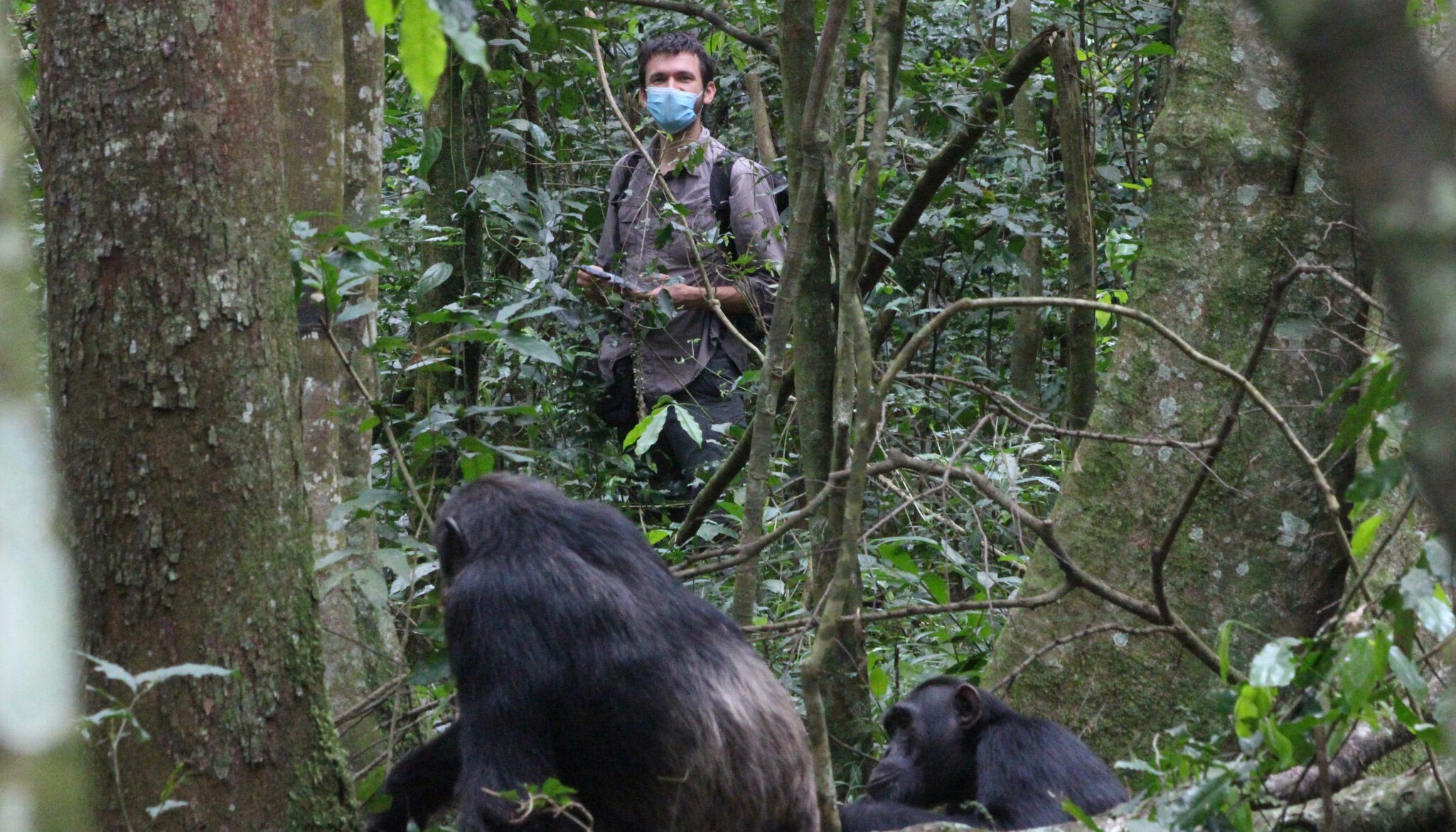
Each sample was packed in an airtight container, the species, size, color, and softness were recorded, and, once back at base camp, frozen to prevent further ripening. To test for alcohol content, Maro used different methods on each of the three field trips: a semiconductor-based device similar to a breathalyzer, a portable gas chromatograph, and a chemical test. All recorded similar alcohol percentages. He tested each method in advance in Dudley’s Berkeley lab using a standard procedure that could easily be replicated in the field, where he typically processed 20 samples in a 12-hour day.
Two of the procedures required thawing the fruit, removing the rind and seeds, blending the pulp, and letting it sit in an airtight container for a couple of hours to release alcohol. Air in the box, or “headspace,” was then extracted for analysis of alcohol content. A third procedure involved extracting the liquid part of the pulp and using color-changing chemicals that react with ethanol.
Linking chimp diet, alcohol content, and behavior
Weighted by the proportion of time chimps eat each type of fruit, the average alcohol content of fruit was 0.32% by weight at Ngogo and 0.31% at Taï. The most frequently consumed fruits at each site — a fig, Ficus musuco, at Ngogo, and the plum-like fruit of the evergreen Parinari excelsa at Taï — were the highest in alcohol content. Troops of male chimpanzees often gather in the canopy of F. musuco trees to consume fruit before going on boundary patrols of their community, Maro noted. And the fruit of P. excelsa is also very popular among elephants, which are known to be attracted to alcohol.
“I think the strength of Aleksey’s approach is that it used multiple methods,” Dudley said. “One of the reasons this has been a tempting target but no one’s gone after it is because it’s so hard to do in a field site where there are wild primates eating known fruits. This dataset has not existed before, and it has been a contentious issue.”
The new study provides the foundation for further studies in chimpanzee reserves to determine how much of the fermented, alcohol-laden fruit is preferentially consumed by chimpanzees. This summer, Maro returned to Ngogo to collect urine samples from chimps sleeping in trees — a fraught endeavor requiring an umbrella — in order to analyze them for alcohol metabolites, using test kits similar to those deployed in some U.S. workplaces. He and team member Laura Clifton Byrne, an undergraduate student at San Francisco State University, also followed chimpanzees to pick fruit freshly dislodged in the canopy and analyzed their alcohol content.
Reference: “Ethanol ingestion via frugivory in wild chimpanzees” by Aleksey Maro, Aaron A. Sandel, Bi Z. A. Blaiore, Roman M. Wittig, John C. Mitani and Robert Dudley, 17 September 2025, Science Advances.
DOI: 10.1126/sciadv.adw1665
The work was funded by UC Berkeley.
Never miss a breakthrough: Join the SciTechDaily newsletter.
Follow us on Google and Google News.
11 Comments
2 drinks in 24 hours is not going to do anything to anyone.
get over it already.
The chimps are probably not reporting how much alcohol they actually consume.
When the chimps see humans gathering up the fermented fruit without consuming it, they probably think the humans are Prohibitionists out to destroy their hooch.
Dam it Clyde I told u. u had to much to drink
This is nothing new. Fruit ferments on the vine or tree. And, as very humanoid organisms, they like to get a buzz. It’s the same for the elephants, they get drunk and stomp through the villages athe fields. Basically the elephantine version.of RAISING HELL
So even though the monkeys do not drink Colt 45 in 40 ounce bottles this proves the drinking is hereditary doesn’t it?
😂
A researcher gathering fruit from the ground is picking discarded fruit. Betcha the fruit that is consumed by brother Chimp has a higher ABV than discarded samples.
I feel that since humans are omnivotes a balanced diet should include water and ptoteins from vegetables and meat with less saturated fasts ,complex carboohydrteb and a variety of fruits is important.
Alcohol and Nicotine should be avoided.
This is not rocket science
[email protected]
L347 813 1679
Without sounding unserious, I raise concern as to the students picking freshly fallen fruit from trees and collecting urine samples with umbrellas – both possibly threatening behaviors to the territorial alcohol infused chimpanzees. Plus in Uganda…
Note to self: I’ve noticed how the squirrels are rapidly responding to the berries I throw out to them as well….i would add I feel captive chimps should be allowed to have this diet and the study documents how hx events and studies definitely show how people evolved.
One of Jane Goodall’s greatest achievements was establishing and organizing the Alcoholics Anonymous Twelve Step Programs for the rainforest chimpanzees.