
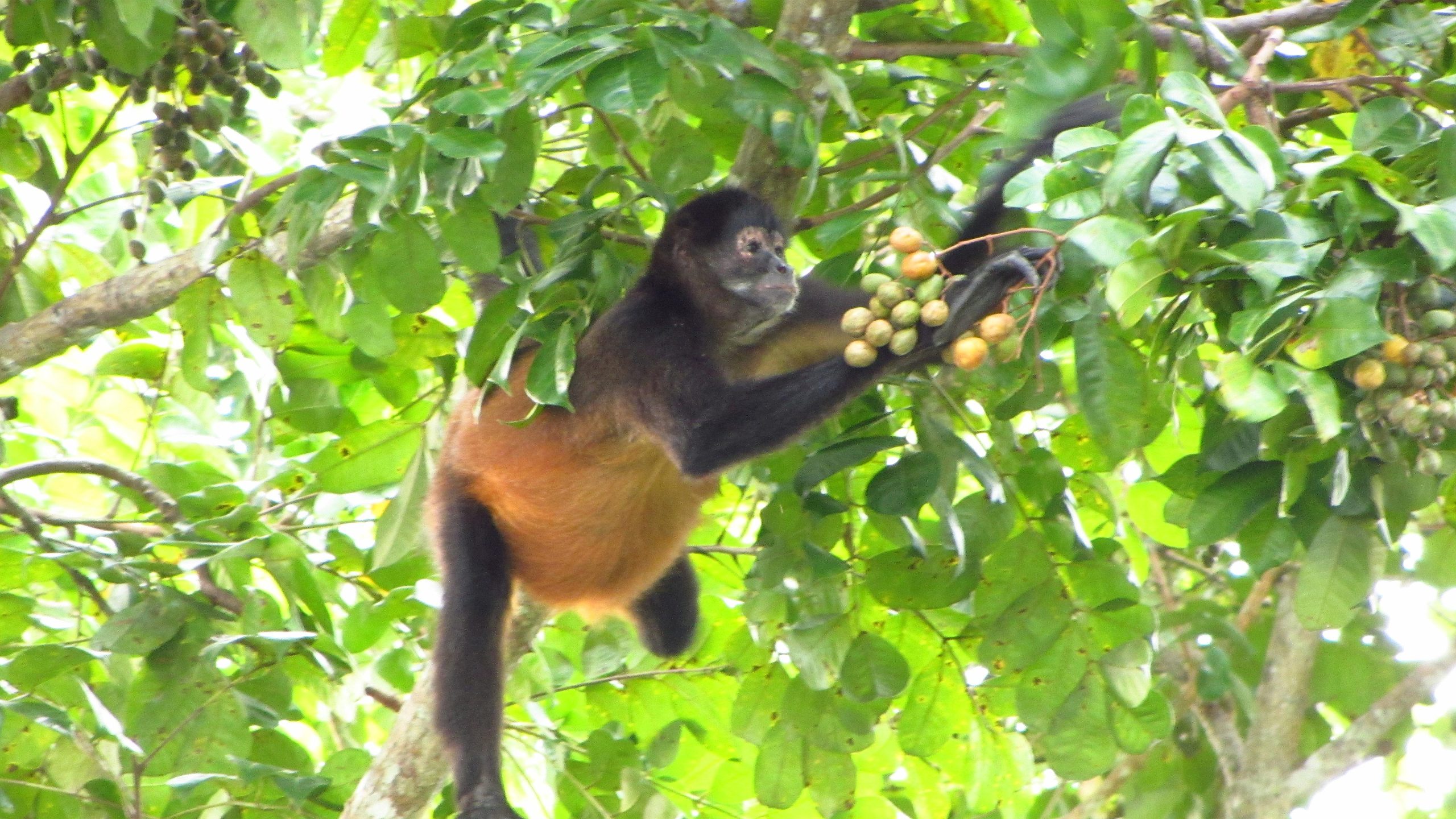
Monkeys routinely consume fruit containing alcohol, shedding light on our own taste for booze.
For 25 years, UC Berkeley biologist Robert Dudley has been intrigued by humans’ love of alcohol. In 2014, he wrote a book proposing that our attraction to booze arose millions of years ago, when our ape and monkey ancestors discovered that the scent of alcohol led them to ripe, fermenting, and nutritious fruit.
A new study now supports this idea, which Dudley calls the “drunken monkey” hypothesis.
The study was led by primatologist Christina Campbell of California State University, Northridge (CSUN), and her graduate student Victoria Weaver, who collected fruit eaten and discarded by black-handed spider monkeys (Ateles geoffroyi) in Panama. They found that the alcohol concentration in the fruit was typically between 1% and 2% by volume, a by-product of natural fermentation by yeasts that eat sugar in ripening fruit.
Alcohol Metabolism in Spider Monkeys
Moreover, the researchers collected urine from these free-ranging monkeys and found that the urine contained secondary metabolites of alcohol. This result shows that the animals were actually utilizing the alcohol for energy — it wasn’t just passing through their bodies.
“For the first time, we have been able to show, without a shadow of a doubt, that wild primates, with no human interference, consume fruit-containing ethanol,” said Campbell, a CUSN professor of anthropology who obtained her Ph.D. in anthropology from Berkeley in 2000. “This is just one study, and more need to be done, but it looks like there may be some truth to that ‘drunken monkey’ hypothesis — that the proclivity of humans to consume alcohol stems from a deep-rooted affinity of frugivorous (fruit-eating) primates for naturally-occurring ethanol within ripe fruit.”
Dudley laid out evidence for his idea eight years ago in the book, The Drunken Monkey: Why We Drink and Abuse Alcohol. Measurements showed that some fruits known to be eaten by primates have a naturally high alcohol content of up to 7%. But at the time, he did not have data showing that monkeys or apes preferentially sought out and ate fermented fruits, or that they digested the alcohol in the fruit.
For the newly reported study, the CSUN researchers teamed up with Dudley and UC Berkeley graduate student Aleksey Maro to analyze the alcohol content in the fruits. Maro is conducting a parallel study of the alcohol content in the fruit-based diet of chimpanzees in Uganda and the Ivory Coast.
“It (the study) is a direct test of the drunken monkey hypothesis,” said Dudley, UC Berkeley professor of integrative biology. “Part one, there is ethanol in the food they’re eating, and they’re eating a lot of fruit. Then, part two, they’re actually metabolizing alcohol — secondary metabolites, ethyl glucuronide and ethyl sulfate are coming out in the urine. What we don’t know is how much of it they’re eating and what the effects are behaviorally and physiologically. But it’s confirmatory.”
Alcohol Content in the Diets of Primates
The study, which appeared this month in the journal Royal Society Open Science, was conducted at a field site, Barro Colorado Island in Panama, where Dudley has often conducted research and where he first began thinking about the role of ethanol in animal diets and how that might play into our enjoyment and abuse of alcohol.
The researchers found that the fruit that spider monkeys sniffed and took a bite out of routinely had alcohol concentrations of between 1% and 2%, about half the concentration of low-alcohol brews The ripe fruits they collected were from the jobo tree, Spondias mombin, and were a major component of the spider monkey diet. But the fruit also has been used for millennia by Indigenous human populations throughout Central and South America to make chicha, a fermented alcoholic beverage.
The researchers also collected urine from six spider monkeys. Five of the samples contained secondary metabolites of ethanol.
“The monkeys were likely eating the fruit with ethanol for the calories,” Campbell said. “They would get more calories from fermented fruit than they would from unfermented fruit. The higher calories mean more energy.”
Evolutionary Connection Between Primates and Human Alcohol Consumption
Dudley said that he doubts that the monkeys feel the inebriating effects of alcohol that humans appreciate.
“They’re probably not getting drunk, because their guts are filling before they reach inebriating levels,” he said. “But it is providing some physiological benefit. Maybe, also, there’s an anti-microbial benefit within the food that they’re consuming, or the activity of the yeast and the microbes may be predigesting the fruit. You can’t rule that out.”
The need for the monkeys’ high caloric intake may similarly have influenced human ancestors’ decisions when choosing which fruit to eat, Campbell said.
“Human ancestors may also have preferentially selected ethanol-laden fruit for consumption, given that it has more calories,” she said. “Psychoactive and hedonic effects of ethanol may similarly result in increased consumption rates and caloric gain.”
Today, the availability of alcohol in liquid form, without the gut-filling pulp of fermenting fruit, means it’s easy to overindulge. The idea that humans’ natural affinity for alcohol is inherited from our primate ancestors could help society deal with the adverse consequences of alcohol abuse.
“Excessive consumption of alcohol, as with diabetes and obesity, can then be viewed conceptually as a disease of nutritional excess,” Campbell said.
Reference: “Dietary ethanol ingestion by free-ranging spider monkeys (Ateles geoffroyi)” by Christina J. Campbell, Aleksey Maro, Victoria Weaver and Robert Dudley, 16 March 2022, Royal Society Open Science.
DOI: 10.1098/rsos.211729
Never miss a breakthrough: Join the SciTechDaily newsletter.
Follow us on Google and Google News.
1 Comment
MONKEYS ARE NOT OUR ANCESTORS. WE DID NOT come from apes, God created us as human from the start. This article is implying we evolved from monkeys and that is WRONG! If we had evolved from an animal, that animal would have become extinct! What is wrong with people? When a human drinks too much, they usually lack energy and some even pass out! This article is nonsense!