
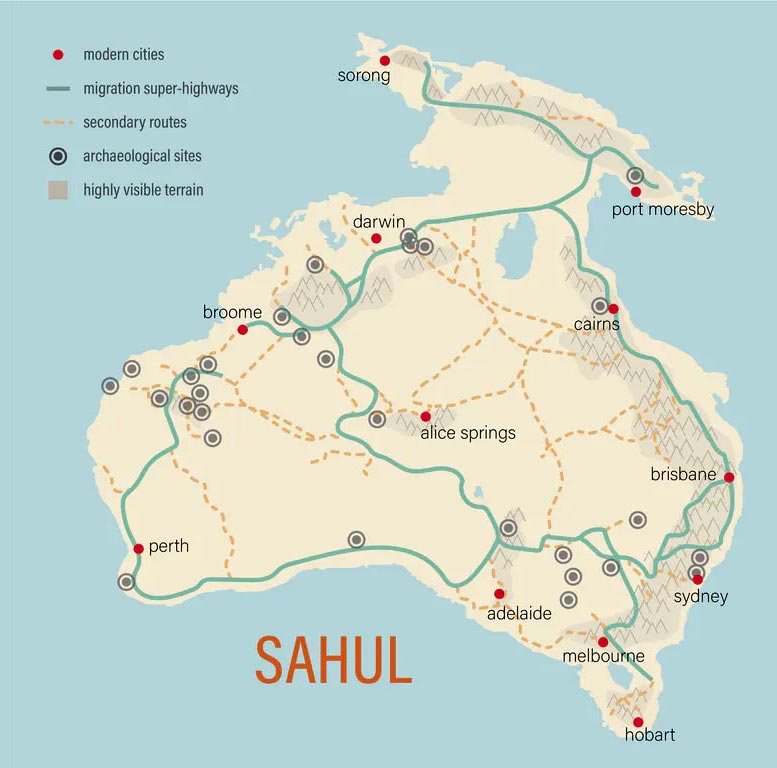
Computational modeling shows that ancient humans followed landmark-rich “superhighways” across Sahul, mirroring archaeological evidence and cultural memory.
The best path across the desert is rarely the straightest. For the first human inhabitants of Sahul — the super-continent that underlies modern Australia and New Guinea — camping at the next spring, stream, or rock shelter allowed them to thrive for hundreds of generations. Those who successfully traversed the landmarks made their way across the continent, spreading from their landfall in the Northwest across the continent, making their way to all corners of Australia and New Guinea.
By simulating the physiology and decisions of early way-finders, an international team* of archaeologists, geographers, ecologists, and computer scientists has mapped the probable “superhighways” that led to the first peopling of the Australian continent some 50,000-70,000 years ago. Their study, published in Nature Human Behaviour, is the largest reconstruction of a network of human migration paths into a new landscape. It is also the first to apply rigorous computational analysis at the continental scale, testing 125 billion possible pathways.
“We decided it would be really interesting to look at this question of human migration because the ways that we conceptualize a landscape should be relatively steady for a hiker in the 21st century and a person who was way-finding into a new region 70,000 years ago,” says archaeologist and computational social scientist Stefani Crabtree, who led the study. Crabtree is a Complexity Fellow at the Santa Fe Institute and Assistant Professor at Utah State University. “If it’s a new landscape and we don’t have a map, we’re going to want to know how to efficiently move throughout a space, where to find water, and where to camp — and we’ll orient ourselves based on high points around the lands.”
“One of the really big unanswered questions of prehistory is how Australia was populated in the distant past. Scholars have debated it for at least a hundred and fifty years,” says co-author Devin White, an archaeologist and remote sensing scientist at Sandia National Laboratories. “It is the largest and most complex project of its kind that I’d ever been asked to take on.”
Reconstructing a Forgotten World Beneath the Oceans
To re-create the migrations across Sahul, the researchers first needed to simulate the topography of the supercontinent. They “drained” the oceans that now separate mainland Australia from New Guinea and Tasmania. Then, using hydrological and paleo-geographical data, they reconstructed inland lakes, major rivers, promontory rocks, and mountain ranges that would have attracted the gaze of a wandering human.
Next, the researchers programmed in-silico stand-ins for the human travelers. The team adapted an algorithm called “From Everywhere to Everywhere,” created by White*, to program the way-finders based on the caloric needs of a 25-year-old female carrying 10 kg (22 lb) of water and tools.
The researchers imbued these individuals with the realistic goal of staying alive, which could be achieved by finding water sources. Like backcountry hikers, the digital travelers were drawn to prominent landmarks like rocks and foothills, and the program exacted a caloric toll for activities such as hiking uphill within the artificial landscape.
When the researchers “landed” the way-finders at two points on the coast of the re-created continent, they began to traverse it, using landmarks to navigate in search of freshwater. The algorithms simulated a staggering 125 billion possible pathways, run on a Sandia supercomputer, and a pattern emerged: the most-frequently traveled routes carved distinct “superhighways” across the continent, forming a notable ring-shaped road around the right portion of Australia; a western road; and roads that transect the continent. A subset of these superhighways map to archaeological sites where early rock art, charcoal, shell, and quartz tools have been found.
Cultural Memory Embedded in the Landscape
“Australia’s not only the driest, but it’s also the flattest populated continent on Earth,” says co-author Sean Ulm, an archaeologist and Distinguished Professor at James Cook University. Ulm is also Deputy Director of the Australian Research Council Centre of Excellence for Australian Biodiversity and Heritage (CABAH), whose researchers contributed to the project. “Our research shows that prominent landscape features and water sources were critical for people to navigate and survive on the continent. In many Aboriginal societies, landscape features are known to have been created by ancestral beings during the Dreaming. Every ridgeline, hill, river, beach, and water source is named, storied, and inscribed into the very fabric of societies, emphasizing the intimate relationship between people and place. The landscape is literally woven into people’s lives and their histories. It seems that these relationships between people and Country probably date back to the earliest peopling of the continent.”
The results suggest that there are fundamental rules humans follow as they move into new landscapes and that the researchers’ approach could shed light on other major migrations in human history, such as the first waves of migration out of Africa at least 120,000 years ago.
Future work, Crabtree says, could inform the search for undiscovered archaeological sites, or even apply the techniques to forecast the movements of human migration in the near future, as populations flee drowning coastlines and climate disruptions.
Reference: “Landscape rules predict optimal superhighways for the first peopling of Sahul” by Stefani A. Crabtree, Devin A. White, Corey J. A. Bradshaw, Frédérik Saltré, Alan N. Williams, Robin J. Beaman, Michael I. Bird and Sean Ulm, 29 April 2021, Nature Human Behaviour.
DOI: 10.1038/s41562-021-01106-8
*Co-authors of the study are Stefani Crabtree (Santa Fe Institute, Utah State University, CABAH) who led the project and convened its first working group at the Santa Fe Institute in 2019; Devin White (Sandia National Laboratories) who wrote the primary algorithm used; and members of the Australian Research Council Centre of Excellence for Australian Biodiversity and Heritage (CABAH), who contributed expertise on the Australian landscape and the Aboriginal communities. CABAH members are Crabtree, Sean Ulm (James Cook University), Corey Bradshaw (Flinders University), Frédérick Saltré (Flinders University), Alan Williams (University of New South Wales); Robin Beaman (James Cook University); and Michael Bird (James Cook University), who also co-organized the 2019 working group in Santa Fe.
The Santa Fe Institute is a nonprofit research center located in Santa Fe, New Mexico. Its scientists collaborate across disciplines to understand the complex systems that underlie critical questions for science and humanity. The Institute is supported by philanthropic individuals and foundations, forward-thinking partner companies, and government science agencies.
Sandia National Laboratories is a multimission laboratory operated by National Technology and Engineering Solutions of Sandia LLC, a wholly-owned subsidiary of Honeywell International Inc., for the U.S. Department of Energy’s National Nuclear Security Administration. Sandia Labs has major research and development responsibilities in nuclear deterrence, global security, defense, energy technologies and economic competitiveness, with main facilities in Albuquerque, New Mexico, and Livermore, California.
CABAH is an ARC Centre of Excellence that brings together expertise from diverse academic disciplines to answer fundamental questions about the natural and human history of our region, including how and when people first came to Australia.
Never miss a breakthrough: Join the SciTechDaily newsletter.
Follow us on Google and Google News.
5 Comments
They’re called the Songlines and Bruce Chatwin wrote a book about them decades ago.
Stephen Baxter the sci fi author suggested in his Evolution book the first OZ humans followed existing trails made by extinct giant snakes that once lived there. The trails led to and from water sources.
Humans can’t imagine past and future coastline continent changes nor supervolcanos …
Thanks for the information, really appreciate it .
A road, a track, a path, but the words ‘super’ and ‘highway’ are verbal over sell. I don’t buy it. Donald might. Note that ‘super’ cars and ‘super’ bikes travel on specially designed tracks. Super man flies non specially designed film sets. Did super prehistoric peoples walk on super prearranged passageways? Super surpasses reality.