
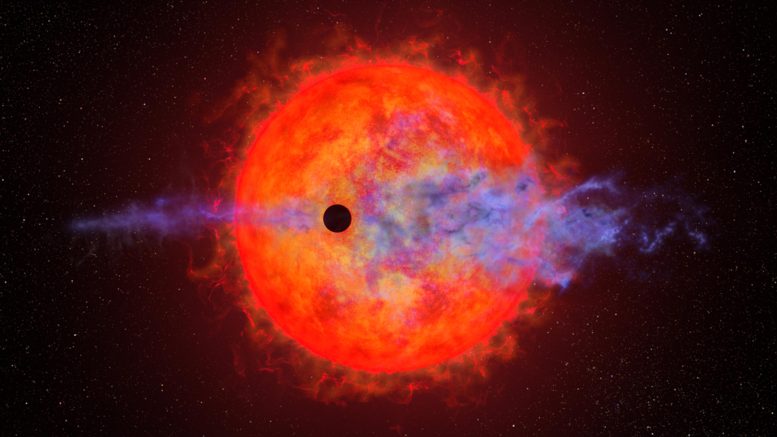
Neptune-sized planet weirdly and sporadically burps hydrogen as it circles its star.
Trillions of miles from Earth, the violent and erratic shedding of a young planet’s atmosphere could provide a rare glimpse into the tumultuous early life that besets most of the planets in our galaxy.
Atmospheric Loss: Unearthing the Bizarre Behavior of AU Mic b
A new study found that a Neptune-sized gas planet known as AU Mic b exhibited some bizarre behavior—it showed no atmospheric shedding during one orbit around its sun then spewed its hydrogen-rich atmosphere into the cosmos on its next go-round. The study was led by Dartmouth PhD candidate Keighley Rockcliffe, Guarini School of Graduate and Advanced Studies, and Assistant Professor of Physics and Astronomy Elisabeth Newton.
All planets with an atmosphere lose some gas as they orbit their suns—a process known as atmospheric escape—either subtly like Earth or in dramatic plumes like AU Mic b. But scientists have never before seen atmospheric escape stop and start between orbits, the researchers report in The Astronomical Journal.
Planetary Hiccups: A Phenomenon First
“This is the first time we’ve seen a planet’s atmospheric escape go from unobservable to very, very observable,” says Rockcliffe, the first author of the study. “In addition, the hydrogen cloud was not a tail behind the planet like we normally see, but like a puff in front of the planet as it orbited. We don’t usually think of planets as burping hydrogen as they go around a star.”
“We are directly probing an essential evolutionary mechanism that the most common planets in our galaxy go through,” Rockcliffe said. “We think our work captures the early stages of this extremely typical process, and we want to use our observations of this system to understand the most common experiences of planets beyond our solar system.”
AU Mic b: A Unique Perspective Into Planetary Evolution
The planet—which is more than four times the diameter of Earth, orbits a star called AU Microscopii that is 32 light-years (roughly 192 trillion miles) from Earth. In star terms, AU Microscopii is a youthful 23 million years old; our sun is roughly 4.6 billion years old. The planet AU Mic b is only 6 million miles from its sun—or one-tenth of the distance Mercury is from our sun.
Despite its size, AU Mic b completes a full orbit in less than nine Earth days. Its discovery by NASA’s Spitzer and TESS space telescopes was published in the journal Nature in 2020. The latest study is based on data from the Hubble Space Telescope.
“We are directly probing an essential evolutionary mechanism that the most common planets in our galaxy go through. We think our work captures the early stages of this extremely typical process.”
Keighley Rockcliffe, Guarini doctoral candidate in physics and astronomy
Comparing Planetary Evolution
The young age and atmospheric behavior of AU Mic b and its sun suggest that the researchers have captured the early stages of planetary evolution, said Newton, who is a co-author on the paper. Most studies on planets outside—and even within—Earth’s solar system pertain to very old worlds.
Older planets have already experienced a wide range of evolutionary processes that make it difficult to extrapolate to planetary evolution at large, Newton said. They’re like trying to study developmental psychology by only observing adults, she said.
AU Mic b: A Galactic Toddler
“This planet is like observing a totally generic toddler,” Newton said. “Systems like AU Mic are our insight into the broader planetary-evolution process. Keighley is making very challenging observations, and there are limited opportunities to even attempt them.”
The planet’s sun is a common type of small, low-intensity star known as a red dwarf. Seventy percent of all stars are red dwarfs, Newton said, including Proxima Centauri, the closest star to our sun.
Hot Neptune: A Gateway to Understanding Other Gas Giants
AU Mic b itself is a type of planet known as a “hot Neptune,” a world similar in size to Neptune that orbits close to its parent star. The evolution of hot Neptunes is thought to be broadly applicable to other gas planets in the galaxy. Scientists think the planets quickly burn off their large gaseous layer and evolve into smaller planets, Rockcliffe said. Only one other young hot Neptune has been observed undergoing atmospheric escape.
“I’m trying to observe that loss of mass as it’s happening to get a snapshot of how planets develop before they get to that smaller, potentially rockier endpoint,” she said.
Young Stars, Young Planets: A Window Into Stellar Environment
Young planets such as AU Mic b also provide scientists with opportunities to examine the tempestuous early years of their young stars. These observations can be used to fine-tune computer models of how planets evolve and interact with their stellar environment, Rockcliffe said.
A 23 Million-Year-Old Star Versus a 5 Billion-Year-Old Star
“There’s an enormous difference between a 23-million-year-old star and a 5-billion-year-old star. The very young stars are going to be throwing out lots of flares and very high-energy radiation. Because we’re looking at young planets, we can see this very extreme but typical interaction happen and use our observations to see if we’re understanding the physics correctly,” Rockcliffe said.
“I’m becoming more convinced that AU Mic b is this nice example of a planet undergoing all these violent but typical processes at once,” she said. “It can hit the corners of many different models and ensure we’re making the most accurate models possible when we’re talking about planet evolution.”
Seeking Earth 2.0: Insights From AU Mic b
With every new planet discovered, the question arises: Could it be another Earth? Some rocky planets experience an early stage similar to what AU Mic b is going through now, Newton said. But even if they don’t, red dwarf systems are currently the best places to find habitable, Earth-like planets.
“Stars like AU Mic are potential hunting grounds for an Earth 2.0,” Newton said. “By understanding this system, we can answer questions about what an Earth-like planet orbiting a red dwarf star would have to contend with early in its evolution.”
Extrapolating Beyond Our Solar System
“The systems we’re looking at are extremely different from our solar system. We can’t really extrapolate from our own experience of atmospheric mass loss,” Rockcliffe added. But “knowing how atmospheres evolve and which planets will have stable atmospheres is important for finding life on other planets. Atmospheres are essential in understanding how life can form and persist.”
For more on this research, see Hubble Sees Evaporating Planet Getting the Hiccups.
Reference: “The Variable Detection of Atmospheric Escape around the Young, Hot Neptune AU Mic b” by Keighley E. Rockcliffe, Elisabeth R. Newton, Allison Youngblood, Girish M. Duvvuri, Peter Plavchan, Peter Gao, Andrew W. Mann and Patrick J. Lowrance, 27 July 2023, The Astronomical Journal.
DOI: 10.3847/1538-3881/ace536
Never miss a breakthrough: Join the SciTechDaily newsletter.
Follow us on Google and Google News.