
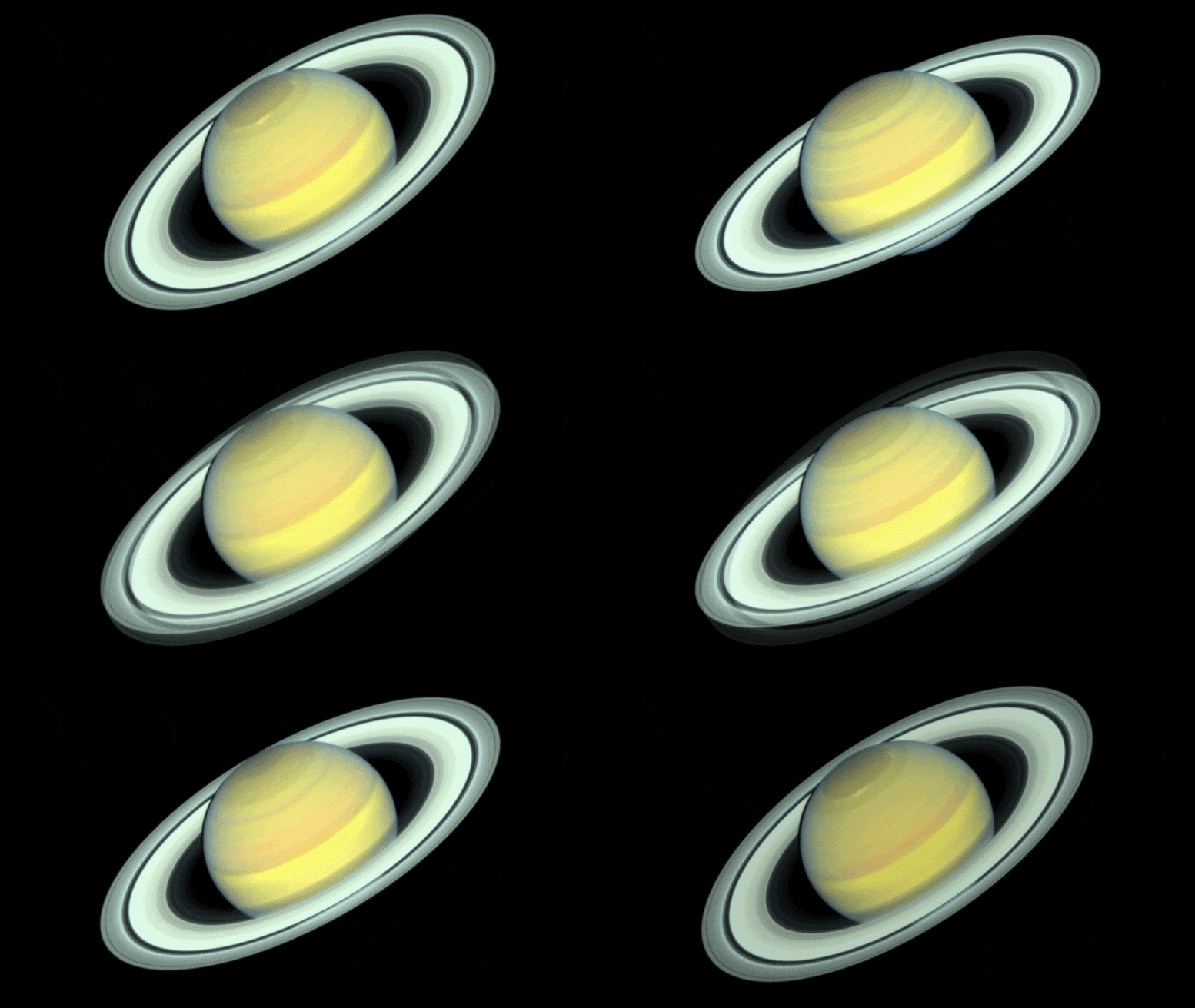
Hubble has revealed seasonal changes in Saturn’s atmosphere, including brighter equatorial regions and shifting wind speeds.
NASA’s Hubble Space Telescope is giving astronomers a view of changes in Saturn’s vast and turbulent atmosphere as the planet’s northern hemisphere summer transitions to fall as shown in this series of images taken in 2018, 2019, and 2020 (left to right).
“These small year-to-year changes in Saturn’s color bands are fascinating,” said Amy Simon, planetary scientist at NASA’s Goddard Space Flight Center in Greenbelt, Maryland. “As Saturn moves towards fall in its northern hemisphere, we see the polar and equatorial regions changing, but we are also seeing that the atmosphere varies on much shorter timescales.” Simon is the lead author of a paper on these observations published on March 11, 2021, in Planetary Science Journal.
“What we found was a slight change from year to year in color, possibly cloud height, and winds – not surprising that the changes aren’t huge, as we’re only looking at a small fraction of a Saturn year,” added Simon. “We expect big changes on a seasonal timescale, so this is showing the progression towards the next season.”

The Hubble data show that from 2018 to 2020 the equator got 5 to 10 percent brighter, and the winds changed slightly. In 2018, winds measured near the equator were about 1,000 miles per hour (roughly 1,600 kilometers per hour), higher than those measured by NASA’s Cassini spacecraft during 2004-2009, when they were about 800 miles per hour (roughly 1,300 kilometers per hour). In 2019 and 2020 they decreased back to the Cassini speeds. Saturn’s winds also vary with altitude, so the change in measured speeds could possibly mean the clouds in 2018 were around 37 miles (about 60 kilometers) deeper than those measured during the Cassini mission. Further observations are needed to tell which is happening.
Saturn is the sixth planet from our Sun and orbits at a distance of about 886 million miles (1.4 billion kilometers) from the Sun. It takes around 29 Earth years to orbit the Sun, making each season on Saturn more than seven Earth years long. Earth is tilted with respect to the Sun, which alters the amount of sunlight each hemisphere receives as our planet moves in its orbit. This variation in solar energy is what drives our seasonal changes. Saturn is tilted also, so as the seasons change on that distant world, the change in sunlight could be causing some of the observed atmospheric changes.
Gas Giant with a Stormy Personality
Like Jupiter, the solar system’s largest planet, Saturn is a “gas giant” made mostly of hydrogen and helium, although there may be a rocky core deep inside. Enormous storms, some almost as large as Earth, occasionally erupt from deep within the atmosphere. Since many of the planets discovered around other stars are gas giants as well, astronomers are eager to learn more about how gas giant atmospheres work.
Saturn is the second largest planet in the solar system, over 9 times wider than Earth, with more than 50 moons and a spectacular system of rings made primarily of water ice. Two of these moons, Titan and Enceladus, appear to have oceans beneath their icy crusts that might support life. Titan, Saturn’s largest moon, is the only moon in our solar system with a thick atmosphere, including clouds that rain liquid methane and other hydrocarbons on to the surface, forming rivers, lakes, and seas. This mix of chemicals is thought to be similar to that on Earth billions of years ago when life first emerged. NASA’s Dragonfly mission will fly over the surface of Titan, touching down in various locations to search for the primal building blocks of life.
Reference: “Midsummer Atmospheric Changes in Saturn’s Northern Hemisphere from the Hubble OPAL Program” by Amy A. Simon, Ricardo Hueso, Agustín Sánchez-Lavega and Michael H. Wong, 11 March 2021, Planetary Science Journal.
DOI: 10.3847/PSJ/abe40f
The Saturn observations are part of Hubble’s Outer Planets Atmospheres Legacy (OPAL) program. “The OPAL program allows us to observe each of the outer planets with Hubble every year, enabling new discoveries and watching how each planet is changing over time,” said Simon, principal investigator for OPAL.
The Hubble Space Telescope is a project of international cooperation between NASA and ESA (European Space Agency). NASA’s Goddard Space Flight Center in Greenbelt, Maryland, manages the telescope. The Space Telescope Science Institute (STScI) in Baltimore conducts Hubble science operations. STScI is operated for NASA by the Association of Universities for Research in Astronomy in Washington, D.C.
Never miss a breakthrough: Join the SciTechDaily newsletter.
Follow us on Google and Google News.
4 Comments
“Billions of years”.
“Life first ‘emerged’”.
Lol, amazing the ideas people promulgate with no proof whatsoever.
Rather believe in science and math than fairytales and hocus-pocus that the balderdash brigade follow
The universe started from a spec of dust and humanity evolved from a thing, to a another bigger thing, to a fish, to a walking fish, then into a monkey and finally…., are you ready… INTO HUMAN HomoSapien. LOL!
@RL
Like you have any proof? Some random dude slapped his fingers and created everything. Oh so convincing! Then some talking snake and an apple has changed the course of the humanity. Ohh give me a brake.