

Researchers have directly observed the optical Magnus effect for the first time, revealing a tiny shift in laser interactions that could affect the precise control of qubits in quantum computers.
Anyone who has watched a spinning soccer ball curve around a defensive wall has seen what happens when spin changes an object’s path through the air. The ball bends away from the direction it initially seemed to be traveling because its rotation creates an uneven force as it moves.
Physicists call this the Magnus effect. Researchers have now observed an optical counterpart of the same phenomenon at a vastly smaller scale, using laser light and a single trapped calcium ion.
Instead of making the ion curve through space, the optical effect shifts the point where a tightly focused laser interacts most strongly with it. An international team led by scientists at the Paul Scherrer Institute PSI measured this tiny sideways displacement experimentally for the first time.
The finding could matter for quantum computers that use lasers to control individual qubits with extreme precision. If the shift is overlooked, the laser may not act exactly where researchers expect. But the effect could also become useful.
“The forces it generates could be used to couple qubits to one another, enabling more complex computations,” explains first author Philip Leindecker from the PSI Center for Photon Science and the Department of Physics at ETH Zurich.
The laser misses its expected target
At first glance, the strongest interaction should occur at the center of the laser beam, where the light is most intense. But tightly focusing laser light also changes the spatial structure of its electromagnetic field. That shifts the point of strongest interaction slightly to one side.
A single ion measures the displacement
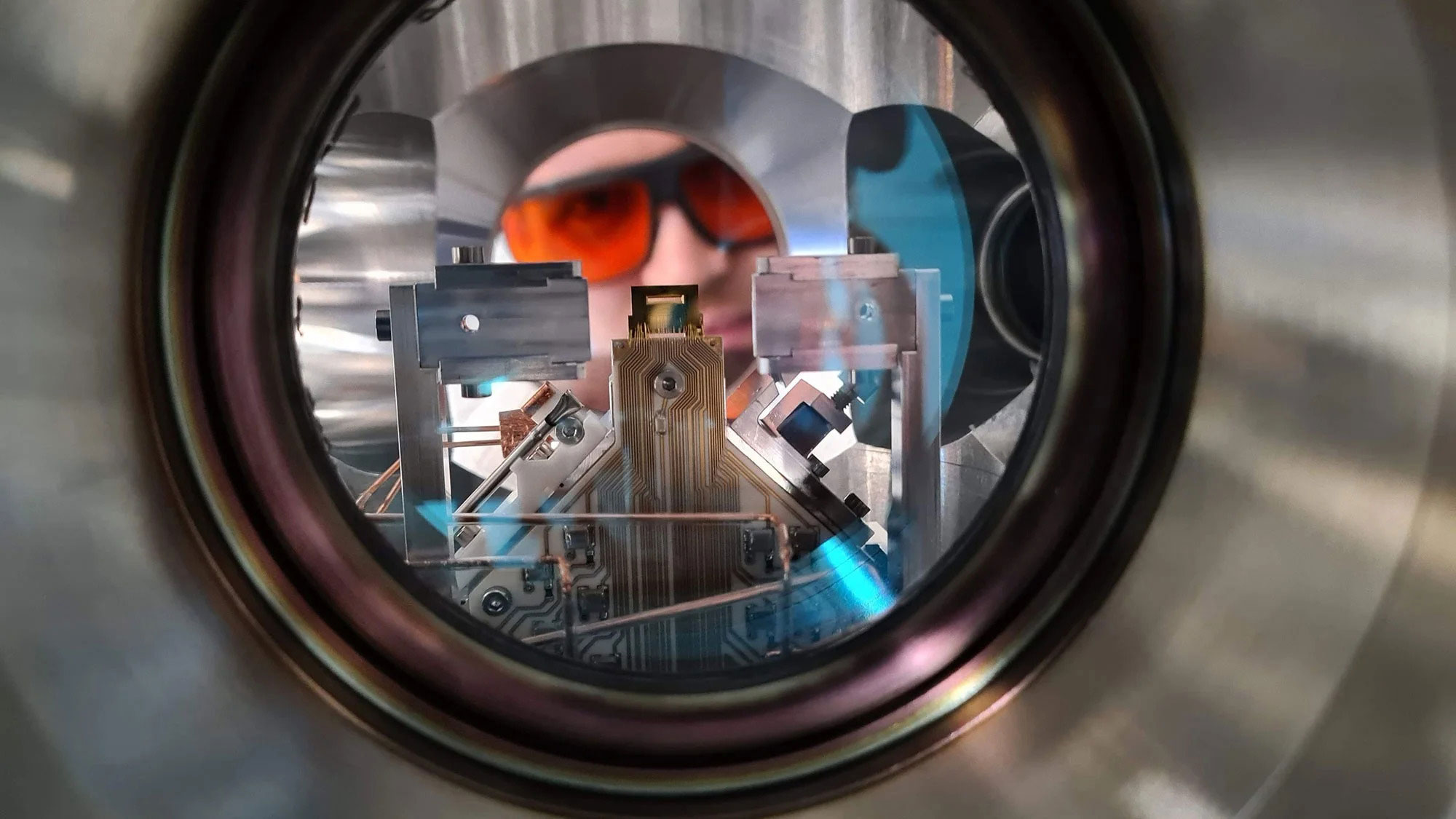
To measure the effect, the researchers used a single calcium ion held almost motionless by electromagnetic fields in an ion trap. Trapped ions can also serve as qubits in quantum computers, where lasers are used to manipulate their quantum states with high precision.
The team moved the tightly focused laser relative to the ion and measured how strongly the ion interacted with the light at different positions.
“Our ion acts like a tiny sensor that we can use to feel out the structure of the laser light,” Leindecker explains. “This makes it possible to measure a shift of just a few hundred nanometers.”
That sensitivity allowed the researchers to observe the optical Magnus effect directly.
The shift could disrupt qubit control
The experiment also revealed a surprising feature of the shift. Its size depended only on the wavelength of the laser light and not on how tightly the beam was focused.
That result could be important for trapped-ion quantum computers. These systems rely on precisely aimed laser light to control individual qubits, so even a tiny sideways shift could contribute to errors if it is not taken into account. At the same time, the forces created by the effect may offer a new way to connect qubits and support more complex operations.
Scientists at the University of Amsterdam had predicted the optical Magnus effect theoretically several years earlier. The new experiment confirms that prediction and provides a more detailed characterization of how the effect behaves.
The findings are reported in Physical Review Letters.
Reference: “Direct Observation of the Optical Magnus Effect with a Trapped Ion” by Philip Leindecker, Louis P. H. Gallagher, Edgar Brucke, Dominique Zehnder, Luka Milanovic, Matteo Marinelli, Rene Gerritsma, Robert J. C. Spreeuw, Jonathan Home and Cornelius Hempel, 6 August 2026, Physical Review Letters.
DOI: 10.1103/kj5p-qqs5
Never miss a breakthrough: Join the SciTechDaily newsletter.
Follow us on Google and Google News.
2 Comments
If this becomes reality, how will errors be detected
Researchers have directly observed the optical Magnus effect for the first time, revealing a tiny shift in laser interactions that could affect the precise control of qubits in quantum computers.
VERY GOOD.
It invites researchers to engage in deep reflection on two questions:
1. What constitutes the physical reality of the quantum?
2. Within the observable physical world, what escapes the many-body description?