
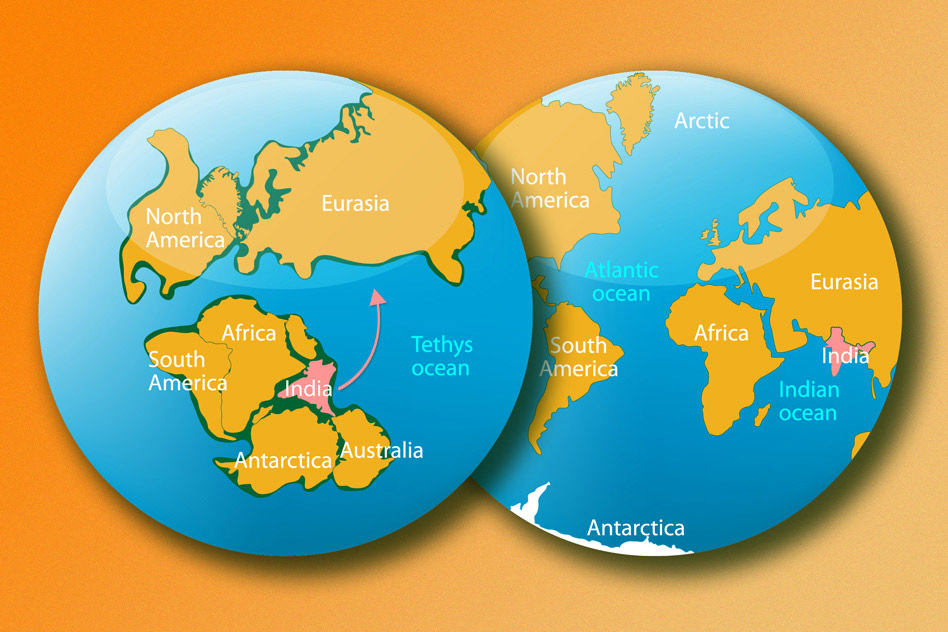
A newly published study from MIT geologists reveals that a double subduction system may have driven India to drift at high speed toward Eurasia some 80 million years ago.
In the history of continental drift, India has been a mysterious record-holder.
More than 140 million years ago, India was part of an immense supercontinent called Gondwana, which covered much of the Southern Hemisphere. Around 120 million years ago, what is now India broke off and started slowly migrating north, at about 5 centimeters (2 inches) per year. Then, about 80 million years ago, the continent suddenly sped up, racing north at about 15 centimeters (6 inches) per year — about twice as fast as the fastest modern tectonic drift. The continent collided with Eurasia about 50 million years ago, giving rise to the Himalayas.
For years, scientists have struggled to explain how India could have drifted northward so quickly. Now geologists at MIT have offered up an answer: India was pulled northward by the combination of two subduction zones — regions in the Earth’s mantle where the edge of one tectonic plate sinks under another plate. As one plate sinks, it pulls along any connected landmasses. The geologists reasoned that two such sinking plates would provide twice the pulling power, doubling India’s drift velocity.
The team found relics of what may have been two subduction zones by sampling and dating rocks from the Himalayan region. They then developed a model for a double subduction system, and determined that India’s ancient drift velocity could have depended on two factors within the system: the width of the subducting plates, and the distance between them. If the plates are relatively narrow and far apart, they would likely cause India to drift at a faster rate.
The group incorporated the measurements they obtained from the Himalayas into their new model, and found that a double subduction system may indeed have driven India to drift at high speed toward Eurasia some 80 million years ago.
“In earth science, it’s hard to be completely sure of anything,” says Leigh Royden, a professor of geology and geophysics in MIT’s Department of Earth, Atmospheric and Planetary Sciences. “But there are so many pieces of evidence that all fit together here that we’re pretty convinced.”
Royden and colleagues including Oliver Jagoutz, an associate professor of earth, atmospheric, and planetary sciences at MIT, and others at the University of Southern California have published their results this week in the journal Nature Geoscience.
What drives drift?
Based on the geologic record, India’s migration appears to have started about 120 million years ago, when Gondwana began to break apart. India was sent adrift across what was then the Tethys Ocean — an immense body of water that separated Gondwana from Eurasia. India drifted along at an unremarkable 40 millimeters per year until about 80 million years ago, when it suddenly sped up to 150 millimeters per year. India kept up this velocity for another 30 million years before hitting the brakes — just when the continent collided with Eurasia.
“When you look at simulations of Gondwana breaking up, the plates kind of start to move, and then India comes slowly off of Antarctica, and suddenly it just zooms across — it’s very dramatic,” Royden says.
In 2011, scientists believed they had identified the driving force behind India’s fast drift: a plume of magma that welled up from the Earth’s mantle. According to their hypothesis, the plume created a volcanic jet of material underneath India, which the subcontinent could effectively “surf” at high speed.
However, when others modeled this scenario, they found that any volcanic activity would have lasted, at most, for 5 million years — not nearly enough time to account for India’s 30 million years of high-velocity drift.
Squeezing honey
Instead, Royden and Jagoutz believe that India’s fast drift may be explained by the subduction of two plates: the tectonic plate carrying India and a second plate in the middle of the Tethys Ocean.
In 2013, the team, along with 30 students, trekked through the Himalayas, where they collected rocks and took paleomagnetic measurements to determine where the rocks originally formed. From the data, the researchers determined that about 80 million years ago, an arc of volcanoes formed near the equator, which was then in the middle of the Tethys Ocean.
A volcanic arc is typically a sign of a subduction zone, and the group identified a second volcanic arc south of the first, near where India first began to break away from Gondwana. The data suggested that there may have been two subducting plates: a northern oceanic plate, and a southern tectonic plate that carried India.
Back at MIT, Royden and Jagoutz developed a model of double subduction involving a northern and a southern plate. They calculated how the plates would move as each subducted, or sank into the Earth’s mantle. As plates sink, they squeeze material out between their edges. The more material that can be squeezed out, the faster a plate can migrate. The team calculated that plates that are relatively narrow and far apart can squeeze more material out, resulting in faster drift.
“Imagine it’s easier to squeeze honey through a wide tube, versus a very narrow tube,” Royden says. “It’s exactly the same phenomenon.”
Royden and Jagoutz’s measurements from the Himalayas showed that the northern oceanic plate remained extremely wide, spanning nearly one-third of the Earth’s circumference. However, the southern plate carrying India underwent a radical change: About 80 million years ago, a collision with Africa cut that plate down to 3,000 kilometers (1,900 miles) — right around the time India started to speed up.
The team believes the diminished plate allowed more material to escape between the two plates. Based on the dimensions of the plates, the researchers calculated that India would have sped up from 50 to 150 millimeters per year. While others have calculated similar rates for India’s drift, this is the first evidence that double subduction acted as the continent’s driving force.
“It’s a lucky coincidence of events,” says Jagoutz, who sees the results as a starting point for a new set of questions. “There were a lot of changes going on in that time period, including climate, that may be explained by this phenomenon. So we have a few ideas we want to look at in the future.”
Reference: “Anomalously fast convergence of India and Eurasia caused by double subduction” by Oliver Jagoutz, Leigh Royden, Adam F. Holt and Thorsten W. Becker, 4 May 2015, Nature Geoscience.
DOI: 10.1038/ngeo2418
Never miss a breakthrough: Join the SciTechDaily newsletter.
Follow us on Google and Google News.