
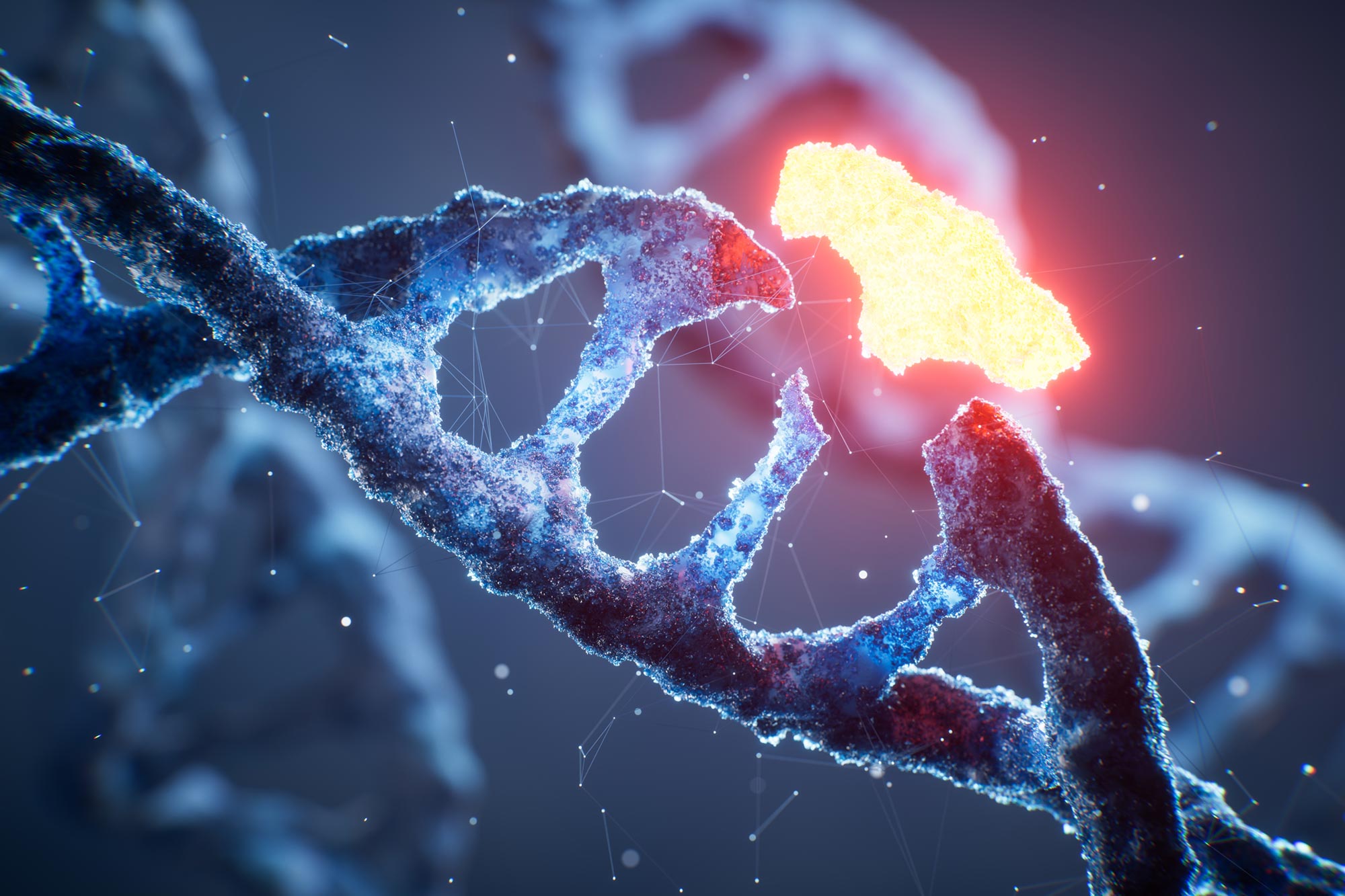
Researchers showed how a natural bacterial enzyme can accurately transcribe DNA containing four extra genetic letters.
Life uses a four-letter DNA alphabet, but could its genetic machinery read a larger one? Researchers at the University of California San Diego have shown that RNA polymerase, the enzyme that copies DNA instructions into RNA, can accurately transcribe an alphabet with eight letters.
Scientists have been developing extra genetic letters to give engineered biological systems a wider range of possibilities, including making compounds not found in nature. Earlier studies have used expanded alphabets to create synthetic DNA molecules capable of recognizing liver cancer cells. Building on such work requires understanding how natural cellular machinery handles these unfamiliar letters.
New genetic letters, familiar recognition signals
The UC San Diego team examined RNA polymerase from Escherichia coli, or E. coli, bacteria. Copying DNA into RNA is the first step in gene expression, the process by which cells use genetic instructions. The researchers tested how the enzyme recognizes two synthetic base pairs, which add four letters to the natural alphabet.
Biochemical experiments established how the enzyme processed those letters, while high-resolution cryo-electron microscopy gave the team detailed views of the process. The researchers captured structural snapshots showing how RNA polymerase recognizes the synthetic letters and incorporates them during RNA production, examining details smaller than the width of a single atom.
The added letters were recognized through the same biochemical and structural signals that the enzyme uses for natural base pairs. This helps explain how RNA polymerase can accurately copy an expanded alphabet using its existing machinery. That molecular understanding could support future diagnostics, treatments, and engineered biological systems that use synthetic genetic information.
Recognition without the usual hydrogen bonds
The team also investigated synthetic base pairs that lack hydrogen bonds, which normally help hold paired genetic letters together. In a related study published in PNAS, the researchers reported that RNA polymerase could recognize another set of synthetic base pairs even without those bonds.
References:
“Structural basis of transcription of the hachimoji eight-letter alphabet by E. coli RNA polymerase” by Qingrong Li, Hyo-Joong Kim, Yan Liu, Juntaek Oh, Peini Hou, Shuichi Hoshika, Grigore Pintilie, Sriram Aiyer, Jenny Chong, Dmitry Lyumkis, Steven A. Benner and Dong Wang, 2 September 2026, Nature Communications.
DOI: 10.1038/s41467-026-76668-0
“Hydrophobic unnatural base pair promotes trigger loop closure and catalysis in cellular RNA polymerase independent of hydrogen bonding” by Qingrong Li, Peini Hou, Michiko Kimoto, Juntaek Oh, Yan Liu, Hui Pen Tan, Jenny Chong, Ichiro Hirao and Dong Wang, 12 August 2026, Proceedings of the National Academy of Sciences.
DOI: 10.1073/pnas.2607774123
This work was supported by grants from the National Institutes of Health (R01 GM102362 and R01 GM148476) to D.W, from the NIH (R01AI135146) to SAB, and NSF grants MCB-2419300 (to SH) and MCB-1939086 (to SAB).
Never miss a breakthrough: Join the SciTechDaily newsletter.
Follow us on Google and Google News.
5 Comments
Messing around with the building blocks of life like this seems like such an irresponsible and scary thing to do. Same with AI. We’re one step away from the future of Bladerunner. Or The Thing. Or any number of Zombie franchises.
Luuta, check with AI to summarize Fred Saberhagen’s ‘Berserkers’. It is what worries AI makers, as AI increasingly is involved in warfighting.
“The Thing” was Alien and any zombies would be destroyed in days or weeks by flies.
More made up stuff?
Only 8 letters in their new “expanded alphabet”?
They need to get a move on … there are 26 letters in the English alphabet, and LGBQTIA+ has already used 7, and is actively looking to use more (hence the +)
Dear Unicorns r Real, while I agree that the article is lacking in composition, in not addressing what the letters represent. The four traditional (AT-CG) and one alternate (U) As well as the molecules they represent. You not addressing this prior to a cynical reply, makes you appear to need to stay on the Pokie-mon web site.