
Close Menu
    Facebook X (Twitter) Instagram
    SciTechDaily
    • Biology
    • Chemistry
    • Earth
    • Health
    • Physics
    • Science
    • Space
    • Technology
    Facebook X (Twitter) Pinterest YouTube RSS
    SciTechDaily
    Home»Biology»Tube Worm Slime Displays Self-Powered, Long-Lasting Bioluminescent Glow
    Biology

    Tube Worm Slime Displays Self-Powered, Long-Lasting Bioluminescent Glow

    By Experimental BiologyMay 21, 2020No Comments3 Mins Read
    Facebook Twitter Pinterest Telegram LinkedIn WhatsApp Email Reddit
    Share
    Facebook Twitter LinkedIn Pinterest Telegram Email Reddit
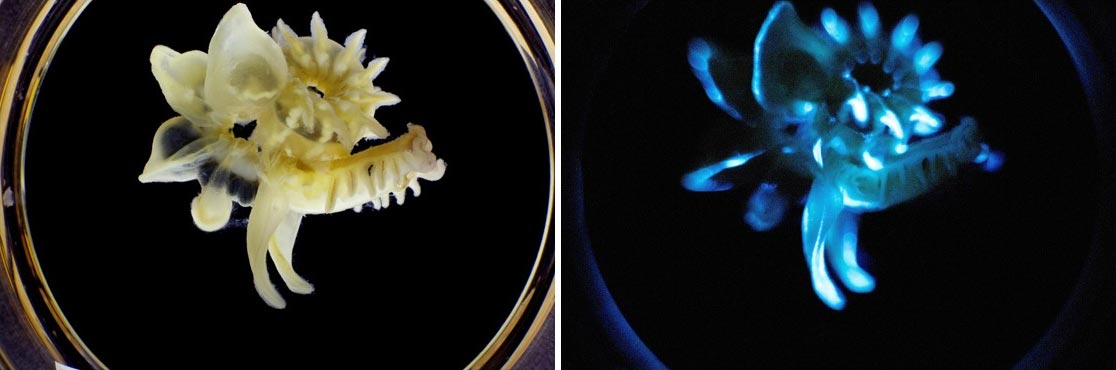
    Parchment Tube Worm by Day and by Night
    The photograph on the left shows the marine parchment tube worm (Chaetopterus sp.) under natural light. The worm is curled up, tucking its tail under its head. The image on the right shows the same worm but in the dark, capturing the blue light (bioluminescence) coming from the slime/mucus that is continuously produced by the worm when it feels threatened. Credit: David Liittschwager

    Marine organism’s bioluminescence could inspire new eco-friendly, long-lasting light sources.

    When threatened, the marine parchment tube worm secretes a sticky slime that emits a unique long-lasting blue light. New research into how the worm creates and sustains this light suggests that the process is self-powered.

    “The light, or bioluminescence, produced by this worm does not appear as flashes, like in most luminous organisms, but as a long-lasting glow,” said Evelien De Meulenaere, PhD, a researcher in Dimitri Deheyn’s lab at the Scripps Institution of Oceanography. “Understanding the mechanisms of this bioluminescence process could inform the design of a light stick that works for several days or, with further optimization, environmentally friendly garden and street lighting.”

    De Meulenaere was scheduled to present this research at the American Society for Biochemistry and Molecular Biology annual meeting in San Diego this month. Though the meeting, to be held in conjunction with the 2020 Experimental Biology conference, was canceled in response to the COVID-19 outbreak, the research team’s abstract was published in this month’s issue of The FASEB Journal.

    After discovering that light production was not linked with any of the organism’s metabolic pathways, the researchers realized that sustaining light production for more than a few milliseconds would require the slime to contain its own energy source.

    Further work revealed that the worm’s slime contains an iron storage protein called ferritin. Artificially adding iron to the mucus increased light production, which led the researchers to believe that ferritin acts as like a molecular battery that stores energy. More recently, they found that exposing ferritin to blue light makes more iron available and that exposing the slime to blue light induces bursts of light lasting several minutes.

    “A light source based on this mechanism could be remotely triggered using blue light to initiate and amplify the process,” said De Meulenaere. “Once we understand exactly how light production happens in the natural system, that information could potentially be used to develop a long-lasting light that is also biodegradable and rechargeable.”

    The tube worm’s bioluminescence could also be used to create biomedical reporter systems. Because it is sensitive to iron such a system could be used to test for iron deficiencies or toxicities. It could also be used as a light-emitting reporter that works for several days. This would allow experiments where various proteins or cells are tracked for much longer periods of time than possible with today’s fluorescent reporters.

    Reference: “Self‐powered bioluminescence in a marine tube worm” by Evelien De Meulenaere, Christina Puzzanghera and Dimitri D. Deheyn, 18 April 2020, The FASEB Journal.
    DOI: 10.1096/fasebj.2020.34.s1.04618

    Never miss a breakthrough: Join the SciTechDaily newsletter.
    Follow us on Google and Google News.

    Biochemistry Bioluminescence Biotechnology Marine Biology Molecular Biology
    Share. Facebook Twitter Pinterest LinkedIn Email Reddit

    Related Articles

    Advanced New Artificial Intelligence Software Can Compute Protein Structures in 10 Minutes

    New Insight Into Biosynthesis: How Cyanobacteria Evolve Their Photosynthetic Machinery

    Breakthrough Understanding of Limb and Organ Regeneration – Closer to the Development of Regenerative Medicine Therapies

    Strange Isotopes: Scientists Explain a Mysterious Methane Isotope Paradox of the Seafloor

    New Era in Coral Biology Research: Scientists Have Cultured the First Stable Coral Cell Lines

    Discovery of Weird Microbes in the Deep Waters of the Black Sea Offers New Insights on Early Evolution of Life

    Unraveling the Mystery of Insect Bioluminescent Systems

    Bioluminescent Bacteria Kill Rivals and Establish Symbiosis in Squid Using Genetic Regulatory Factors

    New Protein Design Technique Could Streamline Drug Creation

    Leave A Reply Cancel Reply

    • Facebook
    • Twitter
    • Pinterest
    • YouTube

    Don't Miss a Discovery

    Subscribe for the Latest in Science & Tech!

    Trending News

    Even Occasional Binge Drinking May Triple Liver Damage Risk

    Liftoff! NASA’s Artemis II Launch Sends Astronauts Around the Moon for First Time in 50 Years

    Scientists Discover New Way To Eliminate “Zombie Cells” Driving Aging

    This New Quantum Theory Could Change Everything We Know About the Big Bang

    This One Vitamin May Help Protect Your Brain From Dementia Years Later

    Stopping Weight-Loss Drugs Like Ozempic Can Quickly Erase Heart Benefits

    A 500-Million-Year-Old Surprise Is Forcing Scientists to Rethink Spider Evolution

    Coffee and Blood Pressure: What You Need To Know Before Your Next Cup

    Follow SciTechDaily
    • Facebook
    • Twitter
    • YouTube
    • Pinterest
    • Newsletter
    • RSS
    SciTech News
    • Biology News
    • Chemistry News
    • Earth News
    • Health News
    • Physics News
    • Science News
    • Space News
    • Technology News
    Recent Posts
    • A Strange Quantum Effect Could Power Future Electronics Without Batteries
    • This Breakthrough Solar Panel Generates Power From Both Sunlight and Raindrops
    • Greenland’s Ice Is Melting Faster Than Ever, and Scientists Are Alarmed
    • NASA Artemis II Nears Dramatic Moon Flyby With Record-Breaking Moment Ahead
    • Scientists Uncover New Metabolic Effects Beyond Weight Loss of Mounjaro
    Copyright © 1998 - 2026 SciTechDaily. All Rights Reserved.
    • Science News
    • About
    • Contact
    • Editorial Board
    • Privacy Policy
    • Terms of Use

    Type above and press Enter to search. Press Esc to cancel.