
Close Menu
    Facebook X (Twitter) Instagram
    SciTechDaily
    • Biology
    • Chemistry
    • Earth
    • Health
    • Physics
    • Science
    • Space
    • Technology
    Facebook X (Twitter) Pinterest YouTube RSS
    SciTechDaily
    Home»Space»New Clues Discovered About the Cosmic Missing Link: Intermediate-Mass Black Holes
    Space

    New Clues Discovered About the Cosmic Missing Link: Intermediate-Mass Black Holes

    By OzGravMay 21, 20201 Comment3 Mins Read
    Facebook Twitter Pinterest Telegram LinkedIn WhatsApp Email Reddit
    Share
    Facebook Twitter LinkedIn Pinterest Telegram Email Reddit
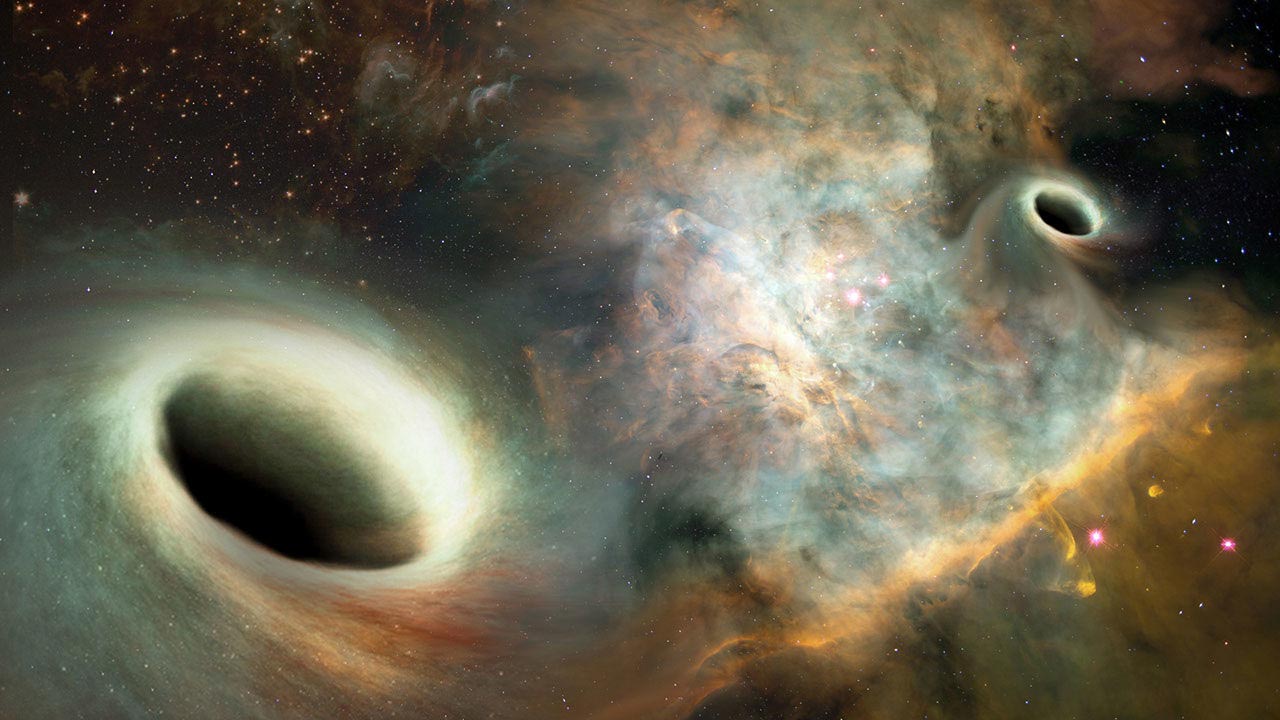
    Two Orbiting Black Holes
    Two orbiting black holes. Credit: Josh Valenzuela/UNM

    A team of researchers from the ARC Centre of Excellence for Gravitational Wave Discovery (OzGrav) recently published a study revealing something unexpected about black holes: intermediate-mass black holes with precessing orbits should be easier to detect than standard ones.​

    Black holes are regions of space-time from which nothing can escape, not even light. They are the corpses of dead stars that collapsed under their own weight, after running out of fuel. As archaeology helps us to understand how dinosaurs lived, the study of black holes helps us to understand how stars formed, evolved, and died.

    When two black holes collide, they release incredible amounts of energy in the form of gravitational waves (ripples in the fabric of space-time), producing the most powerful space-time storms. By observing these waves, scientists can explore the most fundamental properties of gravity.

    Black holes can be classified according to their mass—two different kinds have been identified: black holes with a mass several times bigger than the Sun; and supermassive black holes that lie in the center of most galaxies (the largest type of black hole), containing a mass billions of times the mass of the Sun.

    Intermediate-mass black holes are the elusive missing link; despite the indirect evidence for their existence, scientists have not yet confirmed a conclusive observation of these black holes. Finding them would help to explain the mystery of how stellar mass black holes can evolve into supermassive ones.

    The LIGO and Virgo collaboration searched for intermediate-mass black hole collisions during their first and second observing runs, from 2015 to 2018, but were not successful. On the bright side, the lack of detection allows scientists to confirm how many of these collisions happen in the Universe.

    To achieve this in the study researchers including  OzGrav Alumnus Juan Calderon Bustillo, first determined the observable distance of these collisions using supercomputer simulations. The gravitational-wave signals generated from the collision were recorded and injected into the data to assess their recovery rate in the search algorithms.

    When doing similar studies, scientists have always assumed that two colliding black holes approach each other with a constant orbital plane, like the orbit of the Earth and the Sun. However, there is another possible situation in which the black holes move up and down, describing what is known as a precessing orbit.

    The researchers found that this kind of collision can be observed from a further distance, allowing them to better constrain the number of black hole collisions out there. This also means that these black holes may be easier to detect if they follow precessing orbits rather than standard ones, making them better candidates for a first detection of intermediate-mass black holes.

    Reference: “NuRIA: Numerical Relativity Injection Analysis of spinning binary black hole signals in Advanced LIGO data” by Koustav Chandra, Gayathri V., Juan Calderon Bustillo and Archana Pai, 20 August 2020, Physical Review D.
    DOI: 10.1103/PhysRevD.102.044035
    arXiv:2002.10666

    Never miss a breakthrough: Join the SciTechDaily newsletter.
    Follow us on Google and Google News.

    Astronomy Astrophysics Black Hole OzGrav Popular
    Share. Facebook Twitter Pinterest LinkedIn Email Reddit

    Related Articles

    Explaining “Invisible” Black Holes: How Stellar Winds Can Create Disks Around Black Holes

    Cosmic Ripples in Space and Time: Largest Number of Gravitational Wave Detections to Date

    Investigating the Spins of Binary Black Hole Mergers To Uncover How They Formed and Evolved

    Pulsar Timing Array Explores Mystery Gravitational Waves From Supermassive Black Holes

    Testing Einstein’s Theory of General Relativity From the Shadows and Collisions of Black Holes

    Massive Stellar Triples Leading to Sequential Binary Black-Hole Mergers

    Ripples in the Fabric of Space and Time Offer New Clues to the Shape of Black Holes

    Investigating the Fate of Massive Stars: Bright Explosions or Quiet Collapses Into Black Holes?

    Cosmic Search Continues for Supermassive Black Hole Collisions

    1 Comment

    1. Mohammadtaha on May 21, 2020 7:25 am

      I love star and blake hole space

      Reply
    Leave A Reply Cancel Reply

    • Facebook
    • Twitter
    • Pinterest
    • YouTube

    Don't Miss a Discovery

    Subscribe for the Latest in Science & Tech!

    Trending News

    The Strange “Spacetime Crystal” That Can Suddenly Turn Into a Black Hole

    The Surprising Way Asteroids May Have Helped Life Begin on Earth

    Vast Hidden Structure Discovered Under Miles of Ice in East Antarctica

    A Surprising Discovery Suggests Autism Is Not One Condition

    New Alzheimer’s Discovery Could Change How Scientists Fight the Disease

    Yale Discovery Overturns Long-Held “Evolutionary Dead End” Theory

    UCLA Scientists Uncover a “Hidden Weakness” in Some of the World’s Deadliest Cancers

    Humpback Whale Stuns Scientists With 15,000 Kilometer Journey Across Oceans

    Follow SciTechDaily
    • Facebook
    • Twitter
    • YouTube
    • Pinterest
    • Newsletter
    • RSS
    SciTech News
    • Biology News
    • Chemistry News
    • Earth News
    • Health News
    • Physics News
    • Science News
    • Space News
    • Technology News
    Recent Posts
    • Food Waste Becomes a Powerful Carbon Trap in Climate Breakthrough
    • Battery-Free Artificial Photosynthesis Turns Sunlight, Water, and CO2 Into Fuel
    • How Ancient People Moved a 6-Ton Stone 700 Kilometers to Stonehenge
    • Scientists Finally See How Antibodies Really Attack Viruses
    • The Unexpected Gut Health Risk of Cutting Out Sugar
    Copyright © 1998 - 2026 SciTechDaily. All Rights Reserved.
    • Science News
    • About
    • Contact
    • Editorial Board
    • Privacy Policy
    • Terms of Use

    Type above and press Enter to search. Press Esc to cancel.