
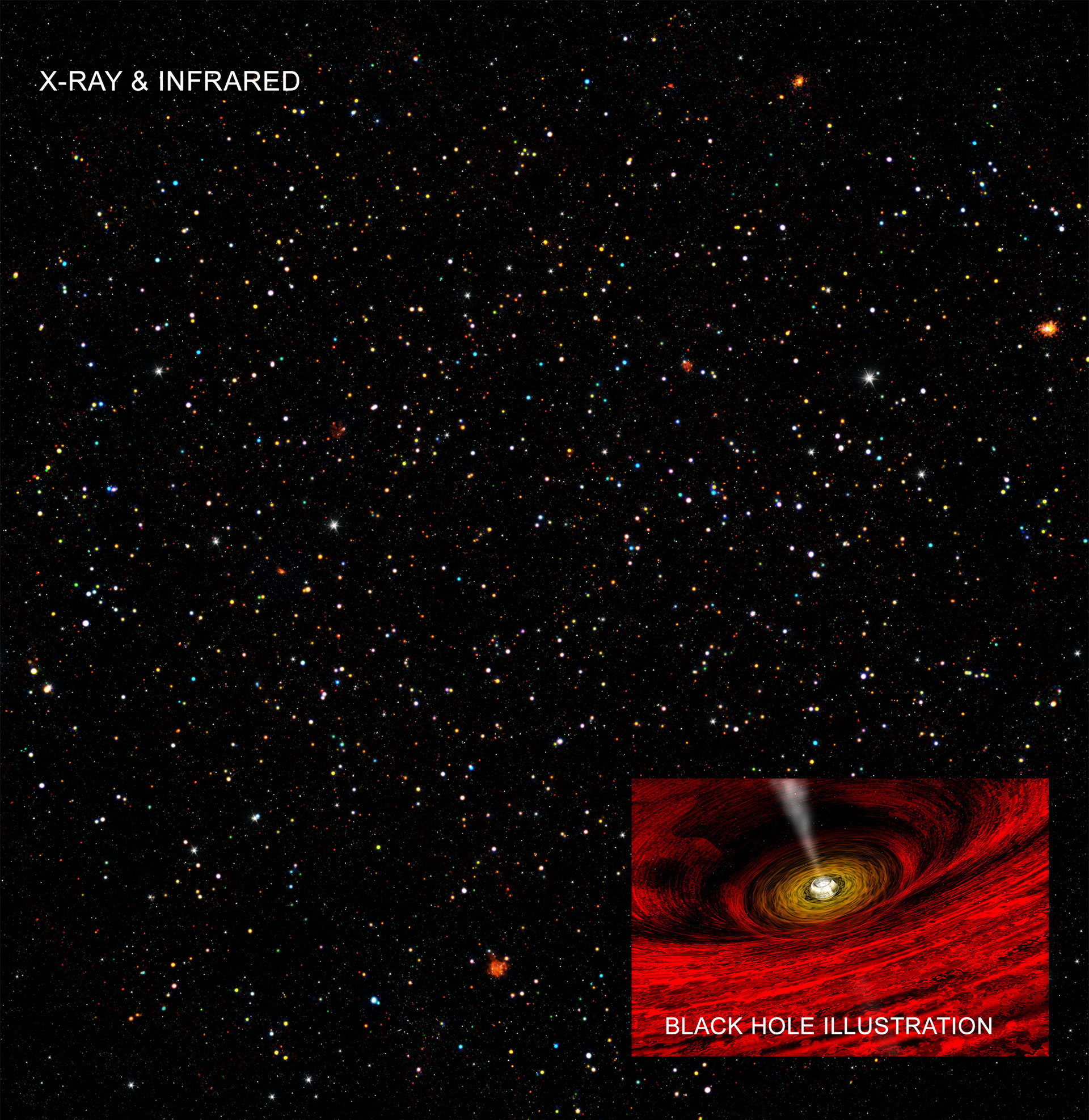
Scientists have taken major steps in their hunt to find black holes that are neither very small nor extremely large. Finding these elusive intermediate-mass black holes could help astronomers better understand what the “seeds” for the largest black holes in the early Universe were.
The new research comes from two separate studies, each using data from NASA’s Chandra X-ray Observatory and other telescopes.
Black holes that contain between about one hundred and several hundred thousand times the mass of the Sun are called “intermediate mass” black holes, or IMBHs. This is because their mass places them in between the well-documented and frequently-studied “stellar mass” black holes on one end of the mass scale and the “supermassive black holes” found in the central regions of massive galaxies on the other.
While several tantalizing possible IMBHs have been reported in recent years, astronomers are still trying to determine how common they are and what their properties teach us about the formation of the first supermassive black holes.
One team of researchers used a large campaign called the Chandra COSMOS-Legacy survey to study dwarf galaxies, which contain less than one percent the amount of mass in stars as our Milky Way does. (COSMOS is an abbreviation of Cosmic Evolution Survey.) The characterization of these galaxies was enabled by the rich dataset available for the COSMOS field at different wavelengths, including data from NASA and ESA telescopes.
The Chandra data were crucial for this search because a bright, point-like source of X-ray emission near the center of a galaxy is a telltale sign of the presence of a black hole. The X-rays are produced by gas heated to millions of degrees by the enormous gravitational and magnetic forces near the black hole.
“We may have found that dwarf galaxies are a haven for these missing middleweight black holes,” said Mar Mezcua of the Institute of Space Sciences in Spain who led one of the studies. “We didn’t just find a handful of IMBHs — we may have found dozens.”
Her team identified forty growing black holes in dwarf galaxies. Twelve of them are located at distances more than five billion light-years from Earth and the most distant is 10.9 billion light years away, the most distant growing black hole in a dwarf galaxy ever seen. One of the dwarf galaxies is the least massive galaxy found to host a growing black hole in its center.
Most of these sources are likely IMBHs with masses that are about ten thousand to a hundred thousand times that of the Sun. One crucial result of this research is that the fraction of galaxies containing growing black holes is smaller for less massive galaxies than for their more massive counterparts.
A second team led by Igor Chilingarian of the Harvard-Smithsonian Center for Astrophysics (CfA) in Cambridge, Mass., found a separate, important sample of possible IMBHs in galaxies that are closer to us. In their sample, the most distant IMBH candidate is about 2.8 billion light-years from Earth and about 90% of the IMBH candidates they discovered are no more than 1.3 billion light-years away.
Scientists have taken major steps in their hunt to find black holes that are neither very small nor extremely large. Finding these elusive so-called intermediate-mass black holes could help astronomers better understand how the largest black holes in the early Universe formed.
With data from the Sloan Digital Sky Survey (SDSS), Chilingarian and his colleagues found galaxies with the optical light signature of growing black holes and then estimated their mass. They selected 305 galaxies with properties that suggested a black hole with a mass less than 300,000 times that of the Sun was lurking in the central regions of each of these galaxies.
Only 18 members of this list contained high-quality X-ray observations that would allow confirmation that the sources are black holes. Detections with Chandra and with XMM-Newton were obtained for ten sources, showing that about half of the 305 IMBH candidates are likely to be valid IMBHs. The masses for the ten sources detected with X-ray observations were determined to be between 40,000 and 300,000 times the mass of the Sun.
“This is the largest sample of intermediate-mass black holes ever found,” said Chilingarian. “This black hole bounty can be used to address one of the biggest mysteries in astrophysics.”
IMBHs may be able to explain how the very biggest black holes, the supermassive ones, were able to form so quickly after the Big Bang. One leading explanation is that supermassive black holes grow over time from smaller black holes “seeds” containing about a hundred times the Sun’s mass. Some of these seeds should merge to form IMBHs. Another explanation is that they form very quickly from the collapse of a giant cloud of gas with a mass equal to hundreds of thousands of times that of the Sun.
Mezcua and her team may be seeing evidence in favor of the direct collapse idea, because this theory predicts that the less massive galaxies in their sample should be less likely to contain IMBHs.
“Our evidence is only circumstantial because it’s possible that the IMBHs are just as common in the smaller galaxies but they’re not consuming enough matter to be detected as X-ray sources”, says Mezcua’s co-author Francesca Civano of the CfA.
Chilingarian’s team has a different conclusion.
“We’re arguing that just the presence of intermediate-mass black holes in the mass range we detected suggests that smaller black holes with masses of about a hundred Suns exist,” says Chilingarian’s co-author Ivan Yu. Katkov of Moscow State University in Russia. “These smaller black holes could be the seeds for the formation of supermassive black holes.”
A paper describing the COSMOS-Legacy result by Mar Mezcua (Institute for Space Sciences, Spain) and colleagues was published in the August issue of the Monthly Notices of the Royal Astronomical Society and is available online. The paper by Igor Chilingarian (Harvard-Smithsonian Center for Astrophysics) on the closer IMBH sample is being published in the August 10th issue of The Astrophysical Journal and is available online.
NASA’s Marshall Space Flight Center in Huntsville, Alabama, manages the Chandra program for NASA’s Science Mission Directorate in Washington. The Smithsonian Astrophysical Observatory in Cambridge, Massachusetts, controls Chandra’s science and flight operations.
References:
“Intermediate-mass black holes in dwarf galaxies out to redshift ~2.4 in the Chandra COSMOS-Legacy Survey” by
M Mezcua, F Civano, S Marchesi, H Suh, G Fabbiano and M Volonteri, 2 August 2018, MNRAS.
DOI: 10.1093/mnras/sty1163
“A Population of Bona Fide Intermediate-mass Black Holes Identified as Low-luminosity Active Galactic Nuclei” by Igor V. Chilingarian, Ivan Yu. Katkov, Ivan Yu. Zolotukhin, Kirill A. Grishin, Yuri Beletsky, Konstantina Boutsia and David J. Osip, 6 August 2018, The Astrophysical Journal.
DOI: 10.3847/1538-4357/aad184
Never miss a breakthrough: Join the SciTechDaily newsletter.
Follow us on Google and Google News.