
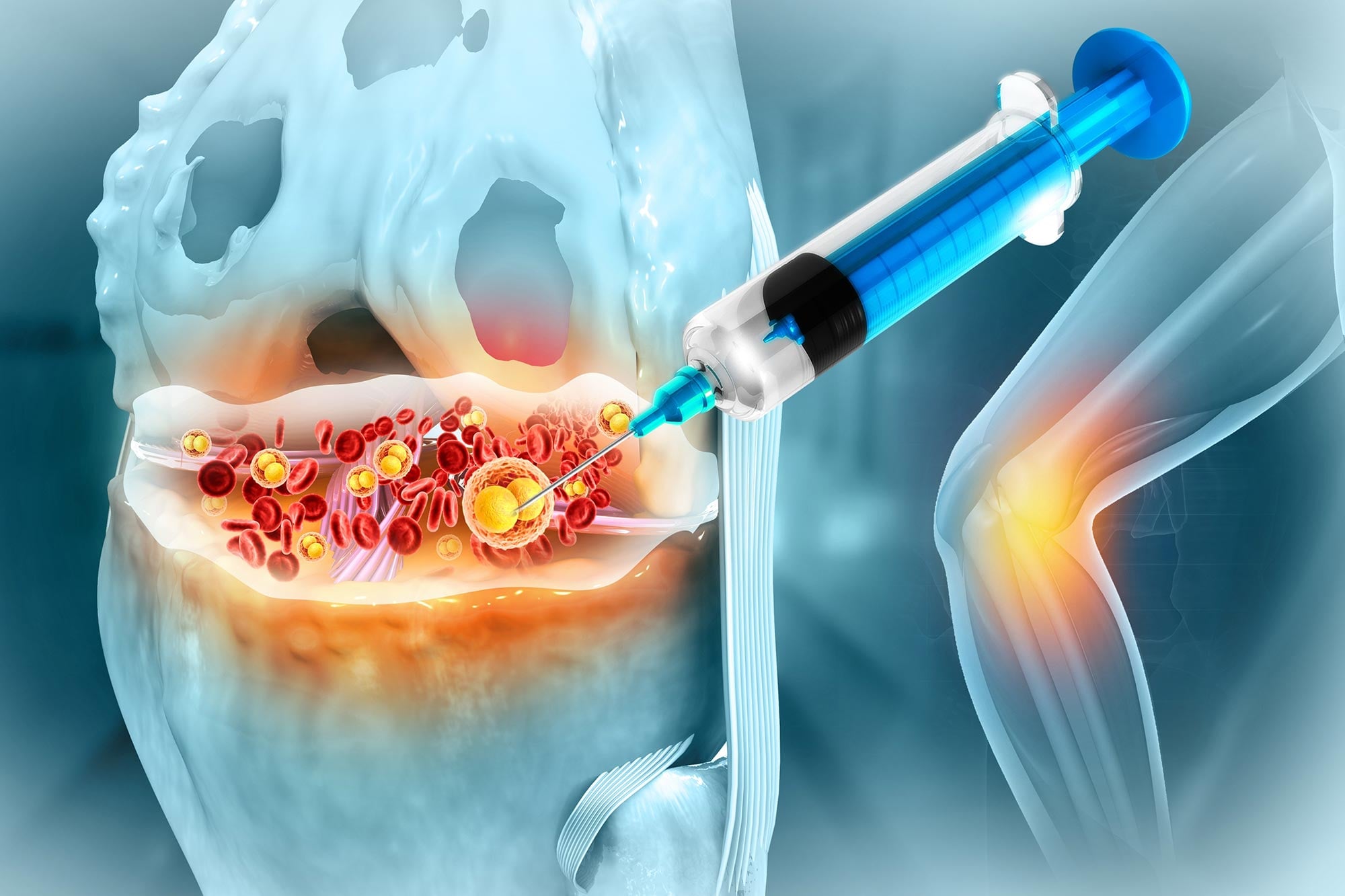
Researchers at Yale have identified lacosamide, an FDA-approved medication, as a promising new treatment for osteoarthritis that may both relieve pain and repair damaged cartilage.
For millions of people with osteoarthritis, everyday activities are often limited by persistent pain and joint stiffness. Treatments such as over-the-counter pain relievers and steroid injections can ease discomfort for a time, but they do not slow the ongoing breakdown of cartilage.
Researchers at Yale have identified a potential new approach. In a study published in Bioactive Materials, they found that the medication lacosamide not only reduced joint pain but also helped reverse cartilage damage in osteoarthritis. The benefits were especially strong when the drug was delivered directly into the joint using a specialized hydrogel.
Although osteoarthritis is often described as a wear-and-tear disease, that label does not fully capture what happens inside affected joints.
Cartilage is maintained by cells called chondrocytes, which constantly balance the creation of new cartilage with the removal of old tissue. Osteoarthritis disrupts that balance, allowing cartilage destruction to outpace repair. As cartilage wears away, bones begin rubbing against each other, and the damage can eventually require procedures such as total knee replacement.
A New Strategy Beyond Symptom Relief
“There is a major unmet need in osteoarthritis,” says the study’s principal investigator and Charles W. Ohse Professor of Orthopaedics & Rehabilitation, Chuan-Ju Liu, PhD. “We need therapies that don’t just mask pain but actually change how the disease progresses.”
At present, no medication approved by the U.S. Food and Drug Administration can both relieve osteoarthritis pain and prevent cartilage from breaking down. Liu’s team explored a different strategy that aims to accomplish both goals.
By repurposing an existing drug and combining it with an advanced hydrogel delivery system, the researchers developed a treatment that could protect joints while providing long-lasting pain relief without relying on addictive opioids.
Nav1.7: A Dual Target for Pain and Cartilage Repair
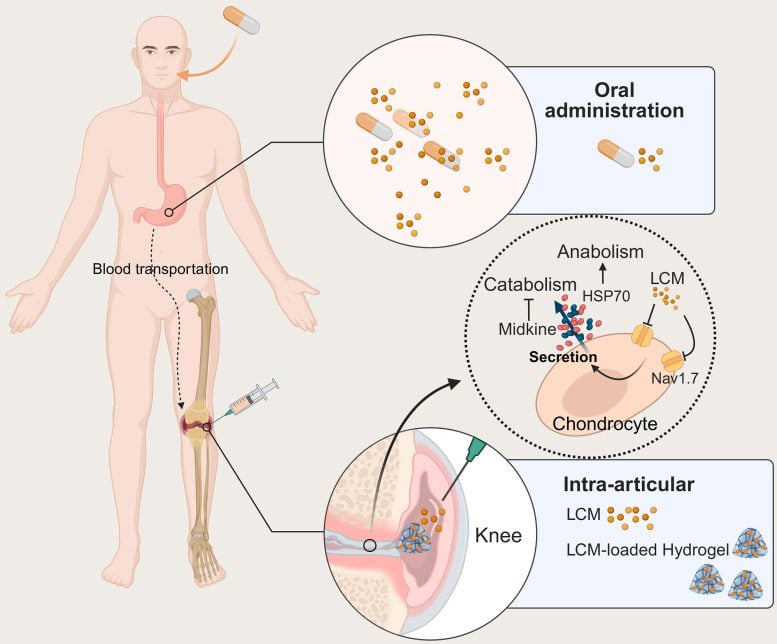
Liu’s research focuses on Nav1.7, a protein that forms a sodium channel. These channels act like tiny gateways in cell membranes, allowing cells to transmit electrical signals.
Scientists long believed Nav1.7 was found mainly in the nerve cells responsible for sending pain signals to the brain. Liu’s team discovered that the same protein is also highly active in chondrocytes, the cells responsible for maintaining cartilage.
Nav1.7 is relatively inactive in healthy joints. In osteoarthritis, however, it becomes overactive. That increase not only amplifies pain signals but also pushes chondrocytes to break down the cartilage they are meant to preserve. The discovery identifies Nav1.7 as a unique target that affects both pain and cartilage health.
“When Nav1.7 becomes dysregulated, it contributes to both joint degeneration and pain,” Liu says. “Our findings suggest that Nav1.7 is a dual-acting target. By blocking this single protein, we can potentially quiet the pain nerves and tell the cartilage cells to not only stop breaking down but start repairing as well.”
Repurposing Lacosamide for Joint Protection
Instead of creating an entirely new medication, the researchers tested existing sodium channel inhibitors. Among them, lacosamide stood out because it produced strong biological effects at much lower doses and had a better safety profile than older drugs in the same class.
Laboratory testing also showed that the drug worked best within a narrow dosing range. At the optimal low concentration, it stimulated the production of cartilage-building proteins while limiting tissue breakdown. Doses that were either too high or too low reduced those benefits.
“This tells us the system is finely tuned,” Liu notes. “There is an optimal range where the drug helps restore balance without overcorrecting. What stood out was not just its effectiveness, but how little of a dose was needed.”
The team also found that lacosamide encourages cells to release two protective signaling proteins, HSP70 and midkine. HSP70 helps cells recover from stress and supports tissue repair, while midkine reduces inflammation and helps protect cartilage from further degeneration.
“These proteins create a supportive environment for cartilage maintenance,” Liu explains. “They allow the effects of the drug to extend beyond individual cells and influence the entire tissue.”
Smart Hydrogel Delivery Extends Drug Effectiveness
Although oral lacosamide performed well in preclinical studies, it circulates throughout the body, increasing the risk of unwanted side effects. To keep treatment focused on the affected joint, the researchers investigated injecting the drug directly into the knee.
However, a major hurdle remained. “The knee joint, which is also the most common location for osteoarthritis, naturally acts like a leaky bucket,” Liu says. “The body’s drainage system can clear out liquids injected into the knee within hours.”
To solve this problem, the researchers created a thermoresponsive hydrogel made from Collagen II. The material remains liquid inside a cool syringe but turns into a firm gel after reaching body temperature. Once in place, it gradually releases the medication over several weeks while keeping it concentrated inside the joint.
“The hydrogel acts as a local reservoir,” Liu says. “It holds the drug in place in the location it is needed most and releases it slowly over time. It transforms a daily pill into a long-lasting, local treatment that stays active for a month or longer.”
In preclinical studies, one injection of the lacosamide-loaded hydrogel every four weeks outperformed a daily oral dose in preventing cartilage loss.
Faster Path Toward Human Osteoarthritis Treatment
Because lacosamide is already approved for use in humans, researchers believe it could reach clinical trials for osteoarthritis much sooner than an entirely new drug.
The medication has also demonstrated benefits in clinical trials involving patients with certain nerve pain disorders linked to Nav1.7 mutations. Those findings increase confidence that the results seen in the laboratory could translate into meaningful benefits for people with osteoarthritis.
The study also reflects a growing trend in medicine that combines drug therapy with advanced biomaterials to improve how treatments are delivered. For patients, that could eventually mean fewer procedures, fewer side effects, and longer-lasting protection against joint damage.
“We are not just developing a treatment,” Liu concludes. “We are developing a system that allows the medicine to work more effectively where it matters most. Our goal is to move beyond symptom control and towards true disease modification. This effort brings us closer to that reality.”
Reference: “Collagen II hydrogel-mediated sustained delivery of lacosamide attenuates cartilage degeneration and pain in osteoarthritis” by Chaopeng He, Guiwu Huang, Lida Moradi, Jingwei Bi, Xinyu Yang, Xin Liu, Xudong Cui, Arya Varthi, Daniel H. Wiznia, Stephen G. Waxman, Wenyu Fu and Chuan-Ju Liu, 26 February 2026, Bioactive Materials.
DOI: 10.1016/j.bioactmat.2026.02.045
Never miss a breakthrough: Join the SciTechDaily newsletter.
Follow us on Google and Google News.
34 Comments
Please be inform that my left n right leg thigh pain concerned info thanks u sir
I would to join the medical trials for this treatment
Please reply me sir thank u ok
Is this injection able drug currently available for qualified physicians?
I am available for Human trials!
So am I. Where do I sign?
come on this works they know it works but they won’t let us get it. the cost of pharmacy loss would be to great for the billionaire that own them. I won’t see this treatment in my life time and it’s very sad that human life has a price.
When will it be available? I would Love to try it!!!
When will it be available in NC?
Will it be available for shoulders?
I also have someone available for trials. Please get back to me if you can.
Siri, DM me. I’m willing to undergo trial. They wanna give me two knee replacements, first ones is 5 months from now. Hopefully this is available in Ontario Canada.
How do I find out if I can qualify for any testing because I was told that I have osteoarthritis in very joint and there are no drugs that have help me
I am very interested in this product for my knee.Let me know as soon as it is available
Yes please. Will be your study project if this will work. Been a sufferer for years and ready for being pain free.
I too would love to get this medication. I’ve had rheumatoid arthritis for over 30 years as well as osteoarthritis of my knees for many years.
Wow! This is great news! I have RA and also Osteoarthritis. My knees aren’t at the point of replacement but x-rays show damage to the knee caps. This sounds wonderful.
I would like to try this medication I have arthritis in my knees and shoulders and hip
Yes please have two people in my family that would be available for a trial please this would help rebuild lives thankyou x
Interested in participating in a trial for my hip!
I really hate to have parts of my body removed and replaced with non-biological parts! I have been holding off on knee replacement surgery for over 7 years, hoping that an alternative like this will be developed! Is there any way to contact these researchers and volunteer to be part of the tests of these medicines?
Would love to find out more information about trials.
I would like to get more information on the many trails help people get better I want to join them
Need this in both knees.
I would be interested in a trial. I had my right knee replaced in 2018 and the left is at the point where it needs to be replaced. Is it too late for this to help if you are at the point where a replacement is recommended?
I really need this for my back and both knees ,the sooner the better.
Please inform – where, who and when the Collagrn II Lacosamide- Hydrogel injections can be aquired – ASAP!!
Have rheumatoid arthritis in both knees and need to avoid surgery / knee replacement!!
Reside in Grand Blanc, Michigan and ready to seek qualification requirements for trail testing ASAP!!
Wow this is great news I would also love to try this medication. I am almost 56 and Osteoporosis taken everything out of me . Wondering if this medication helps with it .
Wow this is great news I would also love to try this medication. I am almost 56 and Osteoporosis taken everything out of me . Wondering if this medication helps with it .
I really need this for my back and both knees ,the sooner the better.
I, along with many other respondents, would be willing to submit to a trial. However, I also had the concern when first reading article, that money always plays the main decision as to whether the drug becomes readily available. Thoughts?
Please let me know when I can try it
How do we gain access to this treatment?
I would love to participate in a trial for my knees, mike