
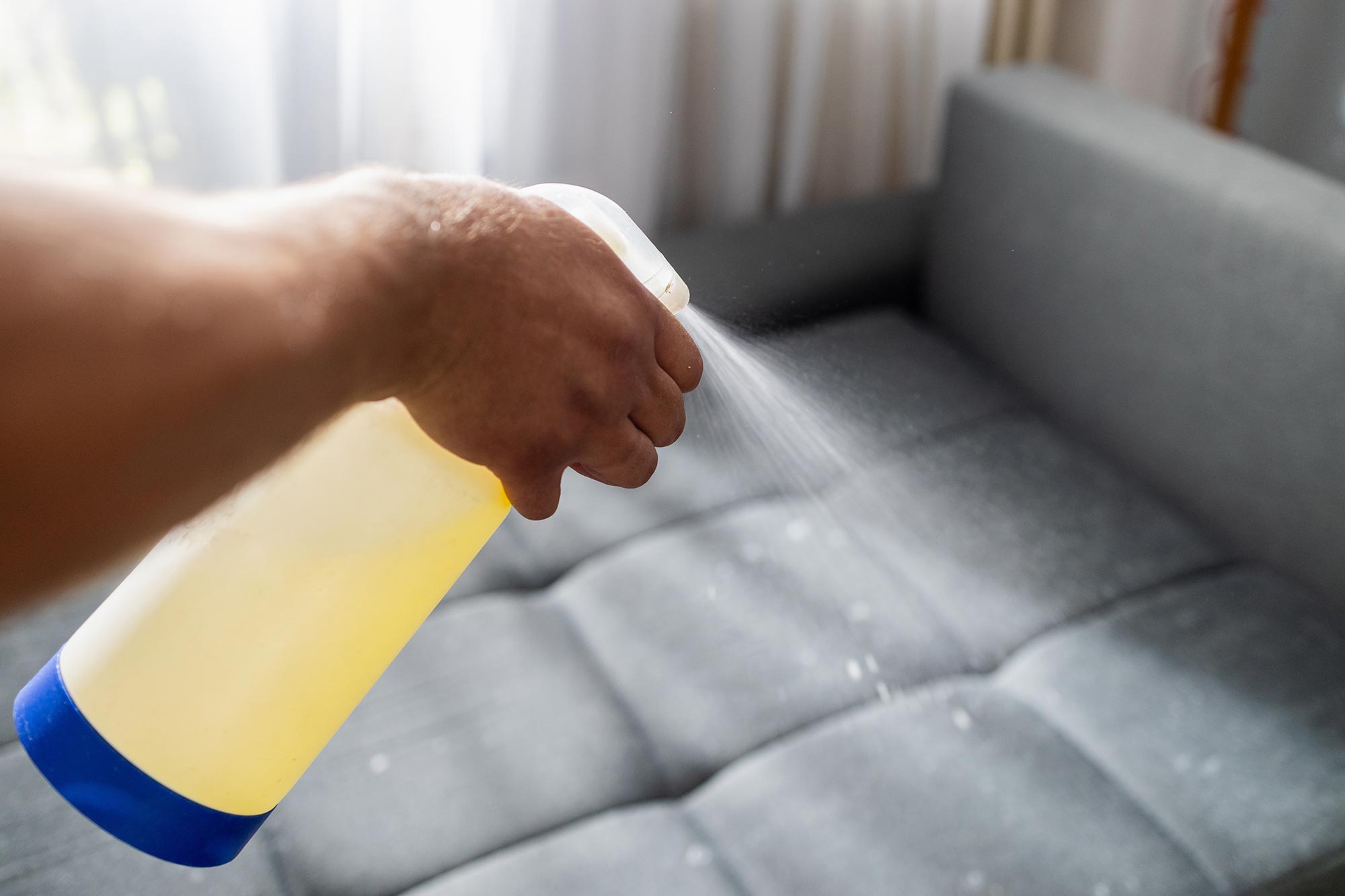
Even botanical and essential oil-based cleaners can release fragrance compounds that react with indoor ozone, creating an unexpected source of ultrafine air pollution.
The scent of a freshly cleaned home may hide a burst of invisible pollution that can penetrate deep into the lungs.
Fragrance chemicals released by common cleaners can react with ozone in indoor air within minutes, according to research led by Brandon Boor. The reaction occurred with both conventional products and botanical essential oil-based alternatives, showing that a natural label does not necessarily prevent this type of pollution.
The researchers found that routine activities such as mopping floors, spraying counters, and wiping surfaces can generate billions or even trillions of nanoparticles. Because the particles are too small to see and often escape detection by home air quality monitors, people may unknowingly inhale them while cleaning.
When a Clean Scent Becomes Air Pollution
“We showed that indoor ozone reactions with fragrances from cleaning produce nanoparticles that carry a respiratory dose comparable to, or greater than, what you would experience from standing outside along a busy road,” said Boor, an assistant professor of civil and construction engineering at Purdue University who studies indoor air quality. “The particles are different in terms of their composition, but the total dose can be higher. You’re not seeing smoke, dust, or haze in the air. Instead, you think the air smells great, so it must be clean.”

Boor and Purdue colleague Nusrat Jung began examining the effects of cleaners and chemical disinfectants on indoor air during the COVID-19 pandemic. They noticed that many products contained strong fragrances intended to leave behind a reassuring scent.
“That’s often to create a pleasant smellscape in the indoor space,” said Boor. “But clean air should not smell like highly concentrated citrus fruit. It should not really smell of anything.”
The chemistry behind the effect is already familiar to atmospheric scientists. Plants release compounds called terpenes, including pinene from pine trees, that react with ozone and produce tiny airborne particles. In forests, this process unfolds relatively slowly because terpene concentrations are generally low. Over time, the particles can combine, grow, and eventually contribute to cloud formation.
Indoor Terpene Levels Can Soar
Inside a home, scented cleaning products can create a much more concentrated chemical environment. Fragrance compounds evaporate from droplets and freshly cleaned surfaces, releasing terpenes such as pinene, limonene (lemon), thymol (thyme), and linalool (lavender). During cleaning, airborne terpene concentrations can climb to tens or hundreds of times those typically found in a forest, Boor said.
The team recreated common household cleaning activities inside a model home on Purdue’s campus. The tiny house contains a working kitchen, wood flooring, and a bathroom, allowing the researchers to study indoor chemistry under realistic but controlled conditions.
Experiments with scented conventional liquid products and botanical-containing disinfectant sprays and wipes showed that outdoor particle-forming chemistry can become faster and more concentrated indoors. The exact particle output depended on the product and how it was applied.
Most of the particles measured just 1 to 30 nanometers across. These nanoparticles, also known as ultrafine particles, are far smaller than the particles tracked by many consumer air monitors. Their size allows them to settle throughout the respiratory tract and reach the deepest regions of the lungs, where they may contribute to irritation and inflammation. Some could potentially cross into the bloodstream.
Billions of Particles Form Within Minutes
One of the most striking findings was the speed of particle formation. The airborne chemicals began reacting almost immediately, meaning substantial exposure could occur before a person had finished cleaning the room.
“By the time you finish cleaning up an indoor space, you’ve already formed a lot of nanoparticles and inhaled them,” said Boor.

A more recent investigation by Boor and Purdue professor Ernest Blatchley examined what happens when scented cleaners are used alongside germicidal far-UV (UV-C) lamps. These devices are designed to disinfect air, but their interaction with oxygen can also produce ozone.
Inside the model home, the lamps raised ozone concentrations to about 20 to 40 parts per billion. Those levels were comparable to, although somewhat lower than, outdoor concentrations measured at the time. When the additional ozone mixed with abundant terpenes from scented cleaners, nanoparticle formation intensified further.
Simple Ways to Reduce Exposure
The findings do not diminish the importance of removing harmful microbes from surfaces. Instead, they show that cleaning practices intended to improve hygiene can simultaneously alter indoor air in less obvious ways.
People can reduce exposure by selecting fragrance-free or low-fragrance products, limiting the number of scented cleaners used during one session, and increasing ventilation with open windows or exhaust fans. The researchers also advise against cleaning with scented products while operating ozone-generating equipment, including Far-UV-C lamps.
“Importantly, cleaning removes viruses and bacteria from surfaces, but it can also generate invisible air pollution,” said Boor. “There’s no visible dust or smoke in the air, but these particles are forming.”
The researchers presented their results during the “Healthy Indoor Spaces: Bridging the Microbiome and Chemistry” symposium at the fall meeting of the American Chemical Society (ACS) at McCormick Place.
Never miss a breakthrough: Join the SciTechDaily newsletter.
Follow us on Google and Google News.
4 Comments
Anyone who has allergy problems should be especially careful. Even if most people don’t notice, fabreez and other products are a real menace.
I’ve always used pure Indian incense…. safety proven for 10,000 years.
That’s simply not true. Just because it’s been used for thousands of years does not mean it’s safe. Incense flares up my asthma. Inhaling smoke of any kind regularly is bad for your lungs. Alcohol has been used for thousands of years and we’re learning it’s a carcinogen, on top of being a general poison for the body.
Even essential oils are bad to breathe in. Especially dangerous for pets.
is there a difference between using aerosol sprays and pump sprays?