
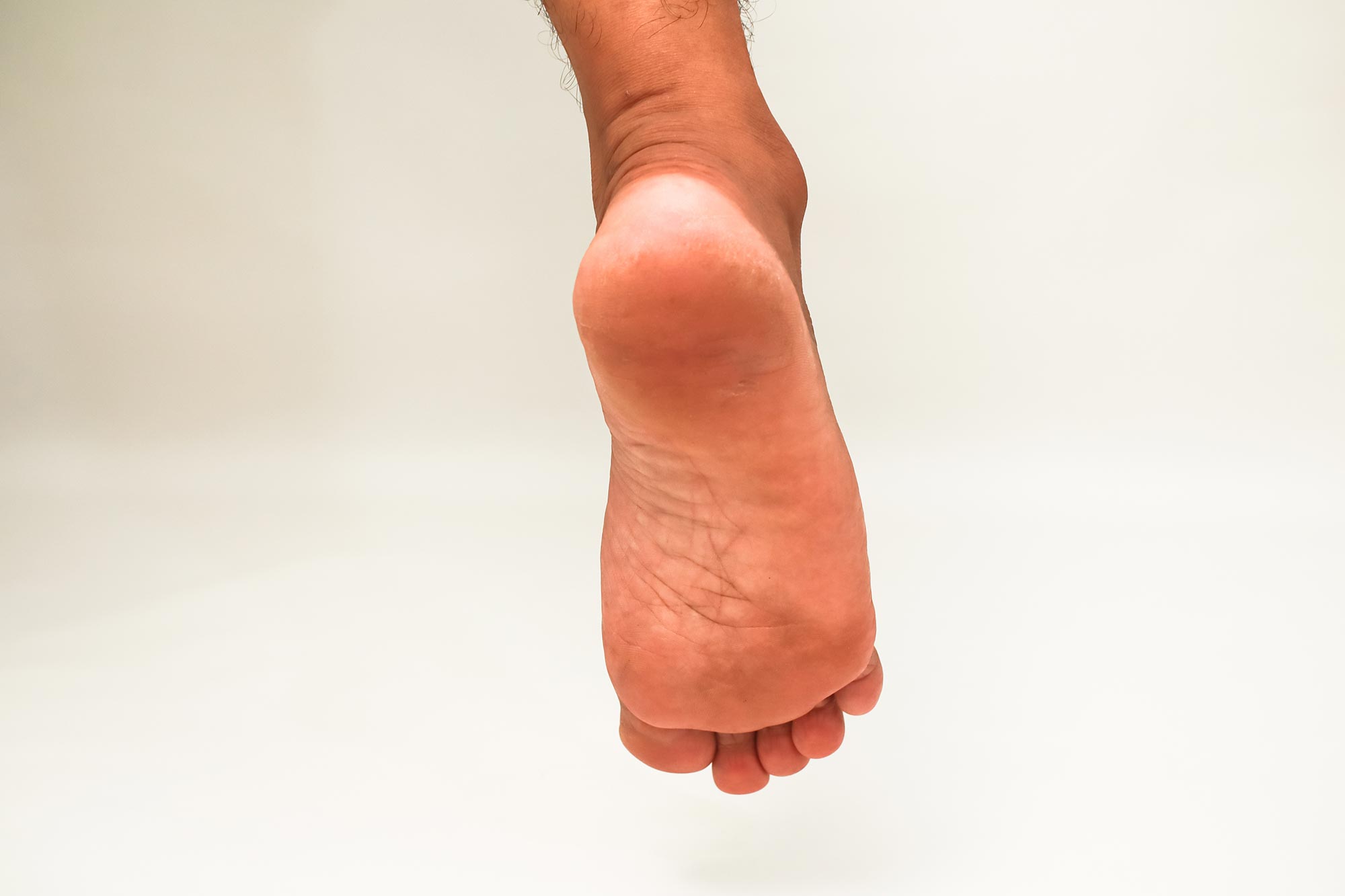
Consistently walking from heel to toe distinguished early humans from other great apes and helped them hunt and gather food efficiently, according to new research.
Landing on the ball of your foot makes for a softer step, but keeping that up takes more energy than walking heel first. A new comparison of humans and chimpanzees suggests that our habit of rolling from heel to toe helped our ancestors cover more ground, even as it put greater demands on their bones and joints.
The study, led by a Penn State researcher and published in the Proceedings of the National Academy of Sciences, challenges an earlier view that humans and other great apes share much the same heel-first walking style. Chimpanzees can land on their heels, but they often touch down elsewhere on the foot. Humans in the study landed heel first every time they walked normally.
“When people think about what makes human walking unique, they talk about upright walking — our backs are straight and our legs are extended,” said study author Nicholas Holowka, an assistant professor of anthropology and co-hire with the Huck Institute of Life Sciences at Penn State. “What we’re saying in this article is that landing on our heel is a unique aspect of human walking that’s maybe been underappreciated. This study presents the best measurable comparison of humans to our closest living relatives, chimpanzees, which shows that what we’re doing when we land is distinctive in key ways.”
Softer steps take more energy
To find out what people gain from that consistent stride, the researchers asked human volunteers to try walking more like chimpanzees. Instead of landing on the heel, they touched down on the ball of the foot just behind the little toe, then lowered the heel, a pattern the researchers called a midfoot-strike.
Participants walked on a treadmill wearing a portable system that measured oxygen consumption and carbon dioxide production, allowing the researchers to calculate the energy each gait required. Heel-first walking saved an estimated 26% to 41% in metabolic energy compared with midfoot strikes.
Nicholas Holowka, assistant professor of anthropology at Penn State, explains the differences between human and chimpanzee walking styles and why humans evolved to walk heel first. Credit: Ben Manning / Penn State
Rolling from the back of the foot toward the toes allows people to move forward efficiently. Landing farther forward offers a different advantage, as study co-author Nathan Thompson, an associate professor at New York Institute of Technology, College of Osteopathic Medicine, explained.
“Imagine you are trying to sneak across a creaky wooden floor,” Thompson said. “You tend to walk on the balls of your feet, because this reduces the rate of loading on the floor and creates less creaking. It’s a softer way to walk.”
Chimpanzees vary their landings
The team measured those landings as part of laboratory experiments involving 12 people at the University at Buffalo. Nine participants wore reflective markers and walked barefoot along an approximately 25-foot runway, making repeated passes with both their normal gait and the altered gait. Metal force plates recorded the forces underfoot while high-speed, high-resolution cameras captured their movements.
Similar equipment at Stony Brook University recorded three male chimpanzees walking along an approximately 36-foot walkway, both upright and on all fours. The researchers added walking data from three more chimpanzees studied by another team and reviewed two additional studies covering a combined 15 chimpanzees.
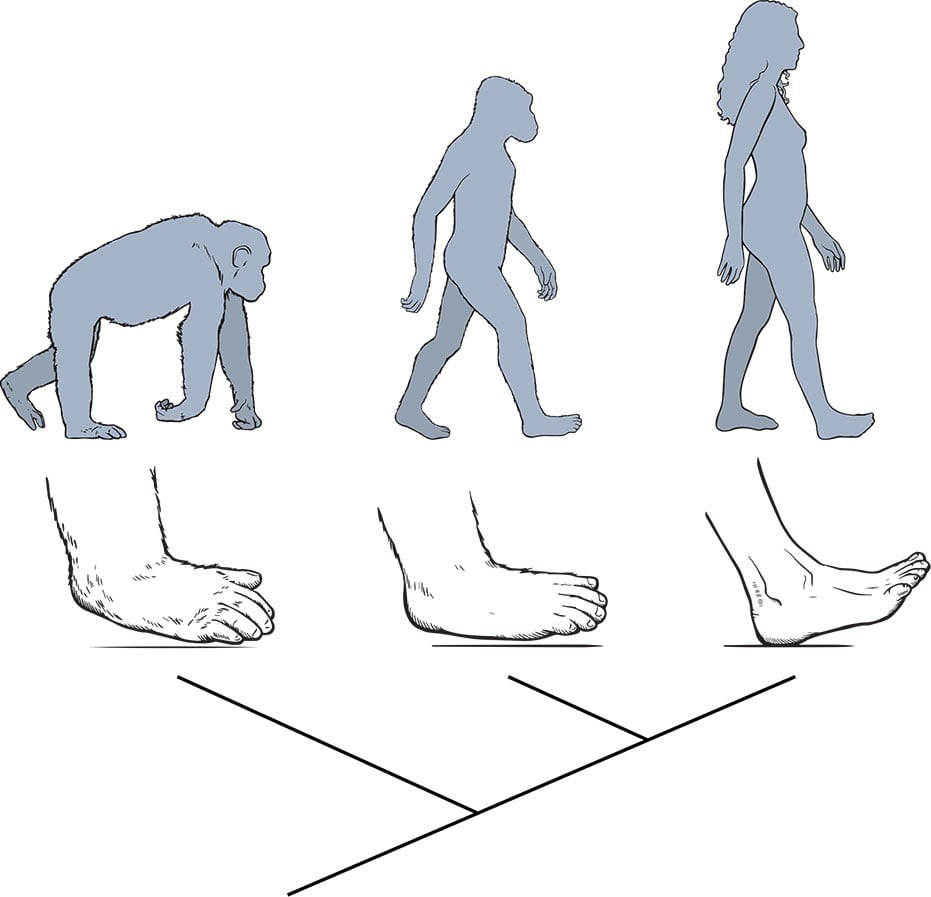
Earlier comparisons had relied on descriptive observations. These measurements revealed how much the chimpanzees varied from step to step. They landed on the side or ball of the foot most of the time and used heel-strikes less often when walking on two legs than when moving on all fours.
“It seems that when walking on two legs, chimpanzees prefer the ‘softer’ way to land on their feet,” Thompson said.
The human volunteers were much more consistent. During normal walking, both their heel-first landings and the angle at which their feet met the ground varied little, within each person’s strides or between participants. The chimpanzees’ ranges of foot-strike angles were 2.4 to 8.6 times greater.
Efficient strides come with harder impacts
For both species, landing on the heel meant that force built up more abruptly. In chimpanzees walking on two legs, the impact loading rate was up to 138% higher for heel-strikes than for midfoot-strikes. In humans, it was up to 162% higher.
Those forces help explain why adopting an efficient stride would also have required changes to the body. Holowka said the earliest human ancestors probably walked with more varied landings, much as chimpanzees do, sometimes placing the heel down first, sometimes landing flat-footed, and sometimes touching down on the ball of the foot. He suggested that the energy cost of this gait likely restricted how far they could travel.
Consistent heel-first walking could have extended that range, but coping with the potentially damaging impacts would have required sturdier bones and joints.
“It seems like humans needed to evolve anatomical adaptations — thicker heel bones and bigger knee and ankle joints — to cope with these high forces,” Holowka said. “We think that the heel-strike played a role in enabling key human behaviors, such as using hunting and gathering strategies that require people to walk really long distances every day to get food, but for a big payoff in food resources.”
The team suggests that this ability to cover ground efficiently ultimately helped humans spread across the world. Holowka also raised a question about how that inherited stride fares on the surfaces people walk on today.
“We humans have evolved to use this high-impact walking style in a way that is safe and natural for us,” Holowka said. “The novel environments that we currently live in with their hard, paved surfaces might upset the evolutionary balance in some ways. It’s something that we’d be interested in looking at in future research. Still, walking a lot is a very healthy exercise and, although high impact, our bodies evolved to cope with it, so we shouldn’t avoid it.”
Reference: “Heel-strike mechanics reveal evolutionary trade-offs in hominin bipedalism” by Nicholas B. Holowka, Matthew C. O’Neill, Vincent Bhandal, Otto Lam, Zacchariah M. Apolito, Caleb A. Massimi, Kevin G. Palmisano, Steven Worthington, Brigitte Demes and Nathan E. Thompson, 8 September 2026, Proceedings of the National Academy of Sciences.
DOI: 10.1073/pnas.2533918123
The research was funded by the U.S. National Science Foundation under grant BCS-0935321, the Leakey Foundation and the Wenner-Gren Foundation.
Never miss a breakthrough: Join the SciTechDaily newsletter.
Follow us on Google and Google News.