
Skeletons buried in Israel’s Upper Galilee reveal migration from ancient Turkey and Iran, TAU researchers say.
An international team of researchers from Tel Aviv University, the Israel Antiquities Authority, and Harvard University has discovered that waves of migration from Anatolia and the Zagros mountains (today’s Turkey and Iran) to the Levant helped develop the Chalcolithic culture that existed in Israel’s Upper Galilee region some 6,500 years ago.
The study is one of the largest ancient DNA studies ever conducted in Israel and for the first time sheds light on the origins of the Chalcolithic culture in the Levant, approximately 6,000-7,000 years ago.
Research for the study was led by Dr. Hila May and Prof. Israel Hershkovitz of the Department of Anatomy and Anthropology, Dan David Center for Human Evolution and Biohistory Research, at TAU’s Sackler Faculty of Medicine; Dr. Dina Shalem of the Institute for Galilean Archaeology at Kinneret College and the Israel Antiquities Authority; and Éadaoin Harney and Prof. David Reich of Harvard University. It was published today in Nature Communications.
In 1995, Zvi Gal, Dina Shalem and Howard Smithline of the Israel Antiquities Authority began excavating the Peqi’in Cave in northern Israel, which dates to the Chalcolithic Period in the Levant. The team unearthed dozens of burials in the natural stalactite cave that is 17 meters (56 feet) long and 5-8 meters (16-26 feet) wide.
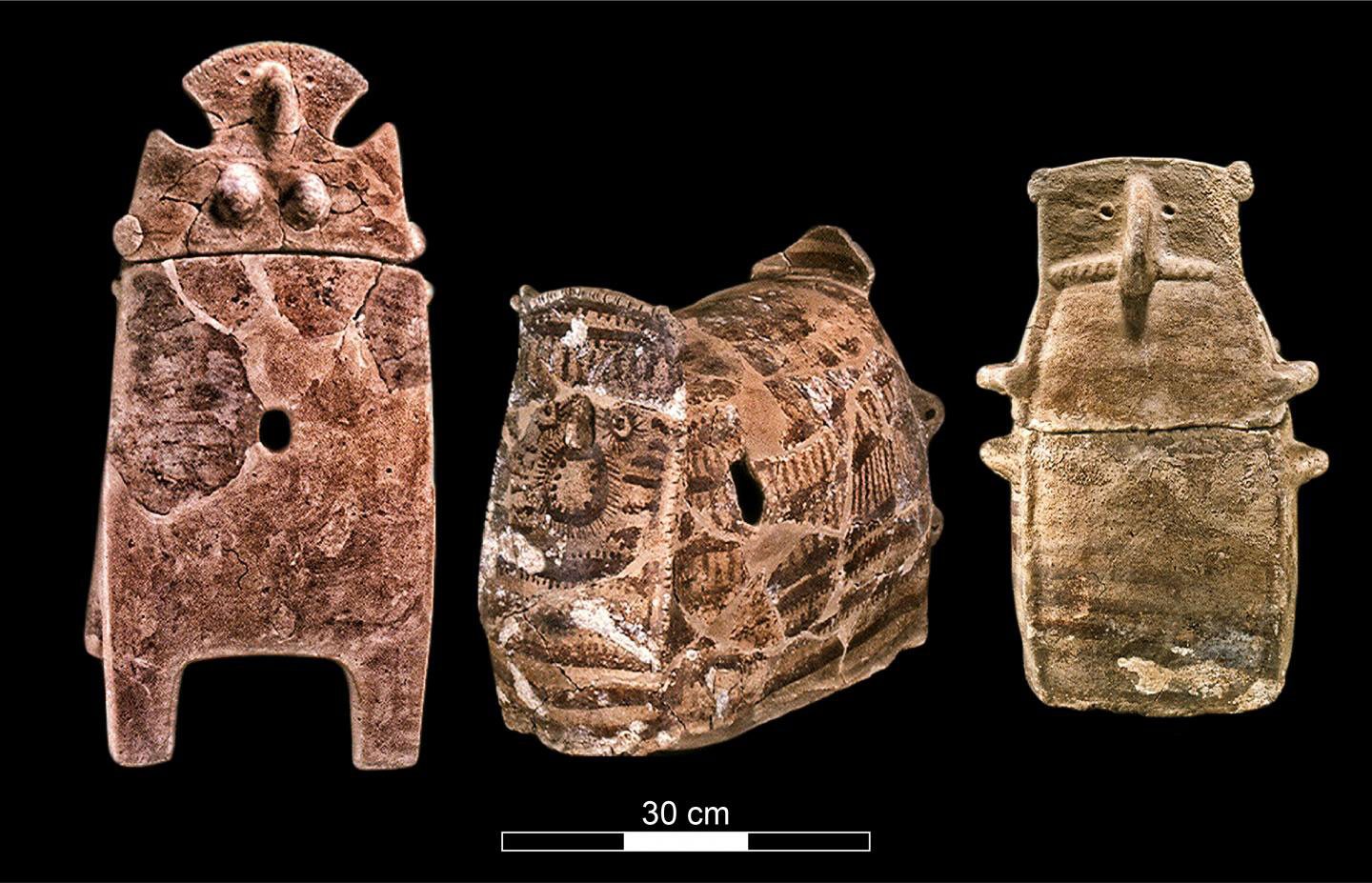
The large number of unique ceramic ossuaries and the variety of burial offerings discovered in the cave suggest that it was once used as a mortuary center by the local Chalcolithic people.
“The uniqueness of the cave is evident in the number of people buried in it — more than 600 — and the variety of ossuaries and jars and the outstanding motifs on them, including geometric and anthropomorphic designs,” Dr. Shalem says. “Some of the findings in the cave are typical to the region, but others suggest cultural exchange with remote regions.
“The study resolves a long debate about the origin of the unique culture of the Chalcolithic people. Did the cultural change in the region follow waves of migration, the infiltration of ideas due to trade relations and/or cultural exchange, or local invention? We now know that the answer is migration.”
The researchers subjected 22 of the skeletons excavated at Peqi’in, dating to the Chalcolithic Period, to a whole genome analysis.
“This study of 22 individuals is one of the largest ancient DNA studies carried out from a single archaeological site, and by far the largest ever reported in the Near East,” Dr. May says.
“The genetic analysis provided an answer to the central question we set out to address,” says Prof. Reich. “It showed that the Peqi’in people had substantial ancestry from northerners — similar to those living in Iran and Turkey — that was not present in earlier Levantine farmers.”
“Certain characteristics, such as genetic mutations contributing to blue eye color, were not seen in the DNA test results of earlier Levantine human remains,” adds Dr. May. “The chances for the success of such a study seemed slim, since most of the ancient DNA studies carried out in Israel have failed due to difficult climatic conditions in the region that destroy DNA.”
“Fortunately, however, human DNA was preserved in the bones of the buried people in Peqi’in cave, likely due to the cool conditions within the cave and the limestone crust that covered the bones and preserved the DNA,” says Prof. Hershkovitz.
“We also find that the Peqi’in population experienced abrupt demographic change 6,000 years ago,” concludes Harney, who led the statistical analysis for the study.
“Indeed, these findings suggest that the rise and falls of the Chalcolithic culture are probably due to demographic changes in the region,” says Dr. May.
Reference: “Ancient DNA from Chalcolithic Israel reveals the role of population mixture in cultural transformation” by Éadaoin Harney, Hila May, Dina Shalem, Nadin Rohland, Swapan Mallick, Iosif Lazaridis, Rachel Sarig, Kristin Stewardson, Susanne Nordenfelt, Nick Patterson, Israel Hershkovitz and David Reich, 20 August 2018, Nature Communication.
DOI: https://doi.org/10.1038/s41467-018-05649-9
Never miss a breakthrough: Join the SciTechDaily newsletter.
Follow us on Google and Google News.
11 Comments
6500 year ago there is no country such a Turkey . Don’t public wrong information.
Gegham: DNA points to the area we now indentify as Turkey. I dont believe the archeologists modern Turkey existed 6000 years ago. Ughhhhhh!
There were no countries 6,000 years ago. The present country names are used as a geographic reference.
yeeet
hi avery
no
Blahhhh :l
fallow me at instagram @yeeet
he be rollin down the street
he be rollin to the beat
U ARE A NERRD
a duck walked up to a lemonade stand, annoyed da man runnin da stand…
and got shot in the face.