
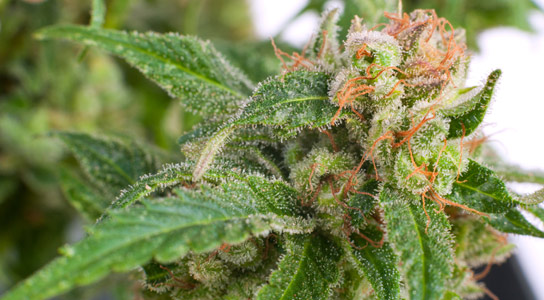
A newly published study from Yale University found that recreational marijuana use was associated with increased impulsivity and greater hostile perceptions and behaviors.
While the negative effects of chronic marijuana use are being documented in a growing body of research, it has been unclear whether recreational use of the substance produces problematic effects in everyday life.
A new study, published online ahead of print in the journal Drug and Alcohol Dependence, suggests that recreational users of marijuana may experience deleterious effects on impulse control and increases in hostility.
Participants in the study used smartphones to monitor their use of marijuana, alcohol, and tobacco, and to assess the impulsivity of their actions, hostile behaviors, and perceived hostility during social interactions. For each subject, days of marijuana use and non-use were compared to look for changes in impulsivity and social behaviors resulting from use.
The findings show that on days when use occurred, impulsivity and hostility were higher than on days when no use occurred. Impulsivity was also higher on the day after marijuana use, suggesting a directional and lasting effect of marijuana use on impulse control.
“Contrary to perceptions of low associated risk with marijuana use among young adults, our findings suggest that recreational use of marijuana may have negative impacts on day-to-day psychological processes and psychosocial function,” said Emily Ansell, lead author and assistant professor of psychiatry at Yale School of Medicine. The results could have implications for recent changes in the legal status of marijuana in some states.
Additional co-authors include Holly Laws of Yale, Michael Roche of Pennsylvania State University, and Rajita Sinha, Foundations Fund Professor of Psychiatry and professor in the Child Study Center and of neurobiology at Yale School of Medicine.
Reference: “Effects of marijuana use on impulsivity and hostility in daily life” by Emily B. Ansell, Holly B. Laws, Michael J. Roche and Rajita Sinha, 6 January 2015, Drug & Alcohol Dependence.
DOI: 10.1016/j.drugalcdep.2014.12.029
Never miss a breakthrough: Join the SciTechDaily newsletter.
Follow us on Google and Google News.
15 Comments
What a load of alcohol industry driven happy horse s#!t. I’ve been smoking – almost daily – since 1969 and I have never be impulsive or hostile to anybody as described in the article.
Yale sucks, it has sucky sports teams, and it graduates a-holes e.g. Bush I and Bush II. Go f-yourself, Yale.
Jim
Absolutely agree with Jim. I never experienced hostile behavior on anybody who used it, and I probably known a hundred people using it including myself. However I experienced countless hostile behavior under the effect of alcohol. They shouldn’t call themselves scientists when they sell and fake results for industries want people to live their life miserable.. Impulsive? LOL 😀 That article is a joke.
Interesting that the Jim’s first comment could easily be seen as hostile…
I do agree that alcohol makes people far more aggressive than cannabis, at least from my own observations.
I sense large amounts of hostility!
I hope this is sarcasm on Jim’s part. If not…Yale may be on to something.
Oh, and this one too: ‘Yale’- a Swedish prison.
I’ve been a daily pot smoker since age 30. I’m now 75 and in good health and still smoking it. Was able to keep a good paying job with a large publishing company in New York City for over 20 years. Moved to Gainesville Fl at the behest of my childhood sweetheart who finally called after 30 years, married the lady in ’92 and we’re still happily so after 22 years now. “Research” like this, which relies on self-reporting of the sort that’s questionable on it’s face, is as unreliable as can be. This article, as Jim so aptly put it, is a load of crap. I’d pay no attention to the alleged ‘findings’ herewith since they make no sense. Besides the likely influence of the liquor industry, there are plenty of puritan types out there who will try anything and lie like rugs to stop the legalization of this eminently harmless herb. Vince
43 people over 14 days… not much of a study, is it? good job, Yale.
I’ve seen a lot of pot smokers in my time, and not one of them had increased hostility when they smoked pot. The truth is, smoking pot calms people down. This report saying otherwise is a lie.
Yale and Scitech Daily have lost all credibility by publishing this kind of nonsense.
Why the hostility towards SciTech 😉 We had nothing to do with the study. We just put it out there so people like you could read it.
So, did they bother to use a strain that balanced THC and CBD levels? That’s the only explanation that I can think of for how they reached a conclusion so at-odds with literally everything known about this substance.
I could see a scenario playing out where some knucklehead researcher who’s interested in studying THC chooses a Cannabis strain with very high ratio of THC, without realizing that CBD acts as an inhibitor of THC’s anxiety and paranoia side effects.
This is of course the reason why medical marijuana as well as recreational dispensaries have been engineering towards strains that have these two chemicals at a 1:1 ratio. (seen as ideal for minimizing side effects)
http://www.mmjjournal.com/thc-vs-cbd/
Of course, I think it goes without saying that studying Cannabis and THC without its ubiquitous side-effect inhibitor chemicals is not representative of actual use.
Hopefully that mistake was accidental.
This Yale “study” used a statistically insignificant number of subjects. It did not monitor the amount of THC or CBD absorbed by the subjects. It did not monitor the duration of REM-sleep of each subject. The length of time over which the subjects were monitored cannot lead to any valid conclusion. The intent and design of the study was to associate pot with negative effects; positive attributes were not part of the study. A biased researcher can get any “result” they want.
I just finished smoking a joint and need some cookies..Hostility no way, video games yes! I can’t tell you the problems I got into when I drank. With Mary I just want to be left in peace. Bless Maryjane the world needs a big bong hit trust me it does not increase hostility it is a chill out plant if anything. This study is BS.
Having smoked on and off for many years I think there is some truth to the study, but also agree with the commenters that it depends on the particular chemical compensation- and the particular psychological make up of the user
I know that I am much more suspect a impulse buying on marijuana, and my judgement is often more short term focused. Hostility, can be more in stressful situations and lower in lower stress situations.
Both alcohol (usually for users) and opiod (in people opposed to legalization) comparisons have little real value.