
Close Menu
    Facebook X (Twitter) Instagram
    SciTechDaily
    • Biology
    • Chemistry
    • Earth
    • Health
    • Physics
    • Science
    • Space
    • Technology
    Facebook X (Twitter) Pinterest YouTube RSS
    SciTechDaily
    Home»Science»30-Year-Old Museum Rock May Hide a New Mosasaur Species
    Science

    30-Year-Old Museum Rock May Hide a New Mosasaur Species

    By Okayama University of ScienceJuly 30, 2026No Comments3 Mins Read
    Facebook Twitter Pinterest Telegram LinkedIn WhatsApp Email Reddit
    Share
    Facebook Twitter LinkedIn Pinterest Telegram Email Reddit
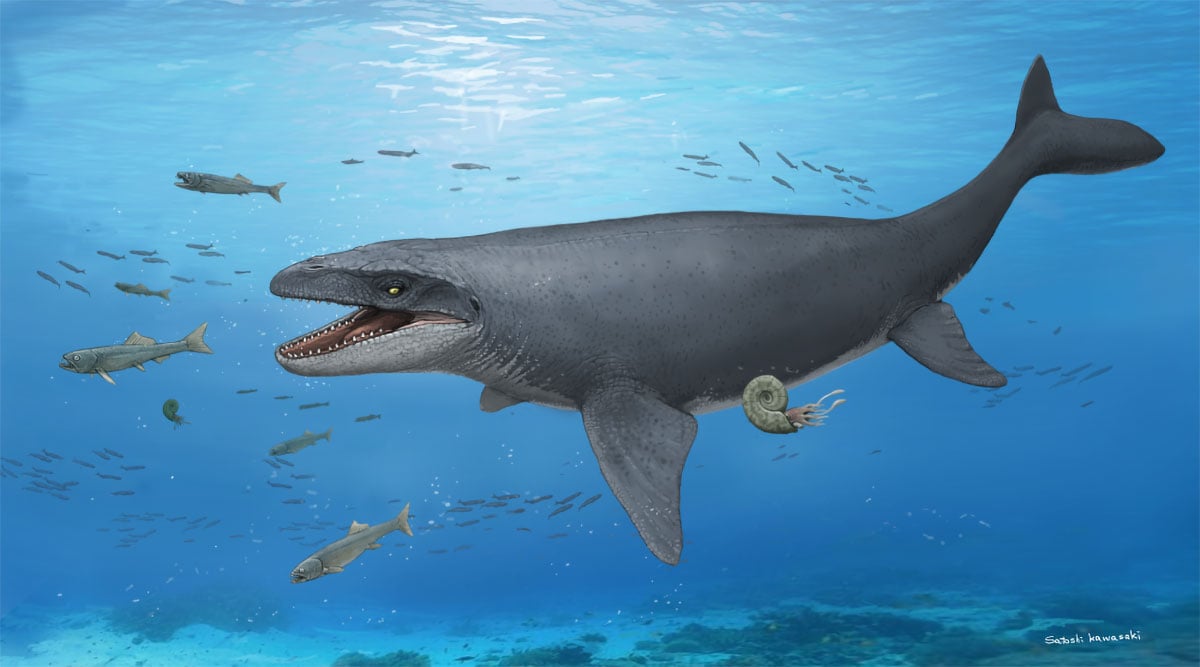
    Life Reconstruction of the Mosasaur Specimen
    Life reconstruction of the mosasaur specimen discovered in Osaka Prefecture, Japan. Credit: Reconstruction by Satoshi Kawasaki, Okayama University of Science

    Fossils newly identified in a rock collected 30 years ago in Osaka Prefecture may belong to a previously unknown species.

    For roughly 30 years, four mosasaur bones remained concealed inside a rock stored at the Natural History Museum, Kishiwada City. When researchers recently examined the unprepared specimen, they uncovered fossils unlike those of any mosasaur previously described, raising the possibility that the remains belong to an unknown species.

    The investigation involved researchers from Okayama University of Science, Tokyo City University, the Natural History Museum, Kishiwada City (Osaka Prefecture), and other institutions. Their finds included a premaxilla, the bone at the very front of the upper jaw. It is the first confirmed premaxilla from a mosasaur fossil found in Japan.

    Mosasaurs were enormous marine reptiles that inhabited oceans around the world during the Late Cretaceous, approximately 98 to 66 million years ago. The Osaka fossils were collected between 1990 and 1992 in Sobura, Kaizuka City, and later placed in the museum’s collection. By returning to rock that had never been fully prepared, researchers recovered four bones that had remained trapped within the surrounding material.

    A hidden jawbone changes the picture

    The newly recognized premaxilla is one of the investigation’s most important discoveries. When the fossil was first collected, researchers lacked enough comparative mosasaur specimens to determine which bones were present or where the animal fit within the group.

    Decades of additional mosasaur research have since produced a much larger global collection of fossils and anatomical information. Those advances gave researchers the evidence needed to identify the bone as a premaxilla.

    Skull anatomy hints at a new species

    Another important clue came from the basisphenoid, a bone positioned near the braincase. The fossil has short, horn-shaped projections extending from its sides and lacks a central groove along its underside.

    These traits differ from those documented in previously described mosasaurs. Although more analysis is required, the unusual anatomy indicates that the specimen could represent a species that has not yet been formally recognized.

    Museum collections still hold discoveries

    The findings demonstrate why unprepared fossils preserved in museums and research collections can remain scientifically valuable decades after they are collected. Reexamining such material can uncover overlooked bones as new research and better comparative evidence make identification possible.

    The fossils may also provide additional information about marine ecosystems in the northwestern Pacific during the Cretaceous Period. Researchers will continue studying the remains to determine whether they belong to a new mosasaur species.

    Meeting: The results were presented at the 177th Annual Meeting of the Paleontological Society of Japan, held at Osaka Metropolitan University on June 27, 2026.

    Never miss a breakthrough: Join the SciTechDaily newsletter.
    Follow us on Google and Google News.

    Anatomy Cretaceous Period Fossils Paleontology Taxonomy
    Share. Facebook Twitter Pinterest LinkedIn Email Reddit

    Related Articles

    Scientists Finally Solve the 20-Year Mystery of Strange Tiny Dinosaur Fossils

    Scientists Reconstruct a Giant 31-Foot “Dinosaur-Killer” Crocodile in Unprecedented Detail

    Paleontologists Unearth New Species of “Mystery” Dinosaur

    Scientists Discover Bizarre 113-Million-Year-Old Hell Ant With Killer Scythe Jaws

    Soaring vs. Flapping: “Remarkable” Fossils Unlock Flight Secrets of Giant Pterosaurs

    Microraptor Feathers Were Black With Iridescent Sheen

    Cretaceous Period Pterosaur Discovered in Northeast China

    Jurassic Period Super-Sized Fleas Had Armored Mouthparts to Attack the Thick Hide of Dinosaurs

    Hundreds of Lost Fossils From the Darwin Collection Rediscovered by the British Geological Survey

    Leave A Reply Cancel Reply

    • Facebook
    • Twitter
    • Pinterest
    • YouTube

    Don't Miss a Discovery

    Subscribe for the Latest in Science & Tech!

    Trending News

    Invisible Black Holes Could Be Triggering Supernovae

    Scientists Discover the First Contagious Cancer in a Freshwater Animal

    THC-CBD Treatment Dramatically Reduces Agitation in Dementia Trial

    Scientists Say Love Follows Mathematical Patterns

    “Zombie Cells” Reveal a Hidden Weakness That Could Help Fight Aging

    Alien Signals May Be Hiding in a Radio Band SETI Has Barely Explored

    Earth’s Hidden Thermostat Has Regulated Climate for 60 Million Years

    This 518-Million-Year-Old Creature Reveals How Spiders Got Their Bite

    Follow SciTechDaily
    • Facebook
    • Twitter
    • YouTube
    • Pinterest
    • Newsletter
    • RSS
    SciTech News
    • Biology News
    • Chemistry News
    • Earth News
    • Health News
    • Physics News
    • Science News
    • Space News
    • Technology News
    Recent Posts
    • A Simple Twist Could Unlock a New Generation of Electronics
    • 30-Year-Old Museum Rock May Hide a New Mosasaur Species
    • Unzipping the Code of Life: Scientists Pinpoint Where DNA First Opens
    • Loneliness Is Making People Sick – but Medicine Can’t Fix It Alone
    • American Heart Association Reveals How Much Coffee Is Safe for Your Heart
    Copyright © 1998 - 2026 SciTechDaily. All Rights Reserved.
    • Science News
    • About
    • Contact
    • Editorial Board
    • Privacy Policy
    • Terms of Use

    Type above and press Enter to search. Press Esc to cancel.