
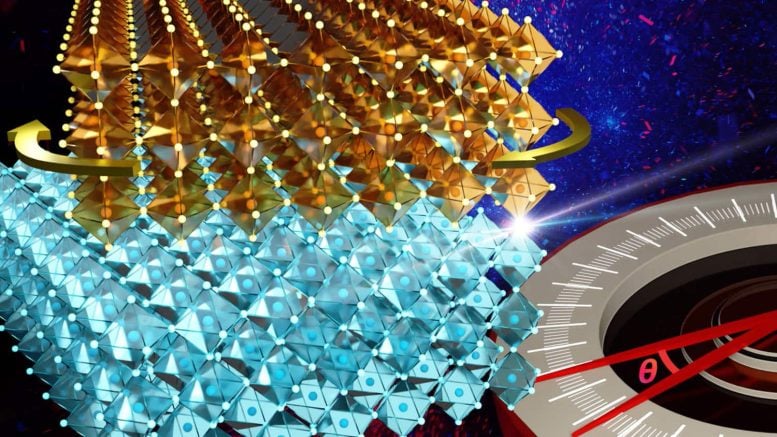
Scientists can now twist large oxide crystals into new materials with potentially powerful electronic properties.
A carefully chosen twist can transform how a material behaves. Researchers have now found a way to apply that principle to large sheets of crystalline oxides, opening a potential route toward electronic materials with structures and properties that can be designed with unusual precision.
The approach gives scientists control over the angle between two stacked oxide layers while creating strong chemical bonds where they meet. Unlike many earlier twistronic materials, the resulting structures can also be produced across areas large enough to be more relevant for practical devices.
Twistronics is based on a surprisingly powerful idea. When two thin crystalline layers are rotated relative to each other, their atomic patterns no longer line up perfectly. The resulting mismatch can alter how electrons move through the material and may produce behaviors that do not exist in either layer alone.
Moving Beyond Weakly Bonded Layers
Most twistronics research has focused on two-dimensional (2D) materials held together by relatively weak van der Waals forces. These weak connections make the layers easier to stack and rotate, but oxide crystals present a different challenge because their atoms tend to form much stronger chemical bonds.
“The field of twistronics was developed using 2D materials that are bonded by weak van der Waals forces,” says Ruijuan Xu, corresponding author of a paper on the work and an assistant professor of materials science and engineering at North Carolina State University. “Our work here demonstrates it is possible to use layers of oxide materials that are connected by strong chemical bonds—while precisely controlling the twist angle between crystalline oxide membranes.
“The strong interlayer bonding we found between oxide layers suggests there may be entirely new interfacial phenomena to explore,” adds Xu. “We’ve demonstrated the ability to control many of the material’s characteristics—including phase structure and domain configuration—in ways that offer new routes for designing materials and devices tailored to specific applications.”
Building Precisely Twisted Oxide Membranes
To build the structures, the researchers produced thin crystalline membranes of sodium niobate (NaNbO3), a complex oxide used here as a model material. They placed visible markers around each membrane using photolithography, a patterning method commonly used in electronics manufacturing.
One membrane was lifted and transferred onto another. By watching how the markers lined up, the team could rotate the upper layer until it reached the intended angle.
The stacked membranes were then heated through an annealing process tailored to sodium niobate. This treatment allowed strong chemical bonds to form between the layers without losing control of their alignment.
“Scale matters for devices,” says Xu. “Because these crystalline membranes can be fabricated over large areas and transferred onto different supports, this approach provides a practical path toward twist-engineered oxide electronics.”
Strong Bonds Reshape the Atomic Lattice
The researchers used synchrotron X-ray diffraction to examine the buried interface where the two crystals joined. Their measurements showed that the connection was not simply a flat boundary between two rigid layers.
Instead, the powerful bonding forces reshaped the material itself. The atomic lattice gradually rotated near the interface, allowing the crystals to adjust to their different orientations. The team also detected changes in the material’s phase structure, suggesting that twisting may affect more than the geometry of the layers.
“We found that the bonds between the two layers are so strong that they are distorting the atomic structure of the material—creating a gradual rotation of the atomic lattice at the interface between the layers,” says Xu. “We also found changes to the phase structure of the material. It remains to be seen how this will affect material properties, but that’s something we are exploring.”
Expanding the Future of Oxide Twistronics
The study focused on NaNbO3, but the researchers believe the assembly method could also work with other complex oxide membranes. That could greatly expand the range of materials available to twistronics and allow scientists to investigate interfaces held together by strong chemical bonds rather than weak attraction alone.
“Our work demonstrates a technique for creating large-area oxide twistronic materials with controlled twist angles and a strong chemical bond between layers,” says Xu. “It’s an exciting time for oxide twistronics, with new opportunities to engineer complex oxide functionalities through twist.”
Reference: “Deterministic Fabrication of Large-Area, High-Crystallinity Oxide Moiré Superlattices” by Reza Ghanbari, Eli Rodrigues, Young-Hoon Kim, Konnor Koons, Yan Li, Kabelo Lebogang, Yiming Ding, Douglas W. Barefoot, Yueyin Wang, Yin Liu, Hua Zhou, Miaofang Chi and Ruijuan Xu, 13 July 2026, ACS Nano.
DOI: 10.1021/acsnano.6c04794
This work was done with support from the National Science Foundation under grants 2442399 and 2340751; the American Chemical Society Petroleum Research Fund under award 68244-DNI10; the Army Research Office under grant W911NF-25-1-0201; the Scialog grant #SA-QMI-2025-097c from Research Corporation for Science Advancement; and the U.S. Department of Energy.
Never miss a breakthrough: Join the SciTechDaily newsletter.
Follow us on Google and Google News.
1 Comment
Oh !!! I wish I was 28 yrs old instead of 74!!! Once a philosophy. Of science and metaphysics. Student …, now music composition …. Now wondering how I might capture the sounds of Singingbowls And resound them at will somehow o. My comps with piano and flute. To picture a persons facial. profiles their musical expression. As it were . Can you help!🎶🎶🎶🔭🌙💌