

The mechanism that stabilizes new ferroelectric semiconductors also creates a conductive pathway, which could make them suitable for use in high-power transistors.
A new type of semiconductor that can store information using electric fields may lead to more energy-efficient computers, ultra-precise sensors, and technologies that convert signals between electrical, optical, and acoustic forms. However, scientists had long been puzzled by how these materials could sustain two opposing electric polarizations without breaking apart.
A team of engineers at the University of Michigan has now uncovered why the materials, known as wurtzite ferroelectric nitrides, don’t tear themselves apart.
“The wurtzite ferroelectric nitrides were recently discovered and have a broad range of applications in memory electronics, RF (radio frequency) electronics, acousto-electronics, microelectromechanical systems, and quantum photonics, to name just a few. But the underlying mechanism of ferroelectric switching and charge compensation has remained elusive,” said Zetian Mi, the Pallab K. Bhattacharya Collegiate Professor of Engineering and co-corresponding author of the study published in Nature.
“How is the material stabilized? It was largely unknown.”

How polarization switching works
Electrical polarization is similar to magnetism, but instead of having a north and south pole like a bar magnet, a polarized material has a positive and a negative end. These new semiconductors can begin with polarization in one direction. When exposed to an electric field, their polarization can flip—the positive end becomes negative and the negative end becomes positive. Even after the electric field is removed, the new polarization remains in place.
But often, it’s not the whole material that switches polarization. Instead, it’s divided into domains of the original polarization and the reversed polarization. Where these domains meet, and especially where two positive ends come together, researchers didn’t understand why the repulsion didn’t create a physical break in the material.
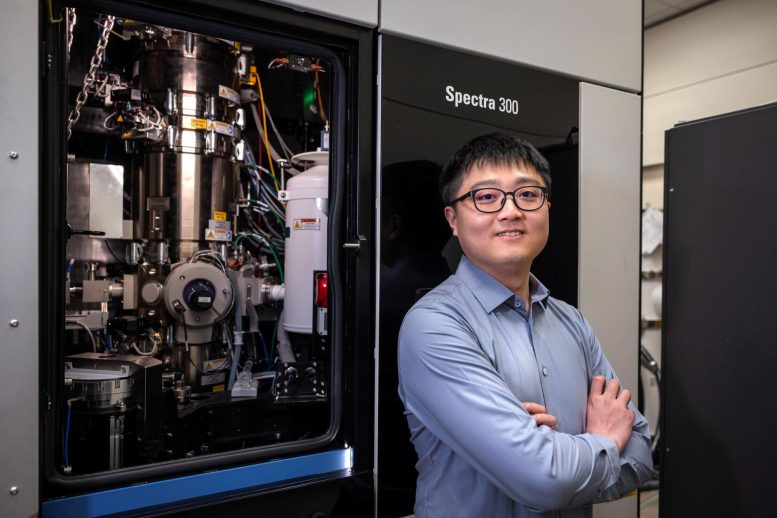
“In principle, the polarization discontinuity is not stable,” said Danhao Wang, U-M postdoctoral researcher in electrical and computer engineering and co-corresponding author of the study. “Those interfaces have a unique atomic arrangement that has never been observed before. And even more exciting, we observed that this structure may be suitable for conductive channels in future transistors.”
With experimental studies led by Mi’s team and theory calculations led by the group of Emmanouil Kioupakis, U-M professor of materials science and engineering, the team found that there is an atomic-scale break in the material—but that break creates the glue that holds it together.
How broken bonds hold the structure together
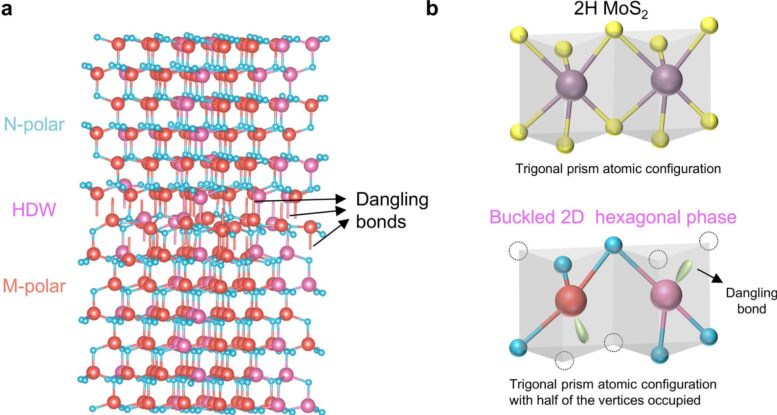
At the horizontal joint, where the two positive ends meet, the crystal structure is fractured, creating a bunch of dangling bonds. Those bonds contain negatively charged electrons that perfectly balance the excess positive charge at the edge of each domain within the semiconductor.
“It’s a simple and elegant result—an abrupt polarization change would typically create harmful defects, but in this case, the resulting broken bonds provide precisely the charge needed to stabilize the material,” said Kioupakis, also the Karl F. and Patricia J. Betz Family Faculty Scholar and a co-corresponding author of the study.
“What’s remarkable is that this charge cancellation isn’t just a lucky accident—it’s a direct consequence of the geometry of tetrahedra,” he said. “This makes it a universal stabilizing mechanism in all tetrahedral ferroelectrics—a class of materials that’s rapidly gaining attention for its potential in next-generation microelectronic devices.”
Atomic imaging and quantum calculations
The team discovered this with electron microscopy that revealed the atomic structure of the particular semiconductor they used, scandium gallium nitride. Where the domains met, the usual hexagonal crystal structure was buckled over several atomic layers, creating the broken bonds. The microscopy showed that the layers were closer together than normal, but density functional theory calculations were needed to reveal the dangling bond structure.

In addition to holding the material together, the electrons in the dangling bonds create an adjustable superhighway for electricity along the joint, with about 100 times more charge-carriers than in a normal gallium nitride transistor. That highway can be turned off and on, moved within the material, and made more or less conductive by reversing, moving, strengthening, or weakening the electrical field that sets the polarization.
The team immediately noticed its potential as a field effect transistor that could support high currents, good for high power and high frequency electronics. This is what they plan to build next.
Reference: “Electric-field-induced domain walls in wurtzite ferroelectrics” by Ding Wang, Danhao Wang, Mahlet Molla, Yujie Liu, Samuel Yang, Shuaishuai Yuan, Jiangnan Liu, Mingtao Hu, Yuanpeng Wu, Tao Ma, Kai Sun, Hong Guo, Emmanouil Kioupakis and Zetian Mi, 16 April 2025, Nature.
DOI: 10.1038/s41586-025-08812-7
The research was funded by the National Science Foundation, Army Research Office, and U-M College of Engineering. Computational resources were provided by the National Energy Research Scientific Computing Center, which is supported by the Department of Energy.
The device was built in the Lurie Nanofabrication Facility and studied at the Michigan Center for Materials Characterization.
Never miss a breakthrough: Join the SciTechDaily newsletter.
Follow us on Google and Google News.
4 Comments
The Strange Secret Behind These Semiconductors That Seemingly Defy Physics.
VERY GOOD.
Ask the researchers?
When words like ‘Defy Physics’ and ‘Strange’ repeatedly appear in your research, does it indicate that the physics rules you firmly believe in are scientific?
According to the topological vortex theory (TVT), the so-called “quantum materials” , electrons or Semiconductors are merely one manifestation of the diverse topological materials found in nature. There is no need to mystify our understanding of quantum phenomena by invoking analogies like Schrödinger’s cat (a cat being both dead and alive simultaneously).
If anyone is truly interested in topological materials, please browse https://zhuanlan.zhihu.com/p/1900140514277320438.
Topological and quantum materials are not in a zero-sum game but act as dual engines driving future technologies. Quantum materials dominate near-term markets, while topological breakthroughs may reshape long-term paradigms.
The essence of quantum materials is topological materials. Topological materials are a cutting-edge topic in condensed matter physics and materials science. Symmetry dominates natural laws, the innovation and development of topology theory based on symmetry provide a foundation for further in-depth research on topological materials.
The so-called peer-reviewed publications in physics today (including Physical Review Letters, Nature, Science, etc.) stubbornly believe that two sets of cobalt-60 rotating in opposite directions are two mirror images of each other, creating a more shameless pseudoscientific theoretical system in the history of science than the “geocentric model”. The author sincerely hopes that every researcher will not be misled by them and go astray.