
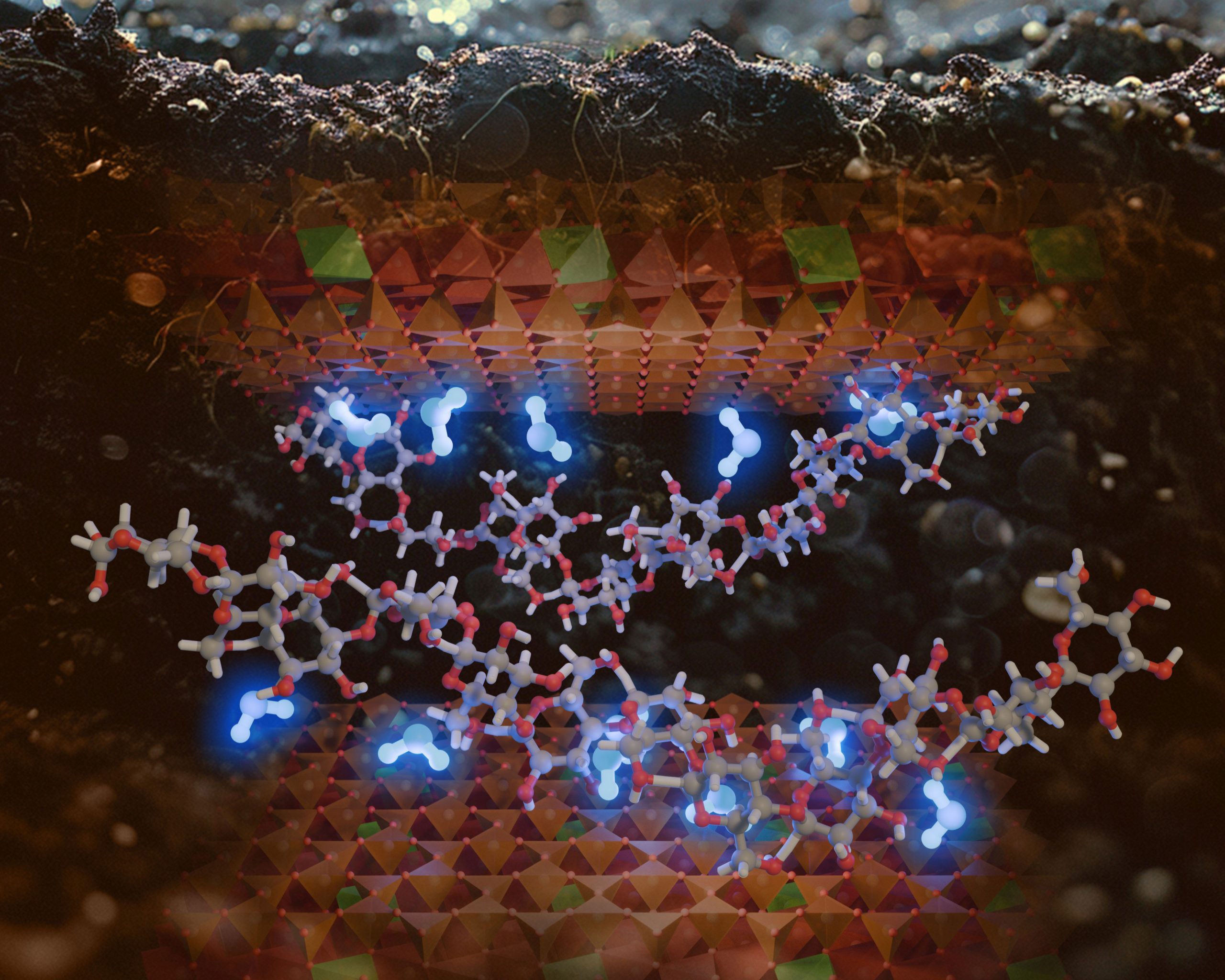
Scientists have uncovered a hidden molecular process that helps soils retain water.
From large-scale farmers to casual home gardeners, people have long observed that adding organic material to soil helps it hold more water.
Now, scientists at Northwestern University have identified the underlying molecular process that explains why this happens, showing how organic matter improves water retention even under extremely dry, desert-like conditions.
The researchers found that carbohydrates, which are common in plants and microbes, act like a kind of molecular adhesive. They use water to form connections between organic materials and soil minerals. These microscopic links help trap moisture that would otherwise evaporate. The findings offer new insight into how soils stay hydrated during drought and may even help explain how water has remained locked inside rocks for billions of years, including on Mars and in meteorites.
The study was published in the journal PNAS Nexus.
“The right amount of minerals and organic matter in soils leads to healthy soils with good moisture,” said Northwestern’s Ludmilla Aristilde, who led the study. “It’s something everyone has experienced, but we haven’t fully understood the physics and chemistry of how that works. By figuring this out, we could potentially engineer soil to have the right chemistry, turning it into long-term sponges that preserve moisture.”
Aristilde, an expert in how organic materials behave in environmental systems, is an associate professor of civil and environmental engineering at Northwestern’s McCormick School of Engineering. She is also affiliated with the Center for Synthetic Biology, the International Institute for Nanotechnology, and the Paula M. Trienens Institute for Sustainability and Energy. Sabrina Kelch, a recent Ph.D. graduate, and postdoctoral researcher Benjamin Barrios-Cerda, both from Aristilde’s lab, are the study’s first and second authors.
Water-trapping bridges
To carry out the research, the team combined a widely found clay mineral (smectite) with three carbohydrates: glucose, amylose, and amylopectin. Glucose is a simple sugar, while amylose and amylopectin are more complex starch-based polymers made of linked glucose units. Amylose forms long, straight chains, while amylopectin has a branched structure.
“We decided to use carbohydrates as a type of organic matter because it exists everywhere,” Aristilde said. “Cellulose, which is the most abundant biopolymer on Earth, is made of glucose, and plants and microbes secrete different, simple to complex carbohydrates into soil. We also selected carbohydrates because they have simple chemistry to avoid complicating our results with certain side reactions.”
The researchers used molecular simulations, quantum mechanical calculations, and lab experiments to study how clay, water, and carbohydrates interact at the nanoscale. Their results showed that hydrogen bonds play a central role in helping these materials retain water.
Hydrogen bonds are weak attractive forces that allow water molecules to cling together, forming droplets or flowing streams. The team found that water molecules can also bond at the same time to both clay surfaces and carbohydrates. This creates tiny bridges of water that connect the two and hold moisture more securely, reducing evaporation.
“When a water molecule is retained via a hydrogen bond with a carbohydrate and a hydrogen bond with the surface of a mineral, this water has a strong binding energy and is stuck between the two things it’s interacting with,” Aristilde said.
Complex sugar quintuples bond strengths
The simulations showed that water trapped between clay and carbohydrates has much stronger binding energy than water attached only to clay. In some cases, complex carbohydrate polymers allowed clay to hold water up to five times more tightly than it could on its own. Even in very dry conditions, this water was far less likely to evaporate and more likely to remain inside the clay’s tiny pores.
“We increased the temperature to measure water loss in both the presence and absence of carbohydrates,” Aristilde said. “Compared to the clay by itself, it required higher temperatures for water to leave the matrix with the presence of the clay and carbohydrates together. This means the water was retained more strongly in the presence of the carbohydrates.”
The structure of these carbohydrates also helps maintain the shape of clay pores. Normally, as clay dries, its nanoscale pores shrink as water is lost. However, long and branched carbohydrate molecules can prevent these pores from collapsing completely. This allows soils to hold onto moisture for longer periods, even during drought.
Beyond improving our understanding of soils on Earth, the findings may also have implications for other environments in the solar system.
“Even though our goal was to understand how soil on Earth holds on to its moisture, the mechanisms we uncovered here may have implications in understanding phenomenon beyond our planet,” Aristilde said. “There is a lot of interest in how this relationship between organics and water might play out on other planets — especially those that are considered to have once harbored life.”
Reference: “Mechanisms of water retention at carbohydrate–clay interfaces” by Sabrina E Kelch, Benjamin Barrios-Cerda, Yeonsoo Park, Eric Ferrage and Ludmilla Aristilde, 9 August 2025, PNAS Nexus.
DOI: 10.1093/pnasnexus/pgaf259
The study was supported by supported by the U.S. Department of Energy (DE-SC0021172) and Northwestern’s International Institute for Nanotechnology.
Never miss a breakthrough: Join the SciTechDaily newsletter.
Follow us on Google and Google News.
1 Comment
thanks