
New findings from 3D fossil analyses show that pterosaurs had diverse flight styles, with bone adaptations indicating either flapping or soaring capabilities.
There has been a longstanding debate about whether the largest pterosaurs were capable of flight. However, the analysis of “remarkable” and “rare” three-dimensional fossils from two different large-bodied azhdarchoid pterosaur species, including one newly discovered, has led scientists to hypothesize that these giants were not only capable of flight but also exhibited varied flight styles.
The research, led by experts from the University of Michigan in the US, the Natural Resources Authority and Yarmouk University in Jordan, and the Saudi Geological Survey in Saudi Arabia, demonstrates that some species of pterosaurs flew by flapping their wings while others soared like vultures.
Their paper, published in the Journal of Vertebrate Paleontology, details how these fossils – which date back to the latest Cretaceous period (approximately 72 to 66 million years ago) – were remarkably three-dimensionally preserved within the two different sites that preserve a nearshore environment on the margin of Afro-Arabia, an ancient landmass that included both Africa and the Arabian Peninsula.

CT Scan Insights on Pterosaur Flight
The research team used high-resolution computed tomography (CT) scans to then analyze the internal structure of the wing bones.
“The dig team was extremely surprised to find three-dimensionally preserved pterosaur bones, this is a very rare occurrence,” explains lead author Dr. Kierstin Rosenbach, from the Department of Earth and Environmental Sciences of the University of Michigan.
“Since pterosaur bones are hollow, they are very fragile and are more likely to be found flattened like a pancake, if they are preserved at all.
“With 3D preservation being so rare, we do not have a lot of information about what pterosaur bones look like on the inside, so I wanted to CT scan them.
“It was entirely possible that nothing was preserved inside, or that CT scanners were not sensitive enough to differentiate fossil bone tissue from the surrounding matrix.”
Luckily, though, what the team uncovered was “remarkable,” via “exciting internal structures not only preserved, but visible in the CT scanner.”
Comparative Flight Mechanisms in Pterosaurs
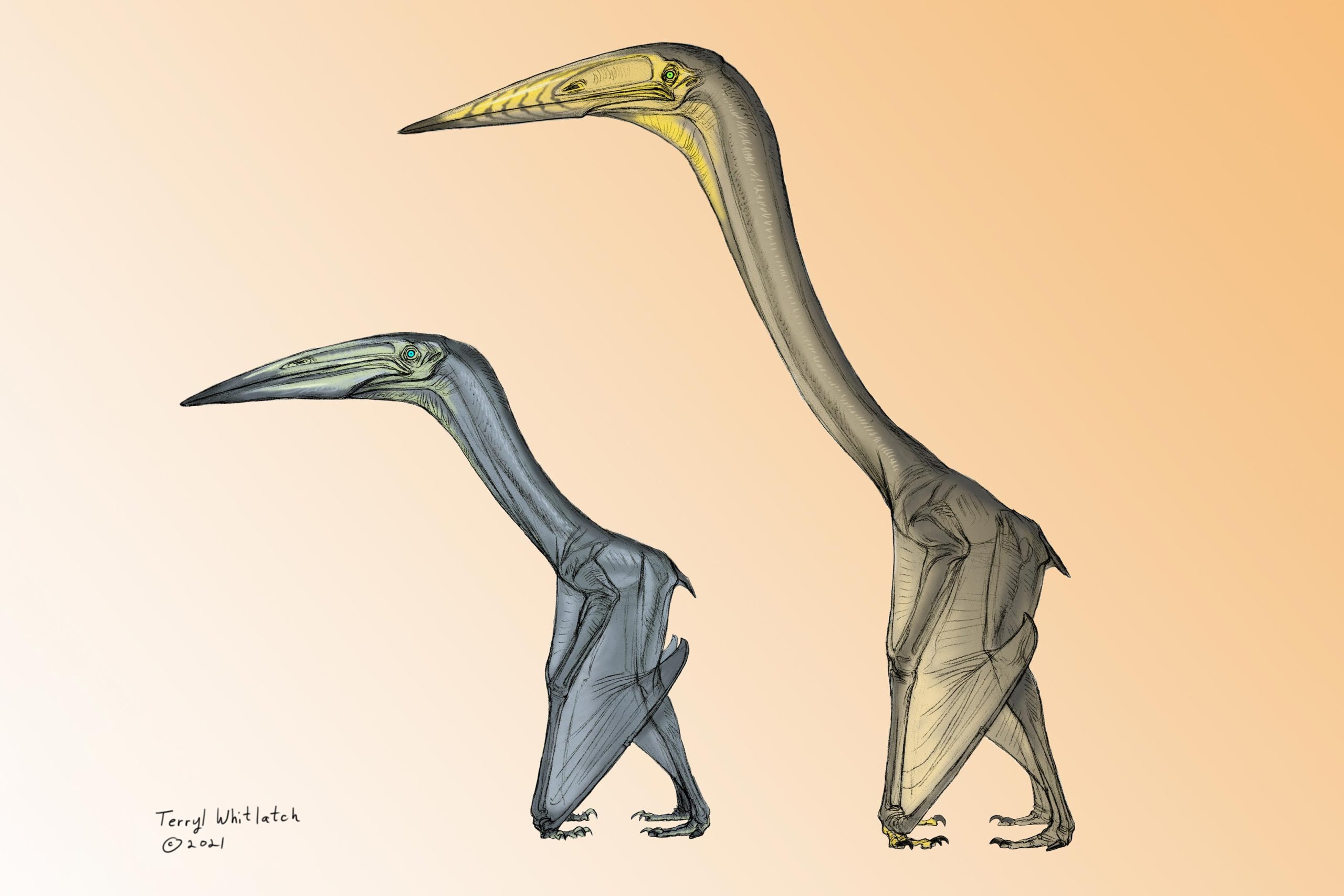
Newly collected specimens of the already-known giant pterosaur, Arambourgiania philadelphiae, confirm its 10-meter wingspan and provide the first details of its bone structure. CT images revealed that the interior of its humerus, which is hollow, contains a series of ridges that spiral up and down the bone.
This resembles structures in the interior of the wing bones of vultures. The spiral ridges are hypothesized to resist the torsional loadings associated with soaring (a sustained powered flight that requires launch and maintenance flapping).
The other specimen analyzed was the new-to-science Inabtanin alarabia, which had a five-meter wingspan. The team named it after the place where it was excavated – near a large grape-colored hill, called Tal Inab. The generic name combines the Arabic words “inab,” for grape, and “tanin” for dragon. ‘Alarabia’ refers to the Arabian Peninsula.

Inabtanin is one of the most complete pterosaurs ever recovered from Afro-Arabia, and the CT scans revealed the structure of its flight bones was completely different from that of Arambourgiania.
The interior of the flight bones was crisscrossed by an arrangement with struts that matched those found in the wing bones of modern flapping birds.
This indicates it was adapted to resist bending loads associated with flapping flight, and so it is likely that Inabtanin flew this way – although this does not preclude occasional use of other flight styles too.
“The struts found in Inabtanin were cool to see, though not unusual,” says Dr. Rosenbach.
“The ridges in Arambourgiania were completely unexpected, we weren’t sure what we were seeing at first!
“Being able to see the full 3D model of Arambourgiania’s humerus lined with helical ridges was just so exciting.”
Implications of Flight Style Diversity
The discovery of diverse flight styles in differently-sized pterosaurs is “exciting”, the experts state, because it opens a window into how these animals lived. It also poses interesting questions, like to what extent flight style is correlated with body size and which flight style is more common among pterosaurs.
“There is such limited information on the internal bone structure of pterosaurs across time, it is difficult to say with certainty which flight style came first,” Dr. Rosenbach adds.
“If we look to other flying vertebrate groups, birds and bats, we can see that flapping is by far the most common flight behavior.
“Even birds that soar or glide require some flapping to get in the air and maintain flight.
“This leads me to believe that flapping flight is the default condition, and that the behavior of soaring would perhaps evolve later if it were advantageous for the pterosaur population in a specific environment; in this case the open ocean.”

Co-author Professor Jeff Wilson Mantilla, Curator at Michigan’s Museum of Paleontology, and Dr. Iyad Zalmout, from the Saudi Geological Survey, found these specimens in 2007 at sites in the north and south of Jordan.
Professor Jeff Wilson Mantilla says the “variations likely reflect responses to mechanical forces applied on the pterosaurs’ wings during flight.”
Future Directions in Flight Research
Concluding, Dr. Rosenbach states: “Pterosaurs were the earliest and largest vertebrates to evolve powered flight, but they are the only major volant group that has gone extinct.
“Attempts to date to understand their flight mechanics have relied on aerodynamic principles and analogy with extant birds and bats.
“This study provides a framework for further investigation of the correlation between internal bone structure and flight capacity and behavior, and will hopefully lead to broader sampling of flight bone structure in pterosaur specimens.”
Reference: “New pterosaur remains from the Late Cretaceous of Afro-Arabia provide insight into flight capacity of large pterosaurs” by Kierstin L. Rosenbach, Danielle M. Goodvin, Mohammed G. Albshysh, Hassan A. Azzam, Ahmad A. Smadi, Hakam A. Mustafa, Iyad S. A. Zalmout and Jeffrey A. Wilson Mantilla, 5 September 2024, Journal of Vertebrate Paleontology.
DOI: 10.1080/02724634.2024.2385068
Never miss a breakthrough: Join the SciTechDaily newsletter.
Follow us on Google and Google News.
5 Comments
After Death some people are Burnt with Fire or Cremated. After Death people should be Buried underground or in Volt. Not Burnt with Fire. I have no idea why some people choose that way for there last action on Earth. Each individuals body do not 100 percent belongs to you. I know Every body have rights to do whatever He or She want with his or her body while you are alive not when you Die. After Death your body belongs to your Creator. And his going to be mad at you for not respect your body. Which may leads you to Hell or leads to some form of Punishment. I know you don’t want to do that. Have respect for your body goes along way in Hell and in Heaven. Maybe you live for 100 years if you are fortunate or and lucky. You should know that you are going to spend more than that in Hell or in Heaven. Take care of your body when you alive and after Death. There’s small small crime that leads people to Hell. If You burn or Cremated your body after Death is like telling your God you don’t care and you should be. Thanks. To be continued. M. Luke.
Hi there, what’s the difference between a person who is blown to bits in war, eaten by sharks and digested out into the wide blue sea, someone burnt to ashes in a fire or a nuclear bomb, etc., and someone who is cremated? God is not limited in His ability to give every believer a brand new glorified body( In which we will live forever on earth with God and all our brothers and sisters in Christ on a brand new Earth with a brand new heaven amongst us!!)a body that can never grow old, get sick or die again– regardless of the shape their mortal bodies were in upon their death. Nowhere in the bible is there scriptures to support the idea that God has rules regarding what is done to our dead bodies. Our bodies all return to a pile of dusty bony bits after enough time has passed. So don’t worry, my friend, about this matter. From a practical point of view cremation is cheap and the best solution for many people who have no way to pay for a funeral home to prepare a body for a casket–and think of the land mass needed for billions, over the centuries, to be placed in the ground in a whole body state in that way.
And because God is infinitely merciful, there will be a SECOND death( Look it up in scripture) in which the enemy and all his demonic spirits and all those who have followed him –rejecting Jesus as savior, and death itself, will all be placed into the lake of fire in which they will cease to exist-they will be as if they never were. So no one will suffer forever in a hell of fire and torture. That is not even supported by scripture IF you interpret scripture righteously– that idea was concocted wrongfully by misled interpreters of the scripture and taught as the truth for many many years.
So be at peace my friend and brother in Christ and know that God is only good and only has good will towards us.
Why they keep pushing flying crocodilian. when they first found pterosaur clearly was very aquatic flightless animal look at it nose /whaley/ it has giant skull the snout this dinosaur could not fly these Webb toe are for swimming the wing like crocodile is for swimming .the nose is more Whaley than modern crocodilian .thylacine is not a wolf it is a early mammal .fossa is a cat
On these ridge on bone I saw gharial scar on the face it look like a zoo on YouTube 2 of them I thought that wa strange because I never seen that on any modern crocodilian .gharial like all modern crocodilian is eusuchian mesoeucrocodylia they have hollow bone beyond the skull it’s a feature of eusuchian .on gharial wing not much data only that same skin as bird wing and other animal the same skin .but the scar was on the face very big clearly see it
I was looking at diaphyseal ridge couple of day ago .on YouTube animals tv they cliam it is slender snout crocodile actrul it is the gharial so the gharial has diaphyseal ridge like pterosaur Arambourgiania these ridge look the same they are flightless .the gator type mesoeucrocodylia Eustreptospondylus has pneumatic vertebrae it can not fly like rest of the dinosaur they are no flying dinosaur if they going to fly it will be in mesoeucrocodylia the most advance dinosaur .no mesoeucrocodylia can fly they are no record of it .so pterosaur has strut like flying bird arambourgiaia does not why are they not the same because none of them can fly