

A sulfur-containing compound may shield one of the body’s most important muscle repair signals from the chemical damage that drives age-related decline.
Aging muscles may not lose the signals needed for repair. Instead, those signals may remain in place but become chemically damaged and unable to do their jobs. Researchers have now identified a sulfur-containing compound that appears to protect one crucial repair protein while also making it bind more strongly to muscle stem cells.
The discovery could eventually inform new approaches to muscle loss caused by aging, inactivity, or extended bed rest. For now, however, the findings are preliminary and come primarily from laboratory experiments and a mouse model, not human clinical trials.
Skeletal muscle is particularly vulnerable to aging. It can gradually lose strength and flexibility as scar tissue and fat accumulate between its fibers. Fast-twitch fibers, which generate the explosive force needed to rise quickly, catch a fall, or climb stairs, are often affected most severely.
The Repair Signal Aging Muscles Lose
A team led by Professor Ryuichi Tatsumi at Kyushu University’s Faculty of Agriculture investigated a possible molecular cause of this decline. Their study, published July 24, 2026, in Scientific Reports, focused on hepatocyte growth factor, or HGF.
Despite its name, HGF is not limited to the liver. In skeletal muscle, it helps launch the earliest stage of repair by activating satellite cells, the resident stem cells positioned alongside muscle fibers.
HGF is normally stored within the extracellular matrix, the supportive material surrounding those fibers. Exercise, injury, or other mechanical stimulation releases it. The protein then connects with c-met receptors on dormant satellite cells, prompting them to awaken, multiply, mature, and help repair or enlarge muscle fibers.
How Nitration Disables Muscle Repair
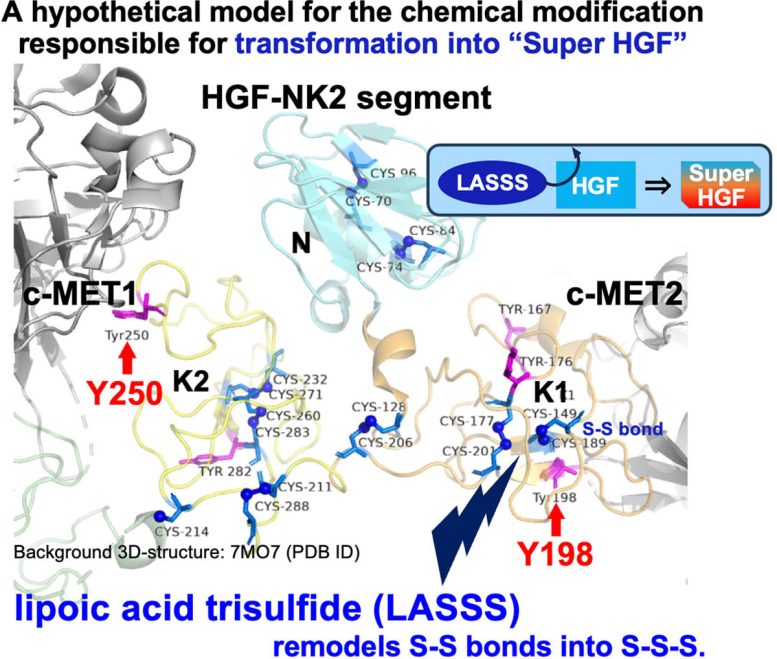
This system becomes less reliable with age. Tatsumi’s team previously found that HGF can undergo nitration, a chemical modification driven by reactive molecules in the body. During this process, nitro groups are added to two locations on the protein, Y198 and Y250.
Those sites are especially important because they form part of the region that HGF uses to bind c-met. Nitration can alter that region enough to weaken or prevent the connection. The protein may still be present, but it can no longer deliver its repair signal effectively.
The damage appears to accumulate particularly in fast-twitch muscle fibers, potentially helping explain why these powerful fibers are preferentially lost during aging. HGF also helps restrain cells involved in fibrosis and fat accumulation, so disabling the protein could contribute to several features of aging muscle at once.
Searching for a Molecular Shield
“HGF is not necessarily missing as we age,” Tatsumi explains. “Rather, it can be chemically altered after it is made. That led us to wonder whether a compound with strong antioxidant capacity might protect HGF, either by preventing nitration or by compensating for the functional loss it causes.”
The researchers tested two sulfur-based antioxidants: glutathione trisulfide (GSSSG) and lipoic acid trisulfide (LASSS). Both belong to a family of compounds called trisulfides, which contain three consecutively connected sulfur atoms. Their unusual chemistry allows them to participate in redox reactions, making them of growing interest in pharmaceutical research.
Initial experiments produced a partial success. Both compounds suppressed nitration at Y198 and Y250, but neither fully restored HGF’s ability to bind c-met. The team then increased the molar ratio of HGF to trisulfide from 1:4000 to 1:8000.

LASSS Creates a Stronger Repair Signal
At the higher ratio, LASSS did something unexpected. HGF exposed to the compound bound to c-met with more than twice the affinity of untreated HGF. It also became more resistant to the loss of function caused by nitration, particularly at Y198. GSSSG did not produce the same enhancement.
“This exceeded our expectations,” comments Tatsumi. “We knew trisulfides had diverse biological functions, but we never expected that simply mixing HGF with LASSS would produce such a striking effect.
“What this tells us is that LASSS does more than simply neutralize reactive molecules. It may interact directly with HGF and induce a subtle structural change, creating an enhanced ‘Super HGF’ form that binds c-met more strongly and resists nitration.”
Protection Beyond Antioxidant Activity
The finding suggests that LASSS may work through more than its antioxidant activity. According to the researchers, it appears to interact directly with HGF and alter the protein’s local structure without disrupting its ability to activate satellite cells or support their growth and development.
The team next examined whether the protective effect would appear in living muscle. They used mice subjected to tail suspension, an established model of muscle atrophy caused by unloading and inactivity.
A New Strategy Against Muscle Decline
Mice pretreated with LASSS developed significantly less HGF nitration than untreated animals. GSSSG again failed to provide the same protection, supporting the idea that the effect depends on the specific interaction between LASSS and HGF rather than antioxidant strength alone.
The research points toward a different way of addressing muscle decline. Instead of replacing a missing growth factor, a future treatment might protect an existing repair signal from age-related damage and improve its ability to activate muscle stem cells.
Because comparable forms of HGF occur in humans and other mammals, the researchers believe the mechanism could eventually have applications for people as well as companion animals such as cats and dogs, helping preserve mobility, independence, and quality of life during aging or prolonged inactivity.
Reference: “Enhanced HGF with increased receptor affinity and nitration-dysfunction resistance through interaction with lipoic acid trisulfide” by Kahona Zushi, Miyumi Seki, Ryota Mizuochi, Kazuki Shitamitsu, Alaa Elgaabari, Sakiho Tanaka, Junri Miyamoto, Kaoru Mizoguchi, Reina Fujimaru, Jiaxi Han, Takashi Nakashima, Shoko Sawano, Wataru Mizunoya, Takahiro Maeno, Issei Yokoyama, Takahiro Suzuki, Judy E. Anderson and Ryuichi Tatsumi, 24 July 2026, Scientific Reports.
DOI: 10.1038/s41598-026-60835-w
Never miss a breakthrough: Join the SciTechDaily newsletter.
Follow us on Google and Google News.