
Close Menu
    Facebook X (Twitter) Instagram
    SciTechDaily
    • Biology
    • Chemistry
    • Earth
    • Health
    • Physics
    • Science
    • Space
    • Technology
    Facebook X (Twitter) Pinterest YouTube RSS
    SciTechDaily
    Home»Space»Swift Reveals Before and After Images of Supernova SN 2014J
    Space

    Swift Reveals Before and After Images of Supernova SN 2014J

    By Francis Reddy, NASA's Goddard Space Flight Center; NASAJanuary 27, 2014No Comments4 Mins Read
    Facebook Twitter Pinterest Telegram LinkedIn WhatsApp Email Reddit
    Share
    Facebook Twitter LinkedIn Pinterest Telegram Email Reddit
    Swifts UVOT Captured Images of a New Supernova
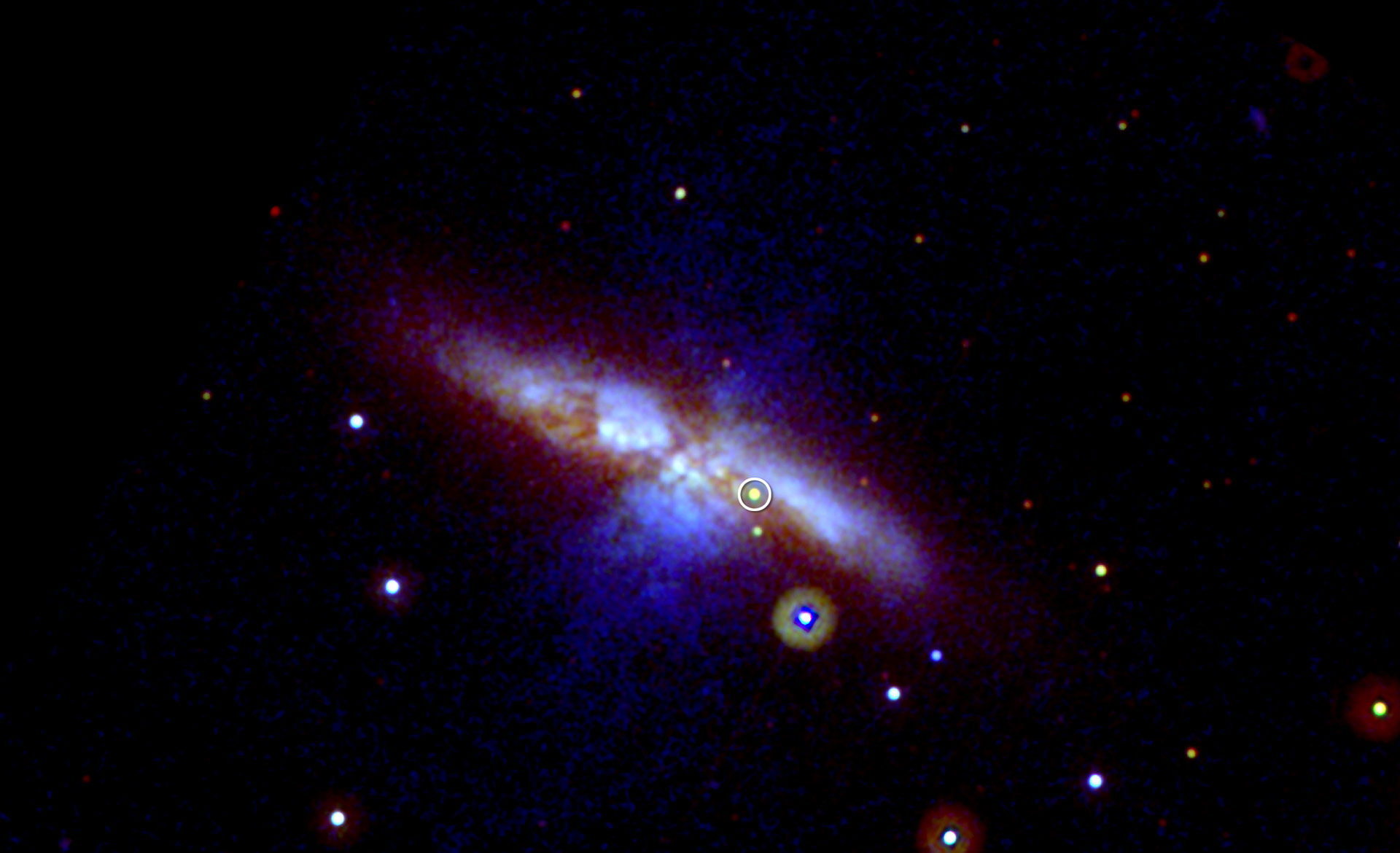
    Swift’s UVOT captured the new supernova (circled) in three exposures taken on January 22, 2014. Mid-ultraviolet light is shown in blue, near-UV light in green, and visible light in red. Thick dust in M82 scatters much of the highest-energy light, which is why the supernova appears yellowish here. The image is 17 arcminutes across, or slightly more than half the apparent diameter of a full moon. Credit: NASA/Swift/P. Brown, TAMU

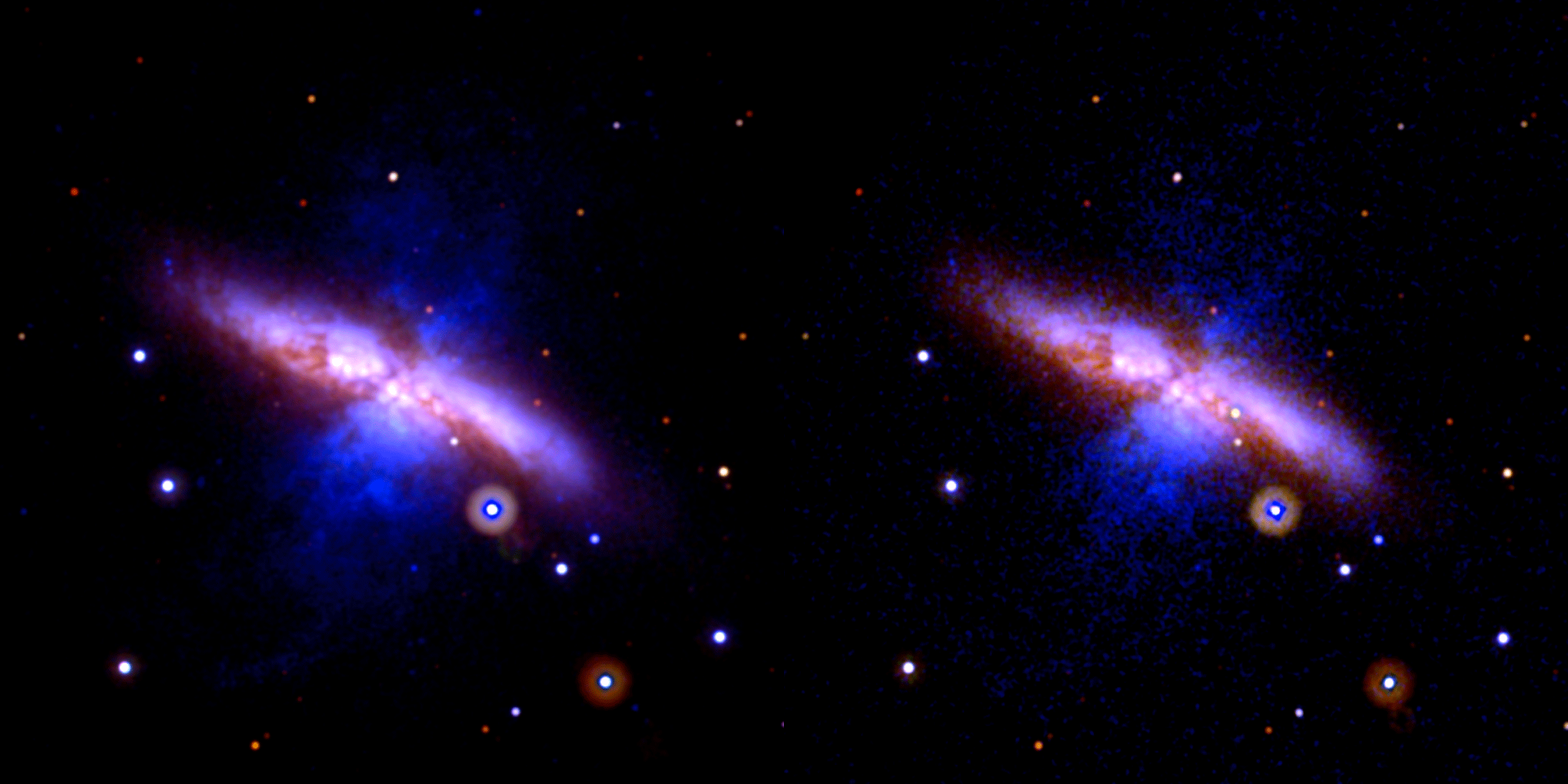
    Swift’s Ultraviolet/Optical Telescope shows before and after images of supernova SN 2014J, which occurred 12 million light-years away in galaxy M82.

    An exceptionally close stellar explosion discovered on January 21 has become the focus of observatories around and above the globe, including several NASA spacecraft. The blast, designated SN 2014J, occurred in the galaxy M82 and lies only about 12 million light-years away. This makes it the nearest optical supernova in two decades and potentially the closest type Ia supernova to occur during the life of currently operating space missions.

    To make the most of the event, astronomers have planned observations with the NASA/ESA Hubble Space Telescope and NASA’s Chandra X-ray Observatory, Nuclear Spectroscopic Telescope Array (NuSTAR), Fermi Gamma-ray Space Telescope, and Swift missions.

    As befits its moniker, Swift was the first to take a look. On January 22, just a day after the explosion was discovered, Swift’s Ultraviolet/Optical Telescope (UVOT) captured the supernova and its host galaxy.
    Swift UVOT Images Show M82 Before and After a New Supernova
    This animated GIF of Swift UVOT images shows M82 before and after the new supernova. The pre-explosion view combines data taken between 2007 and 2013. The view showing SN 2014J (arrow) merges three exposures taken on January 22, 2014. Mid-ultraviolet light is shown in blue, near-UV light in green, and visible light in red. Credit: NASA/Swift/P. Brown, TAMU

    Remarkably, SN 2014J can be seen on images taken up to a week before anyone noticed its presence. It was only when Steve Fossey and his students at the University of London Observatory imaged the galaxy during a brief workshop that the supernova came to light.

    “Finding and publicizing new supernova discoveries is often the weak link in obtaining rapid observations, but once we know about it, Swift frequently can observe a new object within hours,” said Neil Gehrels, the mission’s principal investigator at NASA’s Goddard Space Flight Center in Greenbelt, Maryland.

    Although the explosion is unusually close, the supernova’s light is attenuated by thick dust clouds in its galaxy, which may slightly reduce its apparent peak brightness.

    “Interstellar dust preferentially scatters blue light, which is why Swift’s UVOT sees SN 2014J brightly in visible and near-ultraviolet light but barely at all at mid-ultraviolet wavelengths,” said Peter Brown, an astrophysicist at Texas A&M University who leads a team using Swift to obtain ultraviolet observations of supernovae.

    However, this super-close supernova provides astronomers with an important opportunity to study how interstellar dust affects its light. As a class, type Ia supernovae explode with remarkably similar intrinsic brightness, a property that makes them useful “standard candles” — some say “standard bombs” — for exploring the distant universe.

    Brown notes that X-rays have never been conclusively observed from a type Ia supernova, so a detection by Swift’s X-ray Telescope, Chandra, or NuSTAR would be significant, as would a Fermi detection of high-energy gamma rays.

    A type Ia supernova represents the total destruction of a white dwarf star by one of two possible scenarios. In one, the white dwarf orbits a normal star, pulls a stream of matter from it, and gains mass until it reaches a critical threshold and explodes. In the other, the blast arises when two white dwarfs in a binary system eventually spiral inward and collide.

    Either way, the explosion produces a superheated shell of plasma that expands outward into space at tens of millions of miles an hour. Short-lived radioactive elements formed during the blast keep the shell hot as it expands. The interplay between the shell’s size, transparency, and radioactive heating determines when the supernova reaches peak brightness. Astronomers expect SN 2014J to continue brightening into the first week of February, by which time it may be visible in binoculars.

    M82, also known as the Cigar Galaxy, is located in the constellation Ursa Major and is a popular target for small telescopes. M82 is undergoing a powerful episode of star formation that makes it many times brighter than our own Milky Way galaxy and accounts for its unusual and photogenic appearance.

    Never miss a breakthrough: Join the SciTechDaily newsletter.
    Follow us on Google and Google News.

    Astronomy Astrophysics Chandra X-ray Observatory Fermi Gamma-ray Space Telescope NASA NASA Swift Satellite Popular Supernova
    Share. Facebook Twitter Pinterest LinkedIn Email Reddit

    Related Articles

    Defying Expectations: NASA’s Fermi Sees No Gamma Rays From Nearby Supernova

    Breaking the Cosmic Code: NASA Telescopes Start the Year With a Double Bang

    SN 1006 Unveiled: Chandra and IXPE’s New Insights Into a Millennium-Old Supernova

    Rocketing to the Stars: NASA’s INFUSE Probes Sizzling Supernova Secrets

    Cosmic Collision: Life-Essential Elements Forged in Massive Space Explosion

    Strange Long-Lasting Pulse of High-Energy Radiation Swept Over Earth

    Astronomers Capture Cosmic Hand Hitting a Wall – Watch Blast Wave Moving at 9 Million MPH

    How Do the Most Massive Stars Explode? Bubbles With Titanium Trigger Titanic Explosions

    Star Dies in a Spectacular Supernova – Here’s the Clumpy and Lumpy Debris [Video]

    Leave A Reply Cancel Reply

    • Facebook
    • Twitter
    • Pinterest
    • YouTube

    Don't Miss a Discovery

    Subscribe for the Latest in Science & Tech!

    Trending News

    The Universe Is Expanding Too Fast and Scientists Can’t Explain Why

    “Like Liquid Metal”: Scientists Create Strange Shape-Shifting Material

    Early Warning Signals of Esophageal Cancer May Be Hiding in Plain Sight

    Common Blood Pressure Drug Shows Surprising Power Against Deadly Antibiotic-Resistant Superbug

    Scientists Uncover Dangerous Connection Between Serotonin and Heart Valve Disease

    Scientists Discover a “Protector” Protein That Could Help Reverse Hair Loss

    Bone-Strengthening Discovery Could Reverse Osteoporosis

    Scientists Uncover Hidden Trigger Behind Stem Cell Aging

    Follow SciTechDaily
    • Facebook
    • Twitter
    • YouTube
    • Pinterest
    • Newsletter
    • RSS
    SciTech News
    • Biology News
    • Chemistry News
    • Earth News
    • Health News
    • Physics News
    • Science News
    • Space News
    • Technology News
    Recent Posts
    • A Common Diabetes Drug May Hold the Key to Stopping HIV From Coming Back
    • Ancient “Syphilis-Like” Disease in Vietnam Challenges Key Scientific Assumptions
    • Drinking Alcohol To Cope in Your 20s Could Damage Your Brain for Life
    • Scientists Crack Alfalfa’s Chromosome Mystery After Decades of Debate
    • Ancient Ant-Plant Alliance Collapses As Predatory Wasps Move In
    Copyright © 1998 - 2026 SciTechDaily. All Rights Reserved.
    • Science News
    • About
    • Contact
    • Editorial Board
    • Privacy Policy
    • Terms of Use

    Type above and press Enter to search. Press Esc to cancel.