
Scientists observed rare chemical elements in the gamma-ray burst GRB 230307A, resulting from a neutron star merger. This discovery challenges current understandings of gamma-ray bursts and offers insights into the universe’s elemental composition.
Astronomers have observed the creation of rare chemical elements in the second-brightest gamma-ray burst ever seen – casting new light on how heavy elements are made.
Researchers examined the exceptionally bright gamma-ray burst GRB 230307A, which was caused by a neutron star merger. The explosion was observed using an array of ground and space-based telescopes, including NASA’s James Webb Space Telescope, Fermi Gamma-ray Space Telescope, and Neil Gehrels Swift Observatory.
Discovery and Implications
Publishing their findings on October 25 in Nature, the international research team which included experts from the University of Birmingham, revealed that they found the heavy chemical element tellurium, in the aftermath of the explosion.
Other elements such as iodine and thorium, which are needed to sustain life on earth, are also likely to be amongst the material ejected by the explosion, also known as a kilonova.
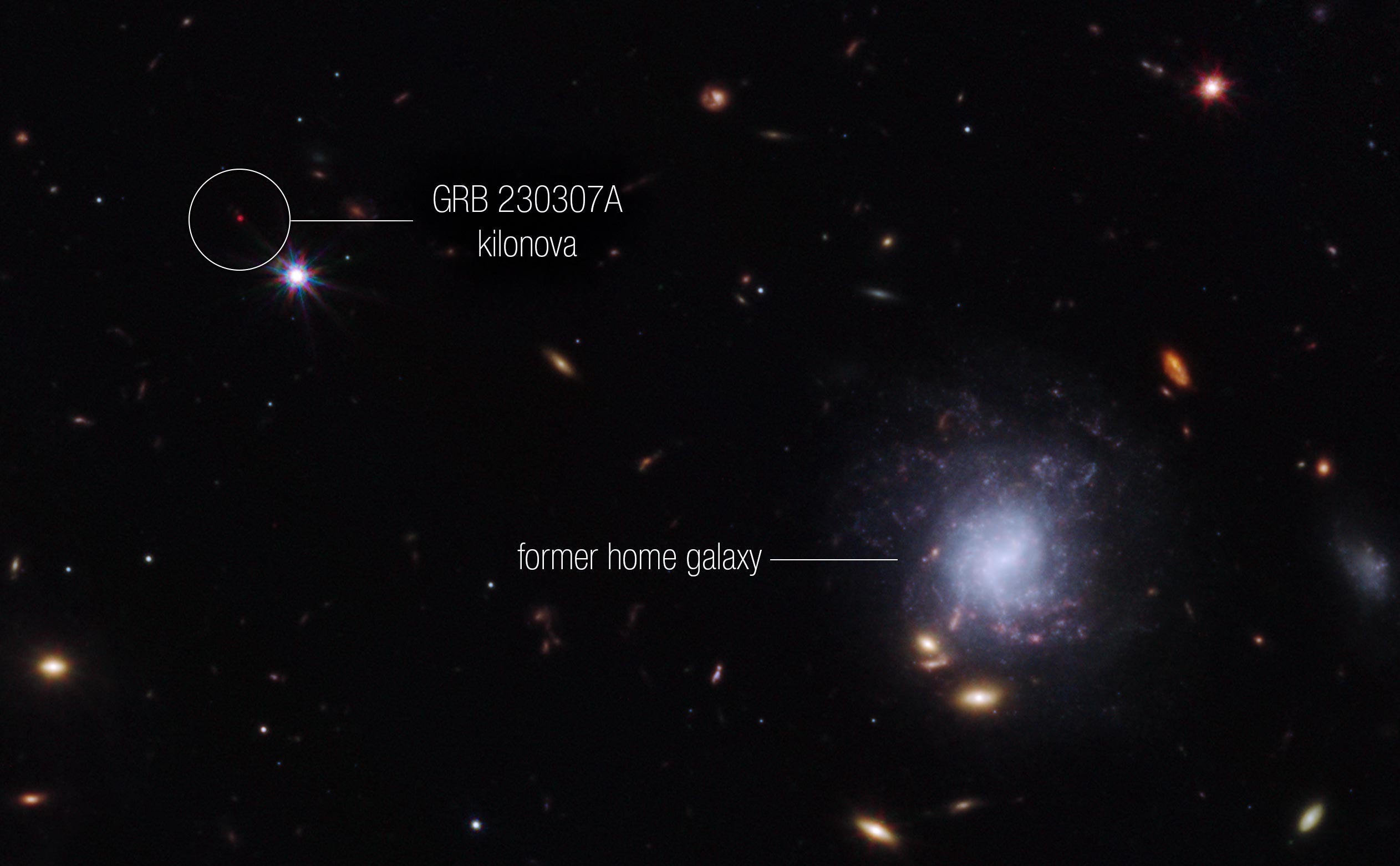
This image from Webb’s NIRCam (Near-Infrared Camera) instrument highlights GRB 230307A’s kilonova and its former home galaxy among their local environment of other galaxies and foreground stars. The neutron stars were kicked out of their home galaxy and traveled the distance of about 120,000 light-years, approximately the diameter of the Milky Way galaxy, before finally merging several hundred million years later.
Credit: NASA, ESA, CSA, STScI, Andrew Levan (IMAPP, Warw)
Dr. Ben Gompertz, Assistant Professor of Astronomy at the University of Birmingham, and co-author of the study explains: “Gamma-ray bursts come from powerful jets traveling at almost the speed of light – in this case driven by a collision between two neutron stars. These stars spent several billion years spiraling towards one another before colliding to produce the gamma-ray burst we observed in March this year. The merger site is the approximate length of the Milky Way (about 120,000 light-years) outside of their home galaxy, meaning they must have been launched out together.”
The Rarity of Kilonovae
Gompertz explained that “colliding neutron stars provide the conditions needed to synthesize very heavy elements, and the radioactive glow of these new elements powered the kilonova we detected as the blast faded. Kilonovae are extremely rare and very difficult to observe and study, which is why this discovery is so exciting.”
GRB 230307A was one of the brightest gamma-ray bursts ever observed — over a million times brighter than the entire Milky Way Galaxy combined. This is the second time individual heavy elements have been detected using spectroscopic observations after a neutron star merger, providing invaluable insight into how these vital building blocks needed for life are formed.
Lead author of the study Andrew Levan, Professor of Astrophysics at Radboud University in the Netherlands, said: “Just over 150 years since Dmitri Mendeleev wrote down the periodic table of elements, we are now finally in the position to start filling in those last blanks of understanding where everything was made, thanks to the James Webb Telescope.”
Understanding the Duration of Gamma-ray Bursts
GRB 230307A lasted for 200 seconds, meaning it is categorized as a long-duration gamma-ray burst. This is unusual as short gamma-ray bursts, which last less than two seconds, are more commonly caused by neutron star mergers. Long gamma-ray bursts like this one are usually caused by the explosive death of a massive star.
Future Research Directions
The researchers are now seeking to learn more about how these neutron star mergers work and how they power these huge element-generating explosions.
Dr. Samantha Oates, a co-author of the study while a postdoctoral research fellow at the University of Birmingham (now a lecturer at Lancaster University) said: “Just a few short years ago discoveries like this one would not have been possible, but thanks to the James Webb Space Telescope we can observe these mergers in exquisite detail.”
Dr. Gompertz concludes: “Until recently, we didn’t think mergers could power gamma-ray bursts for more than two seconds. Our next job is to find more of these long-lived mergers and develop a better understanding of what drives them – and whether even heavier elements are being created. This discovery has opened the door to a transformative understanding of our universe and how it works.”
Reference: “Heavy element production in a compact object merger observed by JWST” by Andrew Levan, Benjamin P. Gompertz, Om Sharan Salafia, Mattia Bulla, Eric Burns, Kenta Hotokezaka, Luca Izzo, Gavin P. Lamb, Daniele B. Malesani, Samantha R. Oates, Maria Edvige Ravasio, Alicia Rouco Escorial, Benjamin Schneider, Nikhil Sarin, Steve Schulze, Nial R. Tanvir, Kendall Ackley, Gemma Anderson, Gabriel B. Brammer, Lise Christensen, Vikram S. Dhillon, Phil A. Evans, Michael Fausnaugh, Wen-fai Fong, Andrew S. Fruchter, Chris Fryer, Johan P. U. Fynbo, Nicola Gaspari, Kasper E. Heintz, Jens Hjorth, Jamie A. Kennea, Mark R. Kennedy, Tanmoy Laskar, Giorgos Leloudas, Ilya Mandel, Antonio Martin-Carrillo, Brian D. Metzger, Matt Nicholl, Anya Nugent, Jesse T. Palmerio, Giovanna Pugliese, Jillian Rastinejad, Lauren Rhodes, Andrea Rossi, Andrea Saccardi, Stephen J. Smartt, Heloise F. Stevance, Aaron Tohuvavohu, Alexander van der Horst, Susanna D. Vergani, Darach Watson, Thomas Barclay, Kornpob Bhirombhakdi, Elmé Breedt, Alice A. Breeveld, Alexander J. Brown, Sergio Campana, Ashley A. Chrimes, Paolo D’Avanzo, Valerio D’Elia, Massimiliano De Pasquale, Martin J. Dyer, Duncan K. Galloway, James A. Garbutt, Matthew J. Green, Dieter H. Hartmann, Páll Jakobsson, Paul Kerry, Chryssa Kouveliotou, Danial Langeroodi, Emeric Le Floc’h, James K. Leung, Stuart P. Littlefair, James Munday, Paul O’Brien, Steven G. Parsons, Ingrid Pelisoli, David I. Sahman, Ruben Salvaterra, Boris Sbarufatti, Danny Steeghs, Gianpiero Tagliaferri, Christina C. Thöne, Antonio de Ugarte Postigo and David Alexander Kann, 25 October 2023, Nature.
DOI: 10.1038/s41586-023-06759-1
Never miss a breakthrough: Join the SciTechDaily newsletter.
Follow us on Google and Google News.