
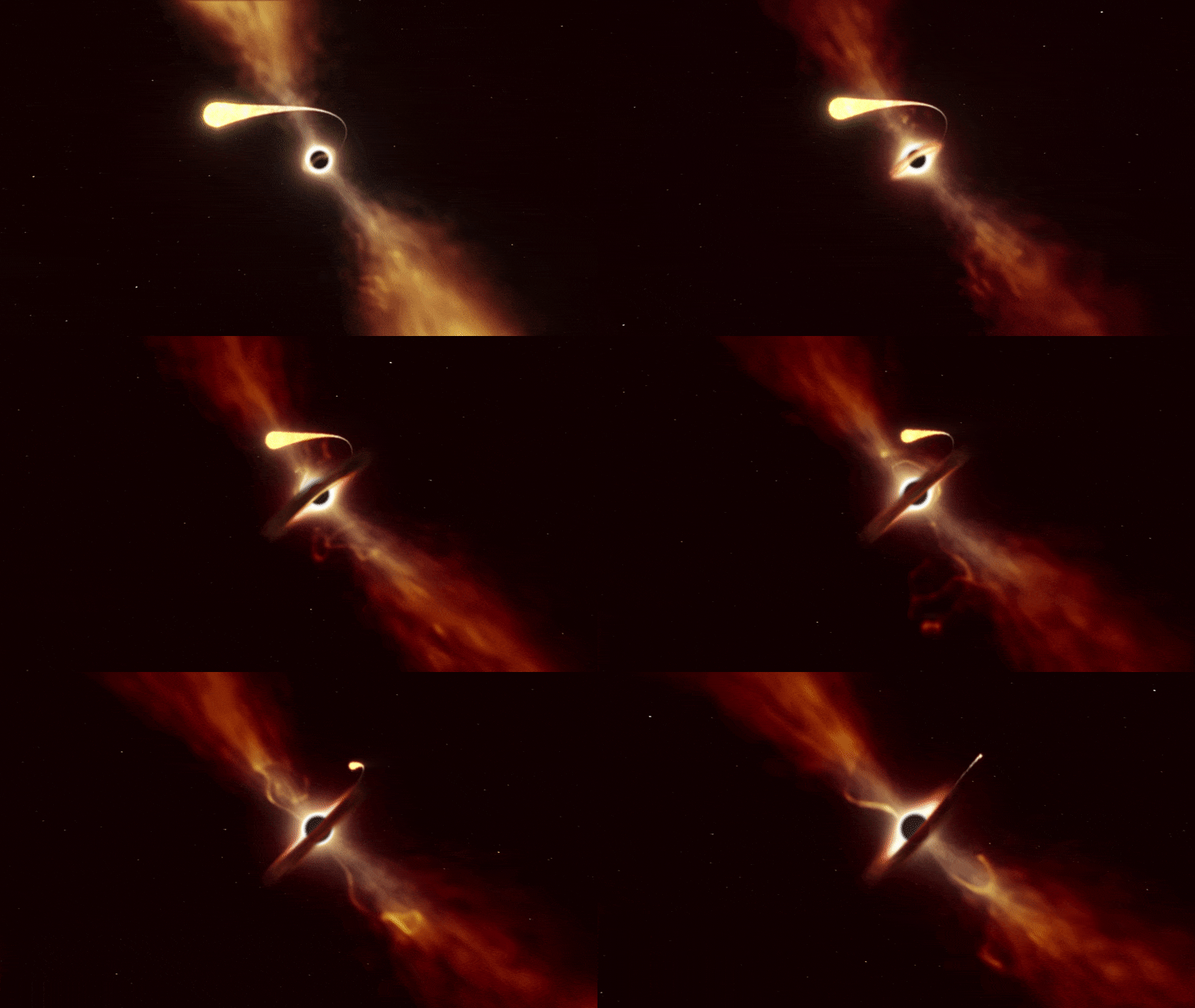
The event was spotted in infrared data — also a first — suggesting further searches in this band could turn up more such bursts.
MIT astronomers have discovered a new tidal disruption event in infrared, providing insights into how supermassive black holes rip apart passing stars. This newly found TDE, labeled WTP14adbjsh, is the closest one observed to date, located in the NGC 7392 galaxy about 137 million light-years from Earth. The discovery highlights that traditional X-ray and optical surveys may miss TDEs in star-forming galaxies due to the presence of dust that obscures the light. By searching in the infrared band, scientists can reveal more previously hidden TDEs in active, star-forming galaxies, offering a more complete picture of black holes and their host galaxies.
Once every 10,000 years or so, the center of a galaxy lights up as its supermassive black hole rips apart a passing star. This “tidal disruption event” happens in a literal flash, as the central black hole pulls in stellar material and blasts out huge amounts of radiation in the process.
Astronomers know of around 100 tidal disruption events (TDE) in distant galaxies, based on the burst of light that arrives at telescopes on Earth and in space. Most of this light comes from X-rays and optical radiation.
MIT astronomers, tuning past the conventional X-ray and UV/optical bands, have discovered a new tidal disruption event, shining brightly in infrared. It is one of the first times scientists have directly identified a TDE at infrared wavelengths.
What’s more, the new outburst happens to be the closest tidal disruption event observed to date: The flare was found in NGC 7392, a galaxy that is about 137 million light-years from Earth, which corresponds to a region in our cosmic backyard that is one-fourth the size of the next-closest TDE.
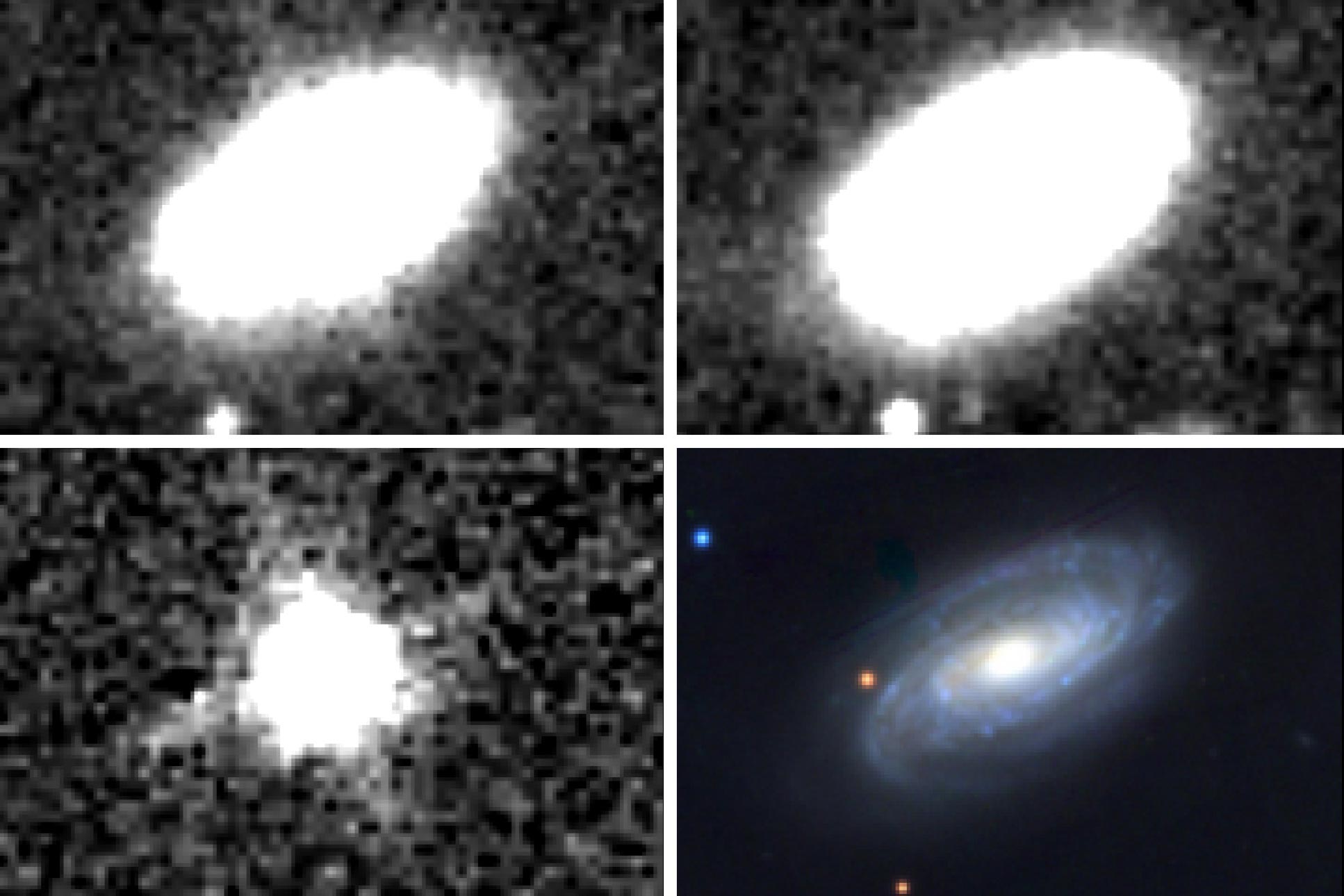
This new flare, labeled WTP14adbjsh, did not stand out in standard X-ray and optical data. The scientists suspect that these traditional surveys missed the nearby TDE, not because it did not emit X-rays and UV light, but because that light was obscured by an enormous amount of dust that absorbed the radiation and gave off heat in the form of infrared energy.
The researchers determined that WTP14adbjsh occurred in a young, star-forming galaxy, in contrast to the majority of TDEs that have been found in quieter galaxies. Scientists expected that star-forming galaxies should host TDEs, as the stars they churn out would provide plenty of fuel for a galaxy’s central black hole to devour. But observations of TDEs in star-forming galaxies were rare until now.
The new study suggests that conventional X-ray and optical surveys may have missed TDEs in star-forming galaxies because these galaxies naturally produce more dust that could obscure any light coming from their core. Searching in the infrared band could reveal many more, previously hidden TDEs in active, star-forming galaxies.
“Finding this nearby TDE means that, statistically, there must be a large population of these events that traditional methods were blind to,” says Christos Panagiotou, a postdoc in MIT’s Kavli Institute for Astrophysics and Space Research. “So, we should try to find these in infrared if we want a complete picture of black holes and their host galaxies.”
A paper detailing the team’s discovery was published on April 28 in Astrophysical Journal Letters. Panagiotou’s MIT co-authors are Kishalay De, Megan Masterson, Erin Kara, Michael Calzadilla, Anna-Christina Eilers, Danielle Frostig, Nathan Lourie, and Rob Simcoe, along with Viraj Karambelkar, Mansi Kasliwal, Robert Stein, and Jeffrey Zolkower of Caltech, and Aaron Meisner at the National Science Foundation’s National Optical-Infrared Astronomy Research Laboratory.
A Flash of Possibility
Panagiotou did not intend to search for tidal disruption events. He and his colleagues were looking for signs of general transient sources in observational data, using a search tool developed by De. The team used De’s method to look for potential transient events in archival data taken by NASA’s NEOWISE mission, a space telescope that has made regular scans of the entire sky since 2010, at infrared wavelengths.
The team discovered a bright flash that appeared in the sky near the end of 2014.
“We could see there was nothing at first,” Panagiotou recalls. “Then suddenly, in late 2014, the source got brighter and by 2015 reached a high luminosity, then started going back to its previous quiescence.”
They traced the flash to a galaxy 42 megarparsecs from Earth. The question then was, what set it off? To answer this, the team considered the brightness and timing of the flash, comparing the actual observations with models of various astrophysical processes that could produce a similar flash.
“For instance, supernovae are sources that explode and brighten suddenly, then come back down, on similar timescales to tidal disruption events,” Panagiotou notes. “But supernovae are not as luminous and energetic as what we observed.”
Working through different possibilities of what the burst could be, the scientists were finally able to exclude all but one: The flash was most likely a TDE, and the closest one observed so far.
“It’s a very clean light curve and really follows what we expect the temporal evolution of a TDE should be,” Panagiotou says.
Red or Green
From there, the researchers took a closer look at the galaxy where the TDE arose. They gathered data from multiple ground- and space-based telescopes which happened to observe the part of the sky where the galaxy resides, across various wavelengths, including infrared, optical, and X-ray bands. With this accumulated data, the team estimated that the supermassive black hole at the center of the galaxy was about 30 million times as massive as the sun.
“This is almost 10 times larger than the black hole we have at our galactic center, so it’s quite massive, though black holes can get up to 10 billion solar masses,” Panagiotou says.
The team also found that the galaxy itself is actively producing new stars. Star-forming galaxies are a class of “blue” galaxies, in contrast to quieter “red” galaxies that have stopped producing new stars. Star-forming blue galaxies are the most common type of galaxy in the universe.
“Green” galaxies lie somewhere between red and blue, in that, every so often they produce a few stars. Green is the least common galaxy type, but curiously, most TDEs detected to date have been traced to these rarer galaxies. Scientists had struggled to explain these detections, since theory predicts that blue star-forming galaxies should exhibit TDEs, as they would present more stars for black holes to disrupt.
But star-forming galaxies also produce a lot of dust from the interactions between and among stars near a galaxy’s core. This dust is detectable at infrared wavelengths, but it can obscure any X-ray or UV radiation that would otherwise be picked up by optical telescopes. This could explain why astronomers have not detected TDEs in star-forming galaxies using conventional optical methods.
“The fact that optical and X-ray surveys missed this luminous TDE in our own backyard is very illuminating and demonstrates that these surveys are only giving us a partial census of the total population of TDEs,” says Suvi Gezari, associate astronomer and chair of the science staff at the Space Telescope Science Institute in Maryland, who was not involved in the study. “Using infrared surveys to catch the dust echo of obscured TDEs … has already shown us that there is a population of TDEs in dusty, star-forming galaxies that we have been missing.”
Reference: “A Luminous Dust-obscured Tidal Disruption Event Candidate in a Star-forming Galaxy at 42 Mpc” by Christos Panagiotou, Kishalay De, Megan Masterson, Erin Kara, Michael Calzadilla, Anna-Christina Eilers, Danielle Frostig, Viraj Karambelkar, Mansi Kasliwal, Nathan Lourie, Aaron M. Meisner, Robert A. Simcoe, Robert Stein and Jeffry Zolkower, 28 April 2023, Astrophysical Journal Letters.
DOI: 10.3847/2041-8213/acc02f
This research was supported, in part, by NASA.
Never miss a breakthrough: Join the SciTechDaily newsletter.
Follow us on Google and Google News.
2 Comments
Recycling at work! The endless transformation of matter –> energy –> matter –> repeat.
I love space. thank you too all the researchers.