
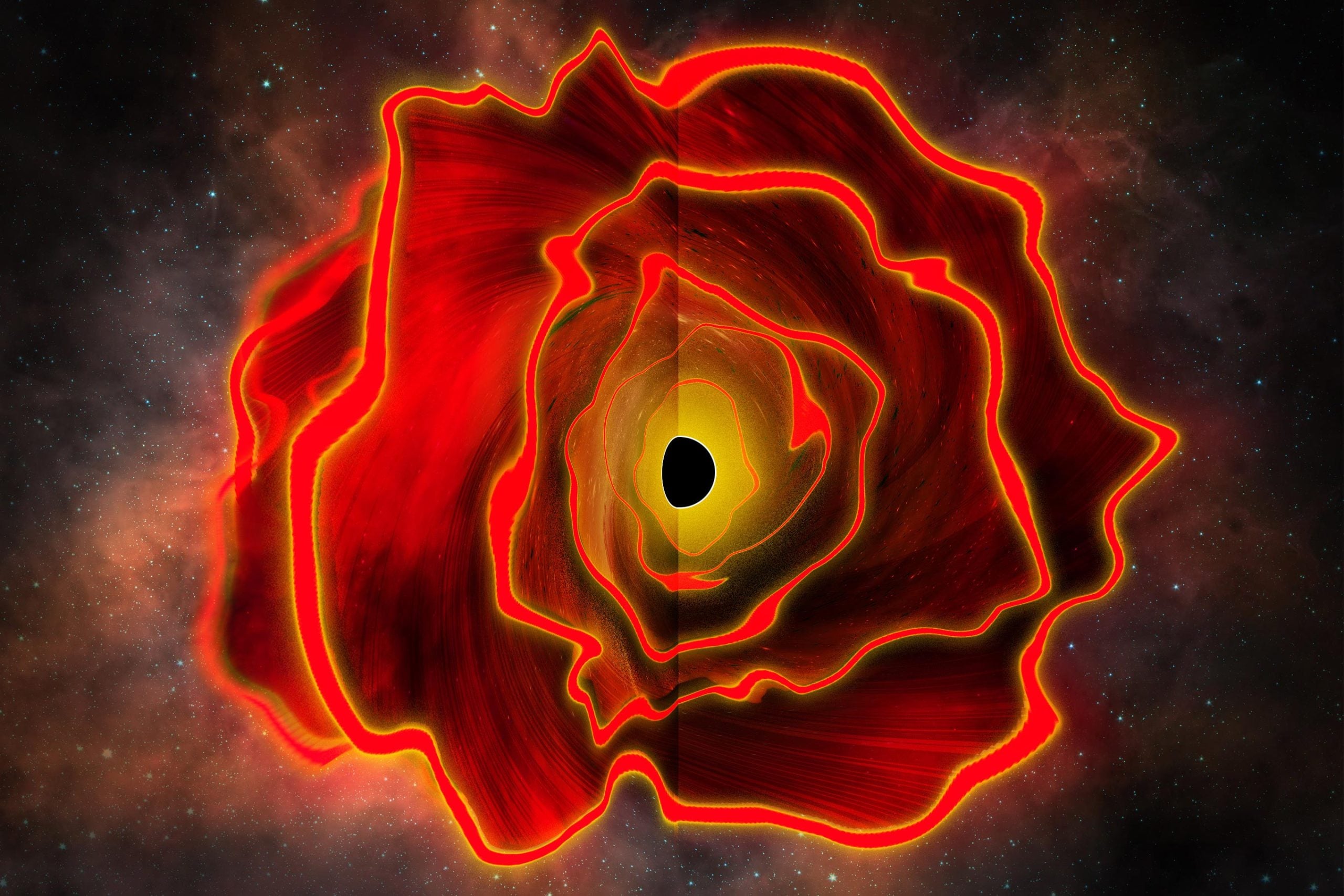
Something in the young universe is shining like a star that should not be possible.
NASA’s James Webb Space Telescope has detected a compact red object so luminous that ordinary nuclear fusion cannot plausibly explain it. Although the source has a star-like appearance and may be surrounded by gas on the scale of the solar system, it radiates roughly 100 billion times more energy than any known star could physically produce.
The leading explanation is far stranger: the glow may come from a rapidly feeding black hole buried inside an enormous, dense envelope of hydrogen.
A Black Hole Star in the Early Universe
Astronomers have dubbed this proposed type of object a “black hole star.” If the interpretation is correct, the discovery could reveal a previously unseen stage in the growth of massive black holes and help explain one of JWST’s most persistent mysteries, the abundance of compact objects known as “little red dots.”
The object, called MoM-BH*-1, was observed as it existed only a few hundred million years after the Big Bang. A study describing it was published in Nature.
“Our picture of this object is evolving very rapidly,” says lead author Rohan Naidu, a NASA Hubble Fellow and Pappalardo Fellow at MIT’s Kavli Institute for Astrophysics and Space Research (MKI). “We think there is a central black hole that is 100,000 times as massive as the sun. And around this black hole, there would be this very extended envelope of gas that looks like a star the size of the solar system. It’s huge.”
JWST’s Mysterious Little Red Dots
JWST was built in part to investigate the first galaxies and black holes, and it quickly began finding objects that challenged expectations about how rapidly structures formed after the Big Bang.
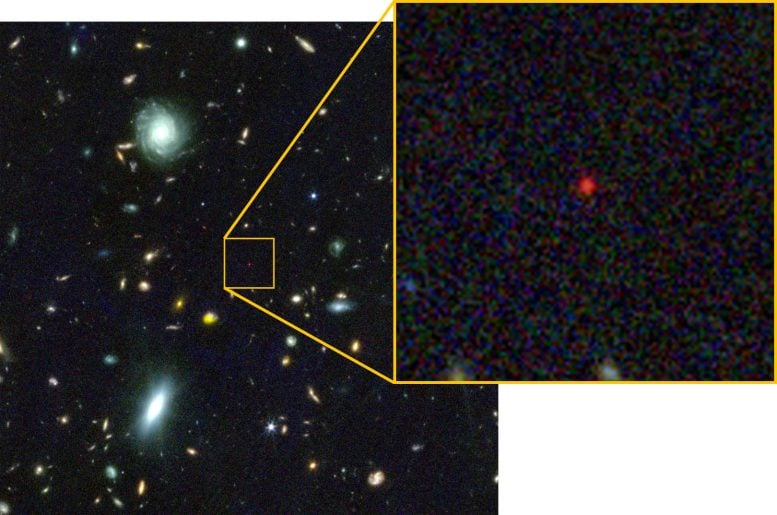
Among the biggest surprises have been “little red dots,” tiny and extremely compact sources that appear frequently in observations of the distant universe. Many show signs that could point to actively feeding black holes, yet some of their other properties look more like those of stars or galaxies.
“These little red dots seem to be everywhere in the early universe but essentially disappear by the present day,” Naidu says. “What exactly these objects are has been one of the most debated topics of the JWST era.”
MoM-BH*-1 may offer a particularly clear look at what is happening inside at least some of them. Unlike a typical little red dot, in which light from the surrounding galaxy can complicate the picture, this object appears to be dominated by the strange central source itself.
A “Mirage or Miracle” Discovery
Researchers were not specifically hunting for such an object. Naidu and his colleagues found it while searching for extremely distant galaxies through a JWST program they called “Mirage or Miracle” (MoM).
The name reflects a problem that emerged soon after JWST began studying the early universe. Some sources appeared so bright that they seemed to be unexpectedly massive galaxies that had formed remarkably quickly. But appearances can be deceptive.
“There’s been this puzzle of many bright galaxies showing up at extremely early times,” Naidu says. “What we found was that what looks like an extremely bright early galaxy, aka a ‘miracle,’ in some cases actually could be a ‘mirage.’”
MoM-BH*-1 was exceptionally red, bright at longer wavelengths, and nearly invisible at shorter ones. Spectroscopy later placed it at a redshift of about 7.76, deep in the era known as cosmic dawn.
Why MoM-BH*-1 Is So Red
Astronomers often have a straightforward explanation for unusually red objects: dust.
Tiny particles surrounding a star, galaxy, or black hole can absorb and scatter shorter wavelengths of light, making an object look redder than it really is.
“When we see something very red in the universe, we often assume that it is surrounded by dust, like soot or ash,” Simcoe explains. “The same way that the wildfire smoke from Canada recently made the sky in Boston look bright red, astronomical objects can also appear redder than their intrinsic color when you see them through a veil of dust.”
But MoM-BH*-1 did not behave like a conventional dust-obscured object.
An Extreme Balmer Break
Its spectrum contained an extraordinarily abrupt change known as a Balmer break. Below a particular wavelength, the amount of detected light plunged. The break was far stronger than astronomers would expect from a normal population of stars.
Vega, one of the brightest stars in Earth’s night sky, also shows a Balmer break because hydrogen in a stellar atmosphere absorbs particular photons. MoM-BH*-1 displays an extreme version of the same basic phenomenon.
“The break we observed in this object is the deepest break we have ever observed in any object, ruling out ‘ordinary’ stars as the source,” Naidu says. “But it made us wonder if we were seeing a new kind of ‘stellar atmosphere,’ but on a spectacular scale.”
Detailed observations strengthen that case. The published analysis found a Balmer break with a measured strength of about 7.7, well above what the researchers say can be produced by ordinary dust-free stellar populations.
Another clue came from its chemistry. The spectrum showed remarkably little evidence of elements heavier than hydrogen and helium.
“It was truly singular in so many ways,” Naidu says.
A Black Hole Wrapped in Hydrogen
The researchers tested different models to determine whether an unusual arrangement of gas could reproduce the observations.
“We started to ask: Could you make something that red using just hydrogen, without any dust?” Simcoe says. “To our surprise, it turns out you can, if you have an extremely dense screen of hydrogen, so dense that it looks more like the surface of an enormous star than a wispy interstellar nebula.”
Instead of a conventional star with fusion occurring in its core, imagine a black hole buried inside a vast, opaque atmosphere of gas. Matter falling toward the black hole releases tremendous amounts of energy. The surrounding hydrogen then absorbs, scatters, and reprocesses that radiation before it escapes into space.
From a great distance, the entire structure can take on some of the observational characteristics of a star, even though its central engine is completely different.
A Star-Like Cocoon Around a Black Hole
The detailed model presented in the Nature study places the black hole inside a dense gas envelope extending roughly 10 to 100 astronomical units. One representative model uses about 40 astronomical units of surrounding gas. For comparison, one astronomical unit is the average distance between Earth and the sun.
The result is effectively a false stellar surface. The gas plays a role resembling a star’s atmosphere, while accretion onto the black hole supplies the energy that fusion normally would.
Too Bright to Be a Normal Star
The object’s luminosity is what ultimately makes an ordinary star so difficult to accept.
“You have something that looks a bit like a star but is 100 billion times brighter,” Naidu says. “That means you can’t be powering this by nuclear fusion, which is the energy source that sits at the heart of all the stars we have.”
Black holes have no such problem.
A black hole itself does not emit light from inside its event horizon, but matter spiraling toward one can become extraordinarily hot and luminous. Active supermassive black holes power quasars, which rank among the brightest persistent objects in the universe.
Simulations Point to an Accreting Black Hole
The team therefore incorporated an accreting black hole into its models and surrounded it with dense hydrogen. The resulting simulated spectrum closely reproduced several of MoM-BH*-1’s most peculiar features, including its extreme Balmer break, weak ultraviolet emission, and unusual hydrogen lines.
Exactly how massive the black hole is remains model dependent. Naidu described a scenario involving a black hole roughly 100,000 times the sun’s mass, while the detailed Nature analysis explores estimates extending into the million-solar-mass range depending on assumptions about how the surrounding gas alters the observed radiation. The paper emphasizes that conventional methods for weighing distant active black holes may give misleading results under such extreme conditions.
If dense gas significantly changes the light escaping from early black holes, astronomers may need to reconsider mass estimates for other distant objects detected by JWST.
How Early Black Holes Grew So Fast
Astronomers have found supermassive black holes containing around a billion solar masses at times when the universe was less than a billion years old. Explaining how black holes became so enormous so quickly has been difficult because there appears to be relatively little cosmic time available for their growth.
One proposed solution is that young black holes sometimes experienced periods of unusually rapid feeding while buried in massive supplies of gas. Dense envelopes could trap and redistribute radiation, potentially allowing the black hole to keep consuming material under conditions very different from those seen in most nearby galaxies.
MoM-BH*-1 may offer a glimpse of such a phase. The Nature study notes that its properties resemble scenarios in which an early black hole is surrounded and nourished by dense gas, possibly during a burst of exceptionally rapid accretion. How these systems initially form remains unresolved.
There is even tentative evidence that MoM-BH*-1 may vary in brightness. Observations taken at different times suggest it brightened by roughly 30 percent, although the researchers caution that the measurements came from different observing configurations. If confirmed through future monitoring, variability would provide another clue that a compact, active black hole is driving the light.
A Possible Answer to the Little Red Dot Mystery
The researchers named it MoM-BH*-1, with the final designation intended to suggest “black hole star one.” They suspect it may be an especially exposed example of something much more common.
“Every little red dot is consistent with being a black hole star, embedded in a generic early galaxy,” Naidu says. “But what is special about MoM-BH*-1 is the black hole star is essentially completely outshining its surrounding host galaxy, such that we’re seeing pure black hole star light.”
Other research is beginning to support the possibility that these objects represent a broader population rather than a single cosmic oddity. A 2026 analysis of 98 little red dots found population-level evidence consistent with dense gas envelopes around central black holes, while a separate study identified hundreds of candidates whose light may be strongly dominated by similar black hole star components.
Reference: “A gas-enshrouded and gas-reddened black hole at cosmic dawn” by Rohan P. Naidu, Jorryt Matthee, Harley Katz, Anna de Graaff, Pascal A. Oesch, Aaron Smith, Jenny E. Greene, Gabriel Brammer, Andrea Weibel, Raphael Hviding, John Chisholm, Ivo Labbé, Robert A. Simcoe, Callum Witten, Wendy Q. Sun, Hakim Atek, Josephine F. W. Baggen, Sirio Belli, Rachel Bezanson, Leindert A. Boogaard, Sownak Bose, Rychard J. Bouwens, Alba Covelo-Paz, Pratika Dayal, Yoshinobu Fudamoto, Lukas J. Furtak, Emma Giovinazzo, Andy Goulding, Max Gronke, Kasper E. Heintz, Michaela Hirschmann, Garth Illingworth, Akio K. Inoue, Benjamin D. Johnson, Joel Leja, Ecaterina Leonova, Ian McConachie, Michael V. Maseda, Priyamvada Natarajan, Erica Nelson, David J. Setton, Irene Shivaei, David Sobral, Mauro Stefanon, Sandro Tacchella, Sune Toft, Alberto Torralba, Pieter van Dokkum, Arjen van der Wel, Marta Volonteri, Fabian Walter, Bingjie Wang, Darach Watson and Katherine Whitaker, 12 August 2026, Nature.
DOI: 10.1038/s41586-026-10846-4
This research was supported, in part, by the MIT Department of Physics, NASA, and the Space Telescope Science Institute.
Never miss a breakthrough: Join the SciTechDaily newsletter.
Follow us on Google and Google News.
5 Comments
more star-trek fantasy
Those little red dots were always there, but we couldn’t make them out because they’re so far in the infrared (=heat) and dimmed by our atmosphere. Now we can finally see what the very earliest universe was like. I wonder how this now story will filter down to children’s picture books!
utilizing the time space for the atom is the answer. use the atom by electron as the only movement to keep the atom uncomprizable…..neutron and electron stay stable. using the electron to stablize all noble gasses to make space time possible for any moisture possible. ulilizing one atom for any other to manipulizing space time or zize can be utililized through any atom or antimatter
We have found many Black Holes that are not feeding at such an intense level, that have powerful jets extending light years.
If Little Red Dots are Black Holes that are surrounded even out to 100 AU by a dense clouds of hydrogen, they should be producing intense jets. But these have none? Feeding so intense that it is the equivalent of 100 billion suns and no jets? That seems rather odd. Are there any theories on that, yet?
If Little Red Dots are Black Holes that are surrounded even out to 100 AU by a dense clouds of hydrogen, they should be producing intense jets. But these have none? Feeding so intense that it is the equivalent of 100 billion suns and no jets? That seems rather odd. Are there any theories on that, yet?