
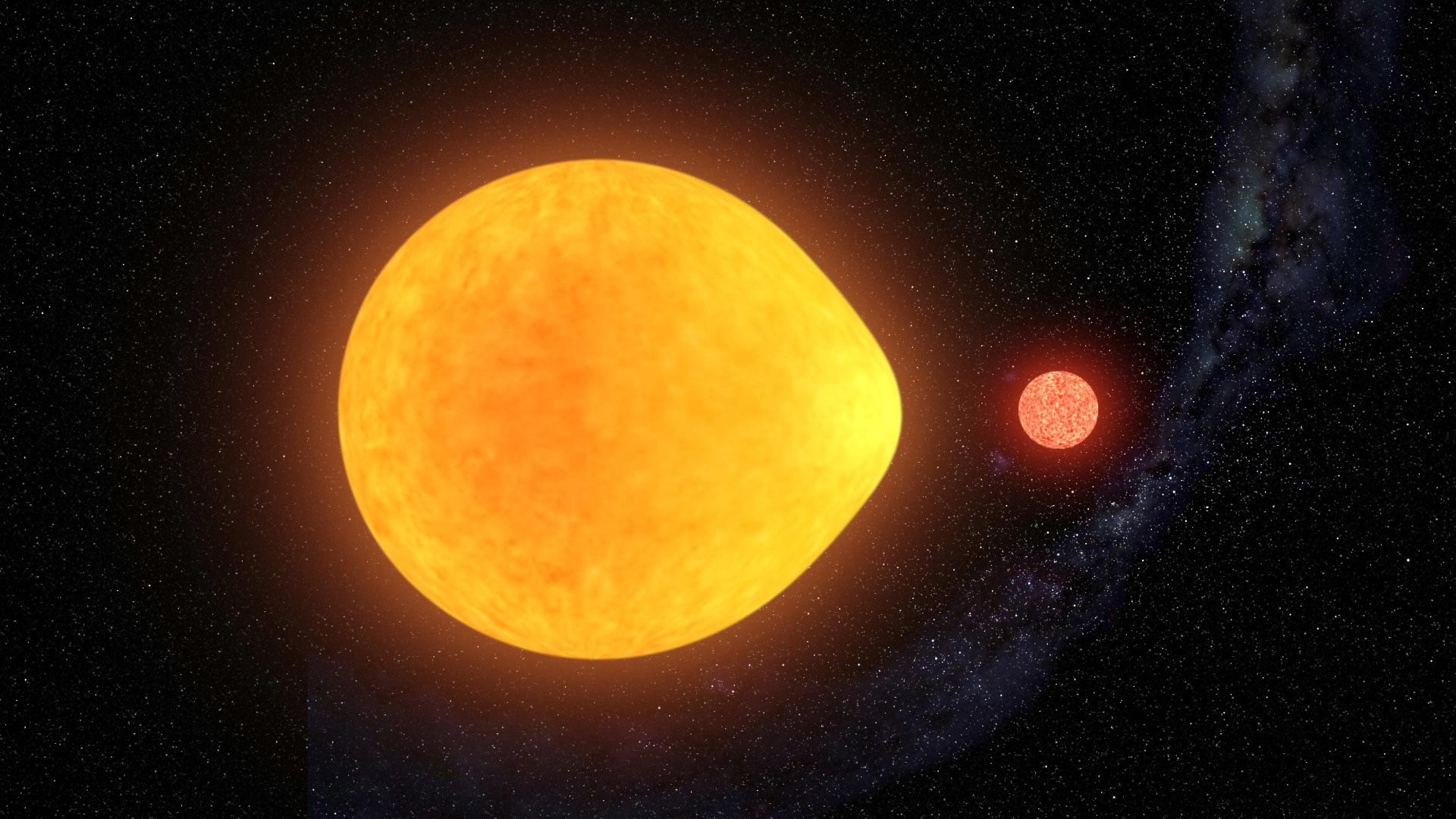
A star that pulses on just one side has been predicted in theory. But it took two simultaneous discoveries on opposite sides of our planet to uncover the first such example of a ‘one-sided pulsator.’
A star that pulsates on just one side has been discovered in the Milky Way about 1500 light-years from Earth. It is the first of its kind to be found and scientists expect to find many more similar systems as technology to listen inside the beating hearts of stars improves.
“What first caught my attention was the fact it was a chemically peculiar star,” said co-author Dr. Simon Murphy from the Sydney Institute for Astronomy at the University of Sydney. “Stars like this are usually fairly rich with metals — but this is metal poor, making it a rare type of hot star.”
Dr. Murphy shared the find with international collaborators to discover others had started to study the star, known as HD74423, which is about 1.7 times the mass of the Sun.
Together they have published their findings today (March 9, 2020) in Nature Astronomy.
“We’ve known theoretically that stars like this should exist since the 1980s,” said co-author Professor Don Kurtz from the University of Central Lancashire in Britain.
“I’ve been looking for a star like this for nearly 40 years and now we have finally found one,” said Professor Kurtz, who is the inaugural Hunstead Distinguished Visitor at the University of Sydney.
Stars that pulsate have been known in astronomy for a long time. Our own Sun dances to its own rhythms. These rhythmic pulsations of the stellar surface occur in young and in old stars, and can have long or short periods, a wide range of strengths and different causes.
There is however one thing that all these stars had thus far in common: the oscillations were always visible on all sides of the star. Now an international team, including researchers from the University of Sydney, has discovered a star that oscillates largely over one hemisphere.
The scientists have identified the cause of the unusual single-sided pulsation: the star is located in a binary star system with a red dwarf. Its close companion distorts the oscillations with its gravitational pull. The clue that led to its discovery came from citizen scientists poring over public data from NASA’s TESS satellite, which is hunting for planets around distant stars.
The orbital period of the binary system, at less than two days, is so short that the larger star is being distorted into a tear-drop shape by the gravitational pull of the companion.
Professor Gerald Handler from the Nicolaus Copernicus Astronomical Centre in Poland and lead author said: “The exquisite data from the TESS satellite meant that we could observe variations in brightness due to the gravitational distortion of the star as well as the pulsations.”
To their surprise, the team observed that the strength of the pulsations depended on the aspect angle under which the star was observed, and the corresponding orientation of the star within the binary. This means the pulsation strength varies with the same period as that of the binary.
“As the binary stars orbit each other we see different parts of the pulsating star,” said Dr. David Jones at the Instituto de Astrofisica de Canarias and co-author of the study. “Sometimes we see the side that points towards the companion star, and sometimes we see the outer face.”
This is how the astronomers could be certain that the pulsations were only found on one side of the star, with the tiny fluctuations in brightness always appearing in their observations when the same hemisphere of the star was pointed towards the telescope.
The discovery of the unusual behavior of the star was initially made by citizen scientists. These amateur astronomy sleuths painstakingly inspected the enormous amounts of data that TESS regularly supplies, as they search for new and interesting phenomena.
While this is the first such star to be found where only one side is pulsating, the authors believe there must be many more such stars.
“We expect to find many more hidden in the TESS data,” said co-author Professor Saul Rappaport from the Massachusetts Institute of Technology in the US.
Reference: “Tidally trapped pulsations in a close binary star system discovered by TESS” by G. Handler, D. W. Kurtz, S. A. Rappaport, H. Saio, J. Fuller, D. Jones, Z. Guo, S. Chowdhury, P. Sowicka, F. Kahraman Aliçavuş, M. Streamer, S. J. Murphy, R. Gagliano, T. L. Jacobs and A. Vanderburg, 9 March 2020, Nature Astronomy.
DOI: 10.1038/s41550-020-1035-1
Never miss a breakthrough: Join the SciTechDaily newsletter.
Follow us on Google and Google News.