
Close Menu
    Facebook X (Twitter) Instagram
    SciTechDaily
    • Biology
    • Chemistry
    • Earth
    • Health
    • Physics
    • Science
    • Space
    • Technology
    Facebook X (Twitter) Pinterest YouTube RSS
    SciTechDaily
    Home»Space»NASA’s Fermi, Swift View Record-Setting Gamma-Ray Burst
    Space

    NASA’s Fermi, Swift View Record-Setting Gamma-Ray Burst

    By Francis Reddy, NASA's Goddard Space Flight CenterMay 6, 2013No Comments4 Mins Read
    Facebook Twitter Pinterest Telegram LinkedIn WhatsApp Email Reddit
    Share
    Facebook Twitter LinkedIn Pinterest Telegram Email Reddit
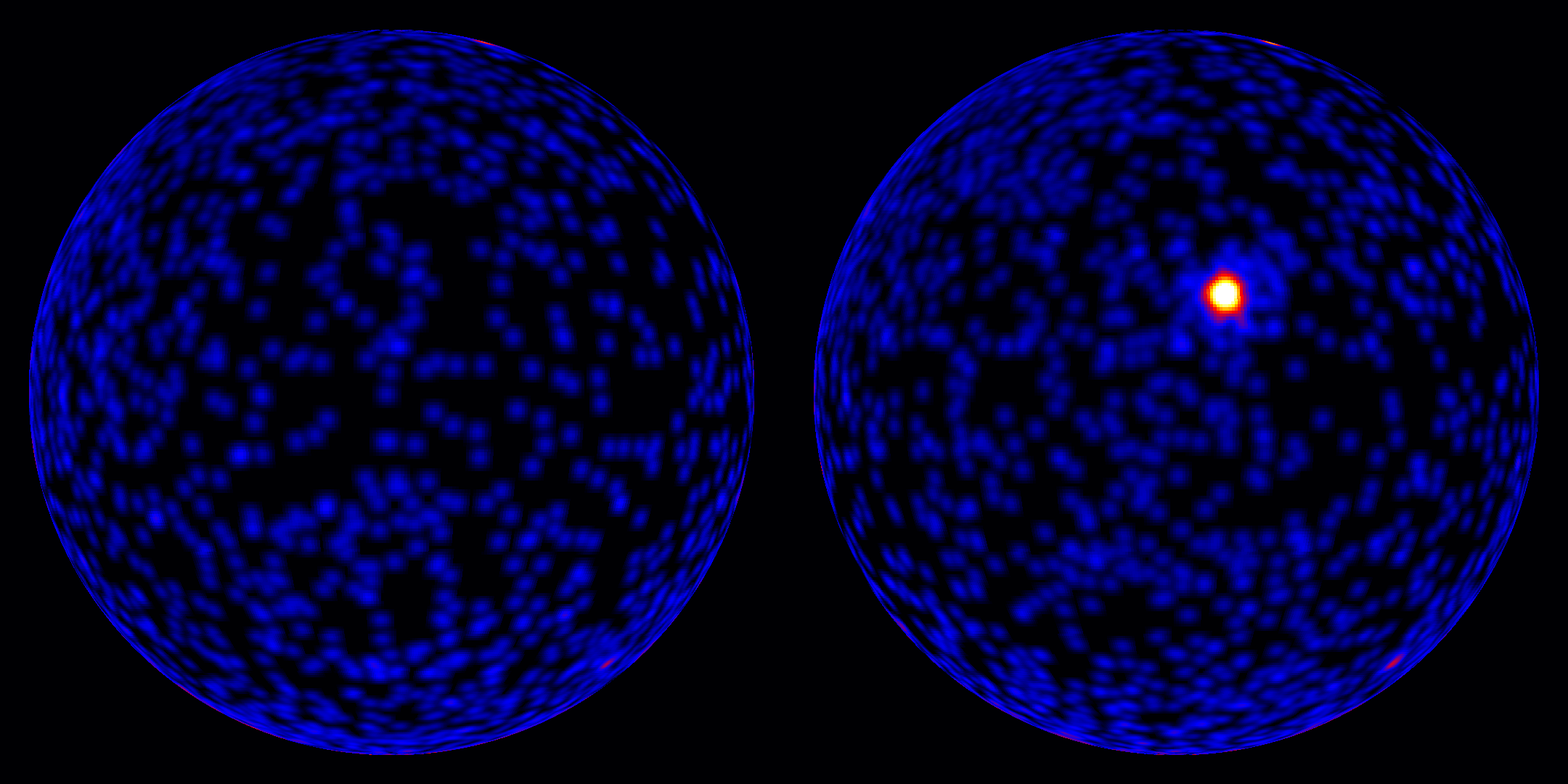
    Fermi Views a Record Setting Blast of Gamma Rays from a Dying Star
    The maps in this animation show how the sky looks at gamma-ray energies above 100 million electron volts (MeV) with a view centered on the north galactic pole. The first frame shows the sky during a three-hour interval prior to GRB 130427A. The second frame shows a three-hour interval starting 2.5 hours before the burst, and ending 30 minutes into the event. The Fermi team chose this interval to demonstrate how bright the burst was relative to the rest of the gamma-ray sky. This burst was bright enough that Fermi autonomously left its normal surveying mode to give the LAT instrument a better view, so the three-hour exposure following the burst does not cover the whole sky in the usual way. Credit: NASA/DOE/Fermi LAT Collaboration

    NASA’s Fermi Gamma-ray Space Telescope and Swift satellite viewed gamma-ray burst 130427A, which produced the highest-energy light ever detected from a GRB.

    A record-setting blast of gamma rays from a dying star in a distant galaxy has wowed astronomers around the world. The eruption, which is classified as a gamma-ray burst, or GRB, and designated GRB 130427A, produced the highest-energy light ever detected from such an event.

    “We have waited a long time for a gamma-ray burst this shockingly, eye-wateringly bright,” said Julie McEnery, project scientist for the Fermi Gamma-ray Space Telescope at NASA’s Goddard Space Flight Center in Greenbelt, Maryland. “The GRB lasted so long that a record number of telescopes on the ground were able to catch it while space-based observations were still ongoing.”
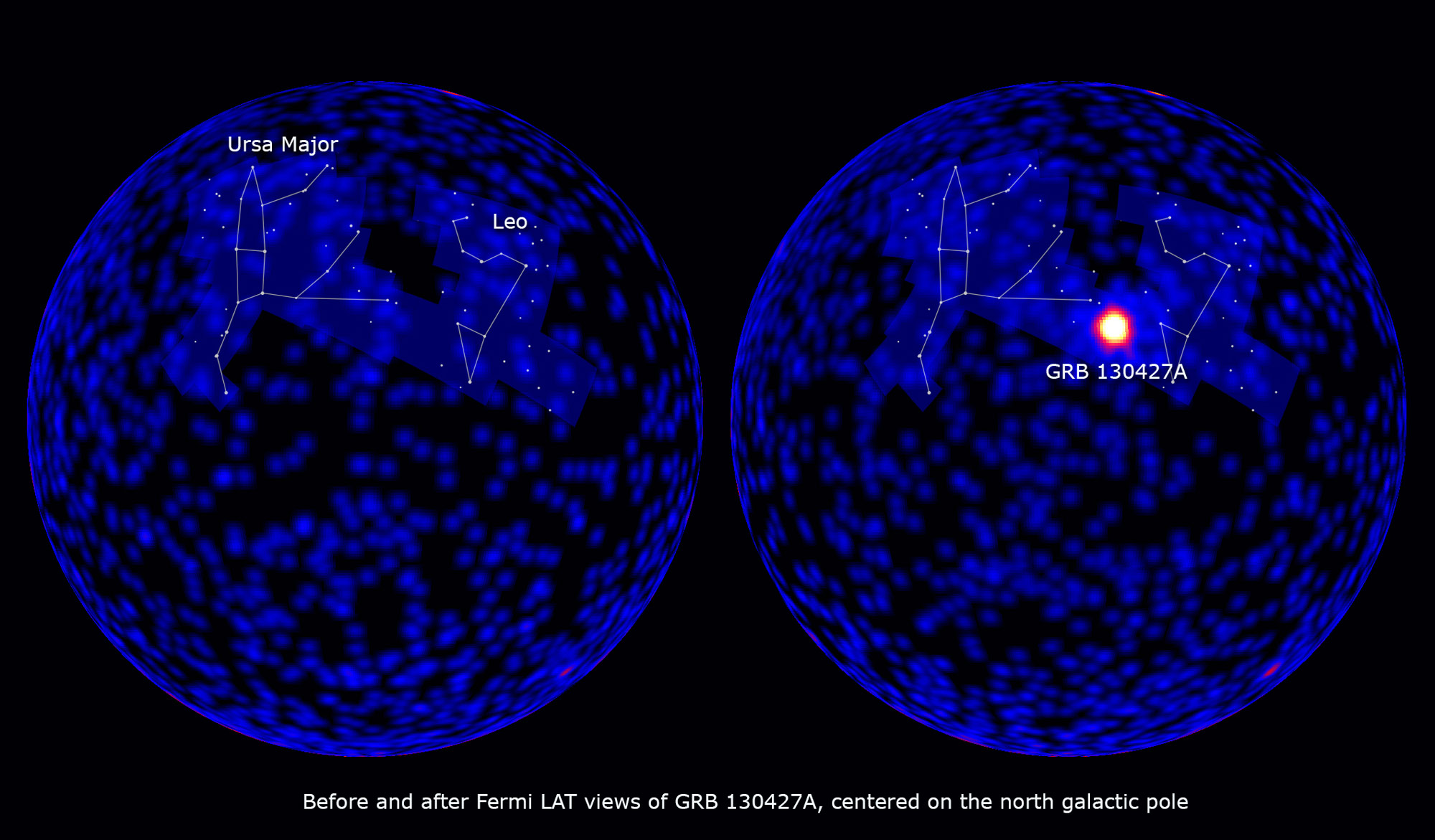
    Fermi Detects Shockingly Bright Gamma Ray Burst
    These maps, both centered on the north galactic pole, show how the sky looks at gamma-ray energies above 100 million electron volts (MeV). Left: The sky during a three-hour interval prior to the detection of GRB 130427A. Right: A three-hour interval starting 2.5 hours before the burst and ending 30 minutes into the event, illustrating its brightness relative to the rest of the gamma-ray sky. GRB 130427A was located in the constellation Leo near its border with Ursa Major, whose brightest stars form the familiar Big Dipper. For reference, this image includes the stars and outlines of both constellations. Credit: NASA/DOE/Fermi LAT Collaboration

    Just after 3:47 a.m. EDT on Saturday, April 27, Fermi’s Gamma-ray Burst Monitor (GBM) triggered on an eruption of high-energy light in the constellation Leo. The burst occurred as NASA’s Swift satellite was slewing between targets, which delayed its Burst Alert Telescope’s detection by less than a minute.

    Fermi’s Large Area Telescope (LAT) recorded one gamma ray with an energy of at least 94 billion electron volts (GeV), or some 35 billion times the energy of visible light, and about three times greater than the LAT’s previous record. The GeV emission from the burst lasted for hours, and it remained detectable by the LAT for the better part of a day, setting a new record for the longest gamma-ray emission from a GRB.
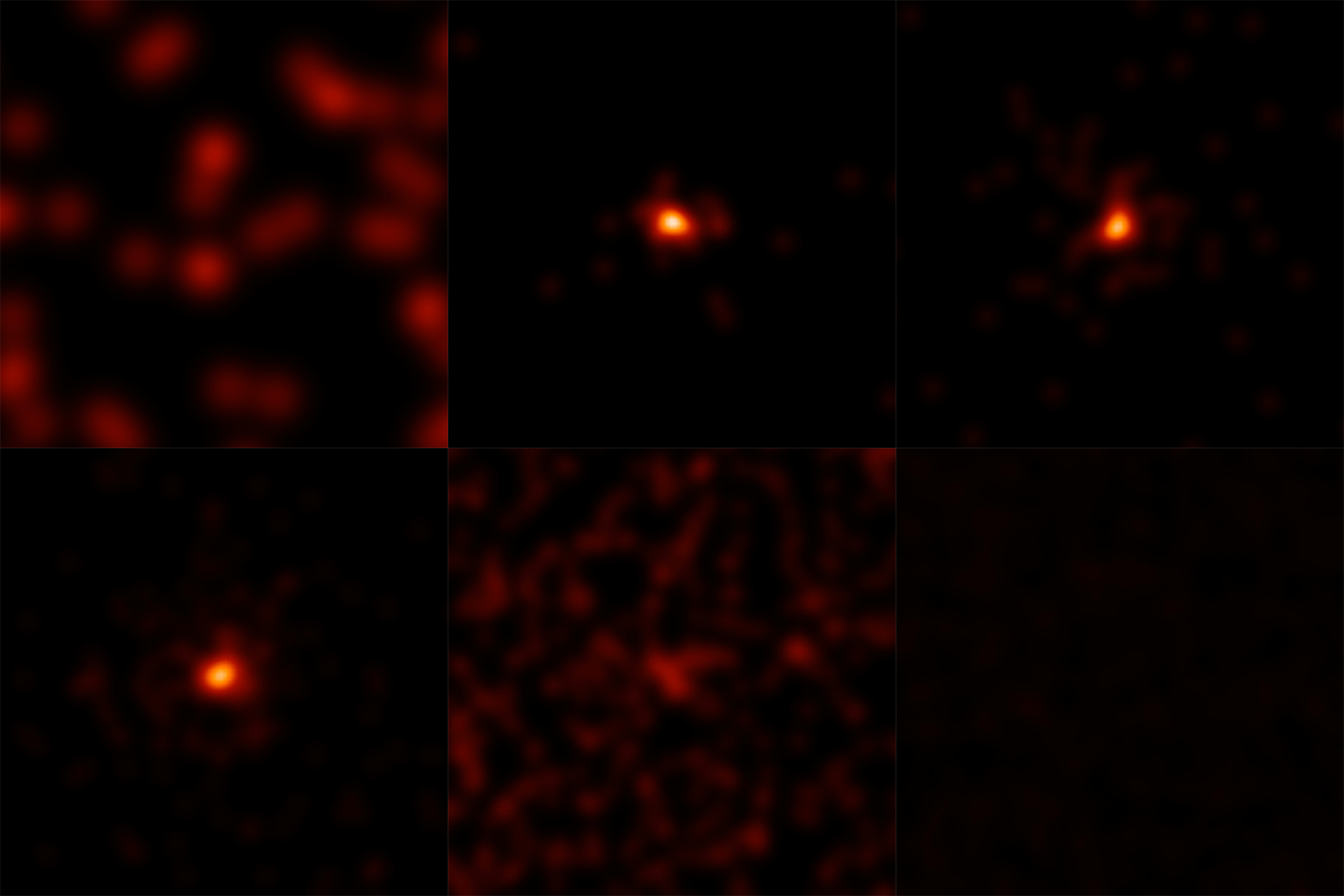
    A Detailed Fermi LAT View of GRB 130427A
    This animation shows a more detailed Fermi LAT view of GRB 130427A. The sequence shows high-energy (100 Mev to 100 GeV) gamma rays from a 20-degree-wide region of the sky starting three minutes before the burst to 14 hours after. Following an initial one-second spike, the LAT emission remained relatively quiet for the next 15 seconds while Fermi’s GBM instrument showed bright, variable lower-energy emission. Then the burst re-brightened in the LAT over the next few minutes and remained bright for nearly half a day. Credit: NASA/DOE/Fermi LAT Collaboration

    The burst subsequently was detected in optical, infrared and radio wavelengths by ground-based observatories, based on the rapid accurate position from Swift. Astronomers quickly learned that the GRB was located about 3.6 billion light-years away, which for these events is relatively close.

    Gamma-ray bursts are the universe’s most luminous explosions. Astronomers think most occur when massive stars run out of nuclear fuel and collapse under their own weight. As the core collapses into a black hole, jets of material shoot outward at nearly the speed of light.

    The jets bore all the way through the collapsing star and continue into space, where they interact with gas previously shed by the star and generate bright afterglows that fade with time.

    If the GRB is near enough, astronomers usually discover a supernova at the site a week or so after the outburst.

    “This GRB is in the closest 5 percent of bursts, so the big push now is to find an emerging supernova, which accompanies nearly all long GRBs at this distance,” said Goddard’s Neil Gehrels, principal investigator for Swift.

    Ground-based observatories are monitoring the location of GRB 130427A and expect to find an underlying supernova by midmonth.

    Never miss a breakthrough: Join the SciTechDaily newsletter.
    Follow us on Google and Google News.

    Astronomy Astrophysics Fermi Gamma-ray Space Telescope Gamma Ray NASA NASA Swift Satellite Telescope
    Share. Facebook Twitter Pinterest LinkedIn Email Reddit

    Related Articles

    Strange Long-Lasting Pulse of High-Energy Radiation Swept Over Earth

    Fermi Data Reveal New Clues to Dark Matter

    Swift Reveals Before and After Images of Supernova SN 2014J

    Astronomers View the Infrastructure of Gamma-ray Burst Jet 120308A

    Astronomers View Cosmic Blast GRB 130427A in Unique Detail

    Fermi Enters Extended Phase of Its Mission – A Deeper Study of the High-Energy Cosmos

    NASA’s Swift Discovers Three Unusually Long-Lasting Stellar Explosions

    NASA’s Fermi Measures Extragalactic Background Light

    New Technique Leads to the Discovery of 5 New Pulsars

    Leave A Reply Cancel Reply

    • Facebook
    • Twitter
    • Pinterest
    • YouTube

    Don't Miss a Discovery

    Subscribe for the Latest in Science & Tech!

    Trending News

    Largest-Ever Study Finds Medicinal Cannabis Ineffective for Anxiety, Depression, PTSD

    250-Million-Year-Old Egg Solves One of Evolution’s Biggest Mysteries

    Living With Roommates Might Be Changing Your Gut Microbiome Without You Knowing

    Century-Old Cleaning Chemical Linked to 500% Increased Risk of Parkinson’s Disease

    What if Your Memories Never Happened? Physicists Take a New Look at the Boltzmann Brain Paradox

    One of the Universe’s Largest Stars May Be Getting Ready To Explode

    Scientists Discover Enzyme That Could Supercharge Ozempic-Like Weight Loss Drugs

    Popular Sweetener Linked to DNA Damage – “It’s Something You Should Not Be Eating”

    Follow SciTechDaily
    • Facebook
    • Twitter
    • YouTube
    • Pinterest
    • Newsletter
    • RSS
    SciTech News
    • Biology News
    • Chemistry News
    • Earth News
    • Health News
    • Physics News
    • Science News
    • Space News
    • Technology News
    Recent Posts
    • Amazonian Chocolate Could Become the Next Superfood, Scientists Say
    • Challenging the Narrative: New Study Shows U.S. Life Expectancy Is Rising Across All States
    • Mystery Illness Kills 5 in Burundi As Doctors Scramble for Answers
    • Bone-Strengthening Discovery Could Reverse Osteoporosis
    • The Most Elusive Number in Physics Just Got Even More Mysterious
    Copyright © 1998 - 2026 SciTechDaily. All Rights Reserved.
    • Science News
    • About
    • Contact
    • Editorial Board
    • Privacy Policy
    • Terms of Use

    Type above and press Enter to search. Press Esc to cancel.