
Close Menu
    Facebook X (Twitter) Instagram
    SciTechDaily
    • Biology
    • Chemistry
    • Earth
    • Health
    • Physics
    • Science
    • Space
    • Technology
    Facebook X (Twitter) Pinterest YouTube RSS
    SciTechDaily
    Home»Biology»Yale and Columbia Biologists Shed New Light on Cell Division
    Biology

    Yale and Columbia Biologists Shed New Light on Cell Division

    By Bill Hathaway, Yale UniversityAugust 22, 2014No Comments2 Mins Read
    Facebook Twitter Pinterest Telegram LinkedIn WhatsApp Email Reddit
    Share
    Facebook Twitter LinkedIn Pinterest Telegram Email Reddit
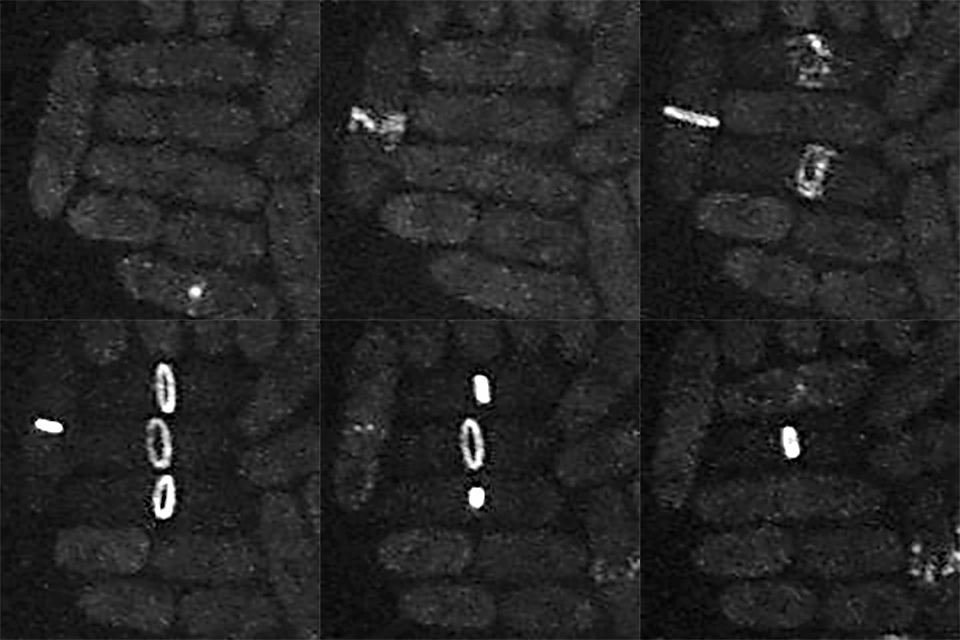
    Researchers Shed New Light on the Rings That Make Cell Division Possible
    Researchers have unraveled the mystery by using computer simulations to understand the formation and constriction of contractile rings. Credit: Yale University

    A team of scientists from Yale and Columbia universities has shed new light on the mechanics of the division of cells that makes life possible.

    Forming like a blown smoke ring does, a “contractile ring” similar to a tiny muscle pinches yeast cells in two. The division of cells makes life possible, but the actual mechanics of this fundamental process have proved difficult to pin down.

    Researchers at Yale and Columbia universities recently shed light on this mystery by accumulating enough information to simulate the formation and constriction of contractile rings on a computer.

    In the accompanying movie, a time series of micrographs show the formation and constriction of contractile rings in four rod-shaped yeast cells. One of the contractile ring proteins is shown in white. Clusters of the protein accumulate around the middle of each cell and then condense into a ring that constricts to pinch the cell in two.

    Thomas Pollard, Sterling Professor of Molecular, Cellular, and Developmental Biology at Yale, and his colleagues discuss the process in recent studies published in Developmental Cell and Cell Reports.

    References:

    “Mechanism of Cytokinetic Contractile Ring Constriction in Fission Yeast” by Matthew R. Stachowiak, Caroline Laplante, Harvey F. Chin, Boris Guirao, Erdem Karatekin, Thomas D. Pollard and Ben O’Shaughnessy, 9 June 2014, Developmental Cell.
    DOI: 10.1016/j.devcel.2014.04.021

    “Contractile Ring Stability in S. pombe Depends on F-BAR Protein Cdc15p and Bgs1p Transport from the Golgi Complex” by Rajesh Arasada and Thomas D. Pollard, 11 September 2014, Cell Reports.
    DOI: 10.1016/j.celrep.2014.07.048


    Never miss a breakthrough: Join the SciTechDaily newsletter.
    Follow us on Google and Google News.

    Columbia University Developmental Biology Molecular Biology Yale University
    Share. Facebook Twitter Pinterest LinkedIn Email Reddit

    Related Articles

    Yale Researchers Track How Cells Repair Rips in DNA

    Drug-Resistant EGFR May Have “Achilles Heel”

    Study Shows How Quickly New Fat Cells Are Created

    New Research Changes the View about the Genetics of Leukemia Risk

    Researchers Identify Molecular Factors that Push the Domino of Life into Motion

    A Closer Look at the Antifreeze Protein That Allows Siberian Beetles to Survive

    Yale Researchers Identify Cells That Morph Into Body Fat

    Atomic Level Splicing Further Establishes RNA’s Chemical and Structural Complexity

    New Design Makes Previously Inaccessible Proteins Vulnerable to Drugs

    Leave A Reply Cancel Reply

    • Facebook
    • Twitter
    • Pinterest
    • YouTube

    Don't Miss a Discovery

    Subscribe for the Latest in Science & Tech!

    Trending News

    New Study Reveals Why Ozempic Works Better for Some People Than Others

    Climate Change Is Altering a Key Greenhouse Gas in a Way Scientists Didn’t Expect

    New Study Suggests Gravitational Waves May Have Created Dark Matter

    Scientists Discover Why the Brain Gets Stuck in Schizophrenia

    Scientists Engineer “Tumor-Eating” Bacteria That Devour Cancer From Within

    Even “Failed” Diets May Deliver Long-Term Health Gains, Study Finds

    NIH Scientists Discover Powerful New Opioid That Relieves Pain Without Dangerous Side Effects

    Collapsing Plasma May Hold the Key to Cosmic Magnetism

    Follow SciTechDaily
    • Facebook
    • Twitter
    • YouTube
    • Pinterest
    • Newsletter
    • RSS
    SciTech News
    • Biology News
    • Chemistry News
    • Earth News
    • Health News
    • Physics News
    • Science News
    • Space News
    • Technology News
    Recent Posts
    • This 15,000-Year-Old Discovery Changes What We Know About Early Human Creativity
    • 35-Million-Year-Old Mystery: Strange Arachnid Discovered Preserved in Amber
    • Revolutionary Gas Turbine Generates Power Without Air Compression
    • Is AI Really Just a Tool? It Could Be Altering How You See Reality
    • JWST Reveals a “Forbidden” Planet With a Baffling Composition
    Copyright © 1998 - 2026 SciTechDaily. All Rights Reserved.
    • Science News
    • About
    • Contact
    • Editorial Board
    • Privacy Policy
    • Terms of Use

    Type above and press Enter to search. Press Esc to cancel.