
Close Menu
    Facebook X (Twitter) Instagram
    SciTechDaily
    • Biology
    • Chemistry
    • Earth
    • Health
    • Physics
    • Science
    • Space
    • Technology
    Facebook X (Twitter) Pinterest YouTube RSS
    SciTechDaily
    Home»Space»Dozens of ‘Comet Crumbs’ Detected by LISA Pathfinder [Video]
    Space

    Dozens of ‘Comet Crumbs’ Detected by LISA Pathfinder [Video]

    By Francis Reddy, NASA’s Goddard Space Flight CenterNovember 18, 2019No Comments2 Mins Read
    Facebook Twitter Pinterest Telegram LinkedIn WhatsApp Email Reddit
    Share
    Facebook Twitter LinkedIn Pinterest Telegram Email Reddit
    LISA Pathfinder
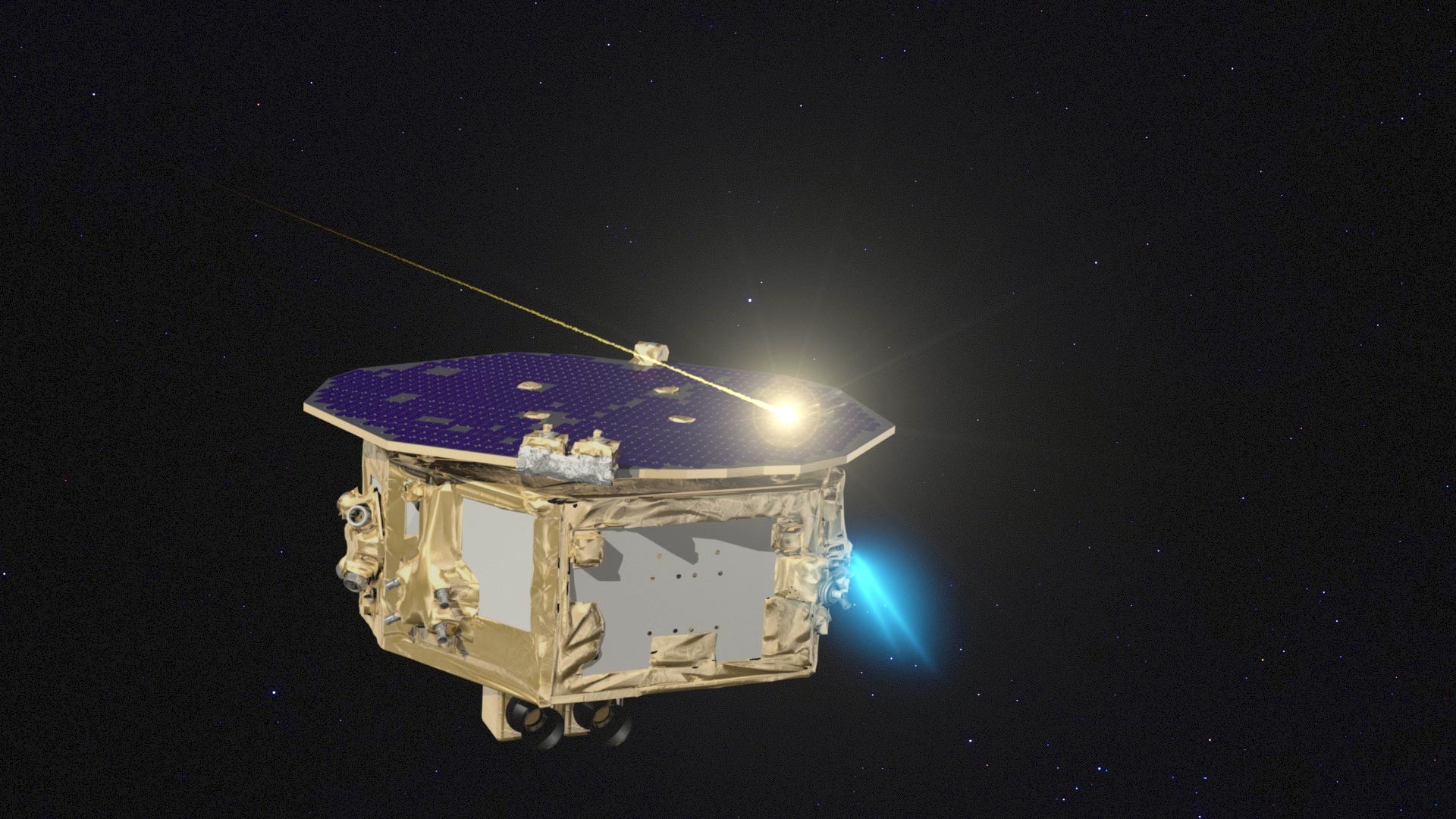
    LISA Pathfinder, led by the European Space Agency (ESA), is designed to test technologies that could one day detect gravitational waves. Gravitational waves, predicted by Einstein’s theory of general relativity, are ripples in spacetime produced by any accelerating body. But the waves are so weak that Earth- or space-based observatories would likely only be able to directly detect such signals coming from massive astronomical systems, such as binary black holes or exploding stars. Detecting gravitational waves would be an important piece in the puzzle of how our universe began. Credit: ESA

    LISA Pathfinder, a mission led by ESA (the European Space Agency) that included NASA contributions, successfully demonstrated technologies needed to build a future space-based gravitational wave observatory, a tool for detecting ripples in space-time produced by, among other things, merging black holes. A team of NASA scientists leveraged LISA Pathfinder’s record-setting sensitivity for a different purpose much closer to home — mapping microscopic dust shed by comets and asteroids.

    Most of these particles, known as micrometeroids, have masses measured in micrograms, similar to a small grain of sand. But at speeds reaching 40,000 mph (64,000 kph), even micrometeoroids pack a punch.

    The NASA team, led by Ira Thorpe at NASA’s Goddard Space Flight Center in Greenbelt, Maryland, detected 54 impacts during the mission, which lasted from 2015 to 2017. Modeling the strikes allowed the researchers to determine what kinds of objects shed the dust. The findings are broadly consistent with existing ideas of what generates micrometeroids found near Earth. The dusty culprits are mostly short-period comets whose orbits are determined by Jupiter. Comets with longer periods, like Halley’s comet, also contributed dust that LISA Pathfinder sensed.

    The new measurements could help refine dust models used by researchers in a variety of studies, from understanding the physics of planet formation to estimating impact risks for current and future spacecraft.

    Never miss a breakthrough: Join the SciTechDaily newsletter.
    Follow us on Google and Google News.

    Astronomy Astrophysics Comet European Space Agency Gravitational Waves LISA NASA NASA Goddard Space Flight Center
    Share. Facebook Twitter Pinterest LinkedIn Email Reddit

    Related Articles

    ESA Is Building a Massive Space Antenna to Listen to the Dark Universe

    NASA Unveils Prototype Telescope for First Space-Based Gravitational Wave Detector

    How LISA – A Gravitational Wave Observatory in Space – Will Transform Our Cosmic Understanding

    Capturing the Ripples of Spacetime: LISA Gravitational Wave Observatory Gets Go-Ahead

    NASA’s Cosmic Vision: Simulating Our Galaxy Through Gravitational Waves

    A Small, Bright Surprise: Two Views of a Sungrazing Comet

    New Comet SWAN Discovered by Solar Observatory Is Visible From Earth Without a Telescope

    NASA’s Solar and Heliospheric Observatory Celebrates 20 Years of Science

    Satellites Monitor the Colliding Winds of O-Type Stars

    Leave A Reply Cancel Reply

    • Facebook
    • Twitter
    • Pinterest
    • YouTube

    Don't Miss a Discovery

    Subscribe for the Latest in Science & Tech!

    Trending News

    Scientists Uncover Potential Brain Risks of Popular Fish Oil Supplements

    Scientists Discover a Surprising Way To Make Bread Healthier and More Nutritious

    After 60 Years, Scientists Uncover Unexpected Brain Effects of Popular Diabetes Drug Metformin

    New Research Uncovers Hidden Side Effects of Popular Weight-Loss Drugs

    Scientists Rethink Extreme Warming After Surprising Ocean Discovery

    Landmark Study Links Never Marrying to Significantly Higher Cancer Risk

    Researchers Discover Unknown Beetle Species Just Steps From Their Lab

    Largest-Ever Study Finds Medicinal Cannabis Ineffective for Anxiety, Depression, PTSD

    Follow SciTechDaily
    • Facebook
    • Twitter
    • YouTube
    • Pinterest
    • Newsletter
    • RSS
    SciTech News
    • Biology News
    • Chemistry News
    • Earth News
    • Health News
    • Physics News
    • Science News
    • Space News
    • Technology News
    Recent Posts
    • Researchers Uncover Source of Strange Deformation in Earth’s Largest Continental Rift
    • Scientists Solve Mystery of Where the Colorado River Vanished Millions of Years Ago
    • Not Just Alzheimer’s: Scientists Uncover Clues to a Second, Overlooked Disorder
    • Scientists Uncover Dangerous Connection Between Serotonin and Heart Valve Disease
    • Scientists Discover a “Protector” Protein That Could Help Reverse Hair Loss
    Copyright © 1998 - 2026 SciTechDaily. All Rights Reserved.
    • Science News
    • About
    • Contact
    • Editorial Board
    • Privacy Policy
    • Terms of Use

    Type above and press Enter to search. Press Esc to cancel.