
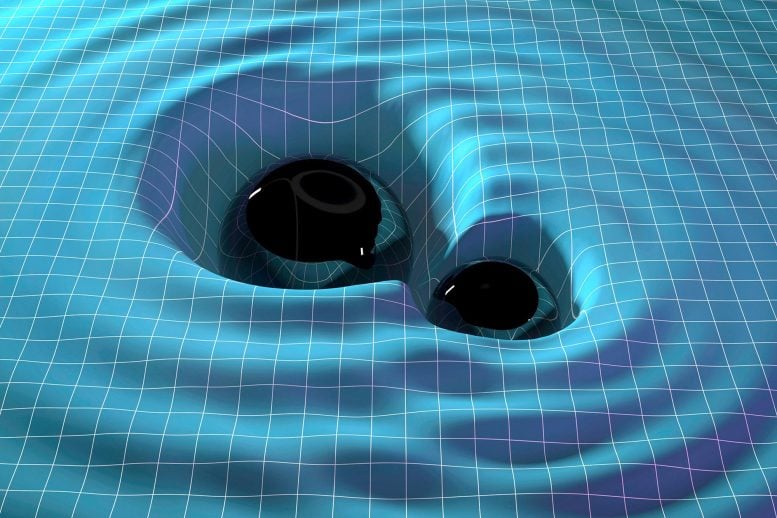
Published in Nature Astronomy the work which shows the unprecedented accuracy with which gravitational wave observations by the space interferometer LISA will be able to detect new fundamental fields
Published in Nature Astronomy the work by Andrea Maselli, researcher at GSSI and INFN associate, together with researchers from SISSA, the University of Nottingham and La Sapienza of Rome, shows the unprecedented accuracy with which gravitational wave observations by the space interferometer LISA will be able to detect new fundamental fields.
Is General Relativity the correct theory of gravitation? Can gravity be used to detect new fundamental fields?
A recent Letter published on February 9, 2022, in Nature Astronomy, authored by a researcher of the GSSI and colleagues from SISSA, the University of Nottingham, and from La Sapienza of Rome, suggests that an answer to these questions may come from LISA, the space-based gravitational-wave (GW) detector which is expected to be launched by ESA/NASA in 2037.
New fundamental fields, and in particular scalars, have been postulated in a variety of scenarios: as explanations for dark matter, as the cause for the accelerated expansion of the Universe, or as low-energy manifestations of a consistent and complete description of gravity and elementary particles.
Observations of astrophysical objects with weak gravitational fields and small spacetime curvature have provided no evidence of such fields so far. However, there is reason to expect that deviations from General Relativity, or interactions between gravity and new fields, will be more prominent at large curvatures. For this reason, the detection of GWs — which opened a novel window on the strong-field regime of gravity — represents a unique opportunity to detect these fields.
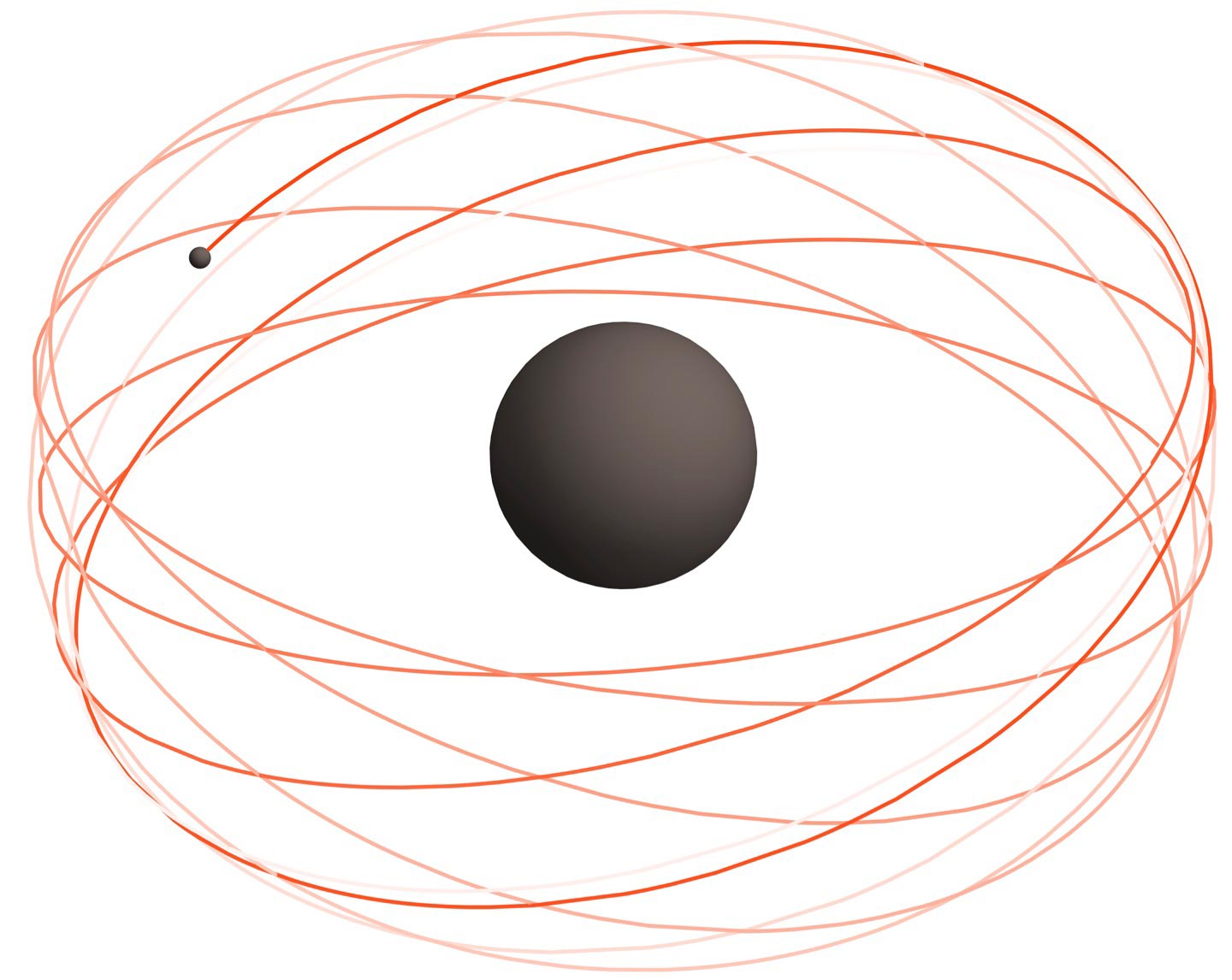
Extreme Mass Ratio Inspirals (EMRI) in which a stellar-mass compact object, either a black hole or a neutron star, inspirals into black hole up to millions of times the mass of the Sun, are among the target sources of LISA, and provide a golden arena to probe the strong-field regime of gravity. The smaller body performs tens of thousands of orbital cycles before it plunges into the supermassive black hole and this leads to long signals that can allow us to detect even the smallest deviations from the predictions of Einstein’s theory and the Standard Model of Particle Physics.

The Authors have developed a new approach for modeling the signal and performed for the first time a rigorous estimate of LISA’s capability to detect the existence of scalar fields coupled with the gravitational interaction, and to measure the scalar charge, a quantity which measures how much scalar field is carried by the small body of the EMRI. Remarkably, this approach is theory-agnostic, since it does not depend on the origin of the charge itself, or on the nature of the small body. The analysis also shows that such measurement can be mapped to strong bounds on the theoretical parameters that mark deviations from General Relativity or the Standard Model.
LISA (Laser Interferometer Space Antenna), devoted to detect gravitational waves by astrophysical sources, will operate in a constellation of three satellites, orbiting around the Sun millions of kilometers far away from each other. LISA will observe gravitational waves emitted at low frequency, within a band not available to terrestrial interferometers due to environmental noise. The visible spectrum for LISA will allow to study new families of astrophysical sources, different from those observed by Virgo and LIGO, as the EMRIs, opening a new window on the evolution of compact objects in a large variety of environments of our Universe.
Reference: “Detecting fundamental fields with LISA observations of gravitational waves from extreme mass-ratio inspirals” by Andrea Maselli, Nicola Franchini, Leonardo Gualtieri, Thomas P. Sotiriou, Susanna Barsanti and Paolo Pani, 10 February 2022, Nature Astronomy.
DOI: 10.1038/s41550-021-01589-5
Never miss a breakthrough: Join the SciTechDaily newsletter.
Follow us on Google and Google News.
5 Comments
… One thing is enough!
So! Would three body system do it…
wow ..what a great concept for some unanswered questions! Great article. sctechdaily always seems to publish cutting edge science. wonderful to read
The time factor projected for the detectors themselves is weeks. The signal being read can have years between peaks.
Patience is the name of the game when dealing with astronomical distances.
I admit to being antsy and peevish waiting for peer reviewed analysis based on observations.
Screw the gravitational waves garbage get down to the real stuff. Electro magnetic science we’ve lost to much time on this and blown too much money Government grant scientist.
Please sir, what’s a scalar? I’ve read about vectors and tensors…….