
University of Texas researcher identifies factors for safe and effective carbon capture and storage.
The road to a stabilized climate is challenging and contentious. A number of solutions will be needed to enable a fast, equitable transition away from fossil fuels: among them the development of sustainable energy sources, greener materials, and methods to remove CO₂ from the atmosphere.
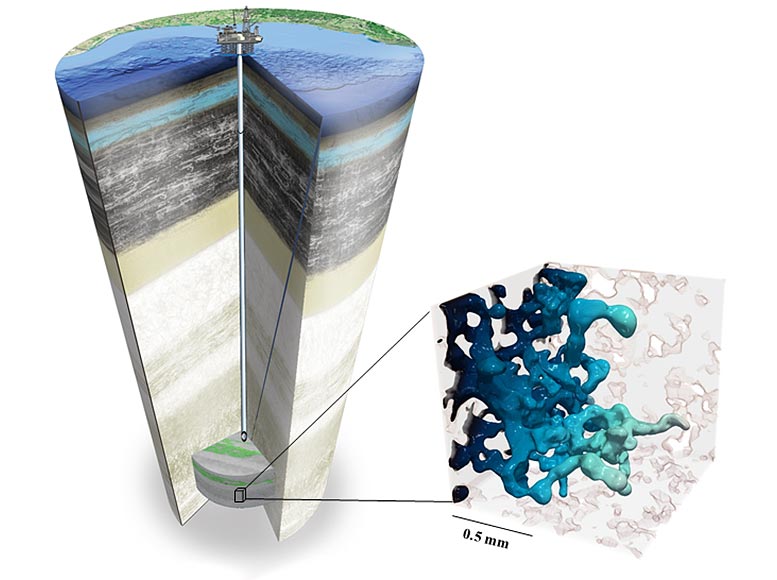
One of the removal methods scientists are exploring is known as carbon capture and storage (CCS). In carbon capture and storage, CO₂ is captured from industrial sources and injected into deep geological reservoirs underground, theoretically for thousands of years, in much the way water is stored in aquifers.
Microscopic Insights into CO₂ Storage Efficiency
Sahar Bakhshian, a researcher at the University of Texas at Austin’s Bureau of Economic Geology, recently used supercomputers at the Texas Advanced Computing Center (TACC) to fundamentally understand how CO₂ storage works at the level of micrometer-wide pores in the rock, and to determine the characteristics and factors that can help optimize how much CO₂ can be stored.
CO2 flow inside the pore space of a millimeter-sized rock sample, which is initially filled with brine. This high-resolution fluid dynamics simulation demonstrates the migration pathway of CO2 when injected into saline reservoirs. Credit: Sahar Bakhshian, University of Texas at Austin
Writing in the International Journal of Greenhouse Gas Control in December 2021, she explored the trapping efficiency of CO₂ through dissolving the gas into the resident brine in saline aquifers.
“We tried different scenarios – using different injection rates and fluid-rock properties — to determine how the properties affect what percentage of injected CO₂ can ideally be trapped by the dissolution mechanism,” she explained.
She found that two factors greatly impacted the amount of CO₂ that could be stored in the spaces within the rocks: wettability (or how well CO₂ molecules stick to the surface of the rock); and injection rate (the speed at which supercritical CO₂ is pushed into the reservoir).
The Role of Capillary Trapping in Secure CO₂ Storage
Another effective process that ensures the security of CO₂ storage is capillary trapping, which happens when CO₂ pinches off and becomes immobilized in the pore space by capillary forces. In a study published in Advances in Water Resources in April 2019, Bakhshian presented the results of pore-scale, two-phase flow simulations that used digital versions of real rocks from a CO₂ storage test-site in Cranfield, Mississippi to explore how CO₂ migrated through the rock’s pore structure during the injection stage and how it can be trapped as immobilized blobs in the pore space during post-injection.
Bakhshian’s work is done under the auspices of the Gulf Coast Carbon Center (GCCC), which has been working on understanding the potential, risks, and best methods for geologic carbon storage since 1998.
Supercomputers are one of the key tools that geoscientists have at their disposal to study processes relevant to carbon capture and storage, according to Bakhshian. “Computational fluid dynamics techniques are essential for this field, to better screen suitable target reservoirs for CO₂ storage, and predict the behavior of CO₂ plumes in these reservoirs,” she said.
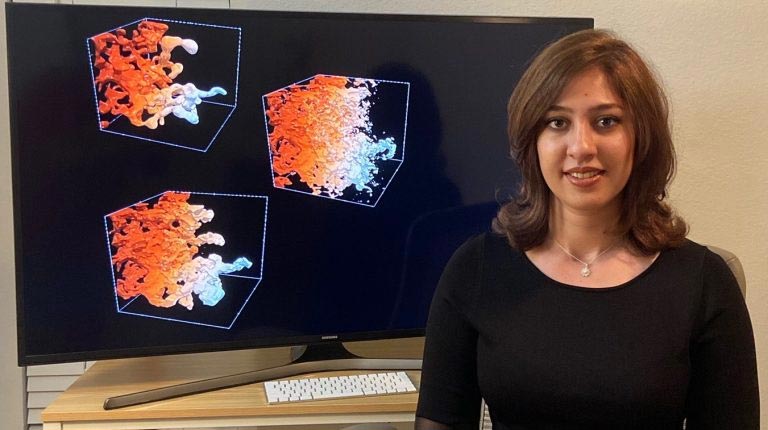
Understanding the dynamics of storage capacity at the level of the pore through high performance computing simulations provides one lens into how carbon capture and storage could be achieved on a large scale.
“Our research is basically trying to characterize geologic settings suitable for storage and exploring the way we inject CO₂ to make sure it’s safe, effective and poses no threat to people or groundwater resources,” said Bakhshian.
Using Machine Learning for Environmental Monitoring
Another aspect of Bakhshian’s research involves using machine learning techniques to develop computationally fast models that can estimate the storage capacity of reservoirs and assist with the environmental monitoring of CO₂.
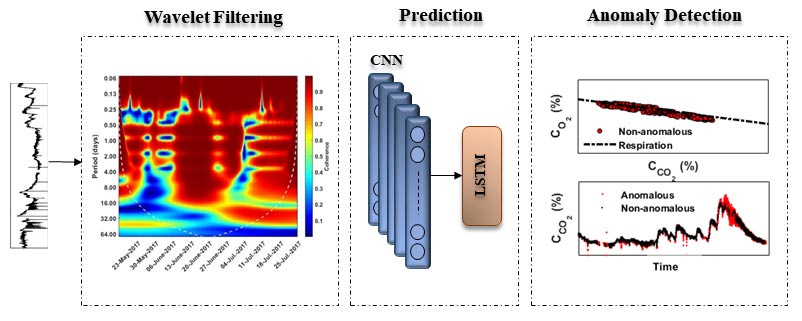
Writing in Environmental Science and Technology in October 2021, Bakhshian proposed a deep learning framework to detect anomalies in soil gas concentration sensor data. The model was trained on data acquired from sensors being used for environmental characterization at a prospective CO₂ storage site in Queensland, Australia.
Bakhshian’s method, which incorporates processes based on natural soil respiration into a deep learning framework, was able to detect anomalies in the sensor data that, in future applications, could represent either sensor errors or leakages.
“Having a trustworthy real-time anomaly detection framework that is trained using the streaming sensor data and guided by a process-based methodology could help facilitate environmental monitoring in future projects,” Bakhshian said.
According to the Global CCS Institute, the U.S. is one of the nations with the greatest potential for geologic CO₂ storage. Though some environmentalists argue that CCS is simply a way for energy companies to continue to extract fossil fuels, others, including the International Panel on Climate Change, include CCS as one of the ways the global community can achieve net-zero emissions by mid-century.
“It’s safe and effective,” said Bakhshian. “And computing will help us find economical ways to achieve this goal.”
Reference: “Dynamics of dissolution trapping in geological carbon storage” by SaharBakhshian, 16 November 2021, International Journal of Greenhouse Gas Control.
DOI: 10.1016/j.ijggc.2021.103520
Never miss a breakthrough: Join the SciTechDaily newsletter.
Follow us on Google and Google News.