

Black holes in dense stellar clusters could combine repeatedly to form objects bigger than anything a single star could produce.
When LIGO’s twin detectors first picked up faint wobbles in their respective, identical mirrors, the signal didn’t just provide first direct detection of gravitational waves — it also confirmed the existence of stellar binary black holes, which gave rise to the signal in the first place.
Stellar binary black holes are formed when two black holes, created out of the remnants of massive stars, begin to orbit each other. Eventually, the black holes merge in a spectacular collision that, according to Einstein’s theory of general relativity, should release a huge amount of energy in the form of gravitational waves.
Now, an international team led by MIT astrophysicist Carl Rodriguez suggests that black holes may partner up and merge multiple times, producing black holes more massive than those that form from single stars. These “second-generation mergers” should come from globular clusters — small regions of space, usually at the edges of a galaxy, that are packed with hundreds of thousands to millions of stars.
“We think these clusters formed with hundreds to thousands of black holes that rapidly sank down in the center,” says Carl Rodriguez, a Pappalardo fellow in MIT’s Department of Physics and the Kavli Institute for Astrophysics and Space Research. “These kinds of clusters are essentially factories for black hole binaries, where you’ve got so many black holes hanging out in a small region of space that two black holes could merge and produce a more massive black hole. Then that new black hole can find another companion and merge again.”
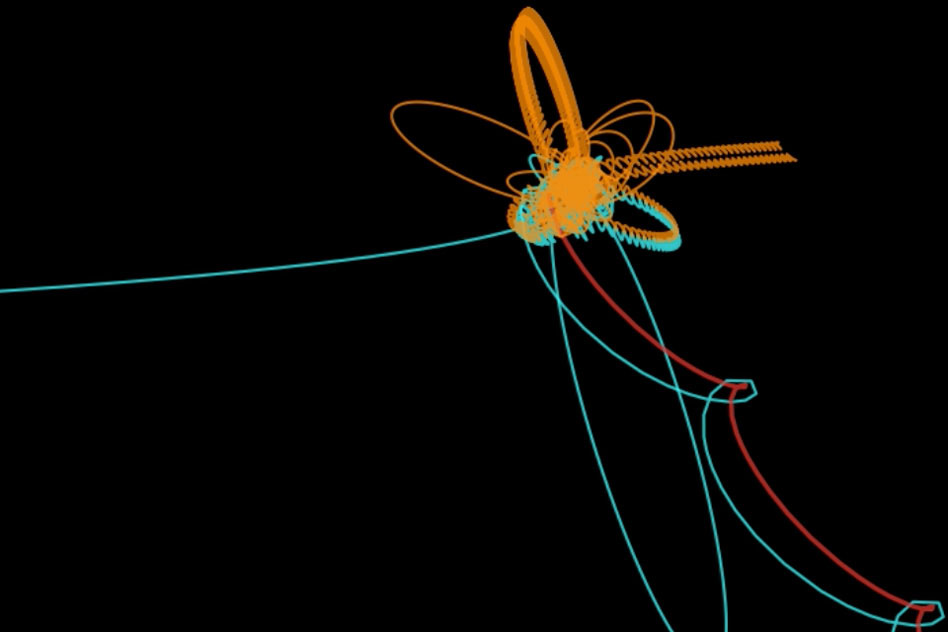
A simulation showing the dynamics of 50 black holes in the center of a star cluster, where two single black holes eventually form a binary black hole. Video: Northwestern Visualization/Carl Rodriguez
If LIGO detects a binary with a black hole component whose mass is greater than around 50 solar masses, then according to the group’s results, there’s a good chance that object arose not from individual stars, but from a dense stellar cluster.
“If we wait long enough, then eventually LIGO will see something that could only have come from these star clusters, because it would be bigger than anything you could get from a single star,” Rodriguez says.
He and his colleagues report their results in a paper appearing in Physical Review Letters.
Running stars
For the past several years, Rodriguez has investigated the behavior of black holes within globular clusters and whether their interactions differ from black holes occupying less populated regions in space.
Globular clusters can be found in most galaxies, and their number scales with a galaxy’s size. Huge, elliptical galaxies, for instance, host tens of thousands of these stellar conglomerations, while our own Milky Way holds about 200, with the closest cluster residing about 7,000 light years from Earth.
In their new paper, Rodriguez and his colleagues report using a supercomputer called Quest, at Northwestern University, to simulate the complex, dynamical interactions within 24 stellar clusters, ranging in size from 200,000 to 2 million stars, and covering a range of different densities and metallic compositions. The simulations model the evolution of individual stars within these clusters over 12 billion years, following their interactions with other stars and, ultimately, the formation and evolution of the black holes. The simulations also model the trajectories of black holes once they form.
“The neat thing is, because black holes are the most massive objects in these clusters, they sink to the center, where you get a high enough density of black holes to form binaries,” Rodriguez says. “Binary black holes are basically like giant targets hanging out in the cluster, and as you throw other black holes or stars at them, they undergo these crazy chaotic encounters.”
It’s all relative
When running their simulations, the researchers added a key ingredient that was missing in previous efforts to simulate globular clusters.
“What people had done in the past was to treat this as a purely Newtonian problem,” Rodriguez says. “Newton’s theory of gravity works in 99.9 percent of all cases. The few cases in which it doesn’t work might be when you have two black holes whizzing by each other very closely, which normally doesn’t happen in most galaxies.”
Newton’s theory of relativity assumes that, if the black holes were unbound to begin with, neither one would affect the other, and they would simply pass each other by, unchanged. This line of reasoning stems from the fact that Newton failed to recognize the existence of gravitational waves — which Einstein much later predicted would arise from massive orbiting objects, such as two black holes in close proximity.
“In Einstein’s theory of general relativity, where I can emit gravitational waves, then when one black hole passes near another, it can actually emit a tiny pulse of gravitational waves,” Rodriguez explains. “This can subtract enough energy from the system that the two black holes actually become bound, and then they will rapidly merge.”
The team decided to add Einstein’s relativistic effects into their simulations of globular clusters. After running the simulations, they observed black holes merging with each other to create new black holes, inside the stellar clusters themselves. Without relativistic effects, Newtonian gravity predicts that most binary black holes would be kicked out of the cluster by other black holes before they could merge. But by taking relativistic effects into account, Rodriguez and his colleagues found that nearly half of the binary black holes merged inside their stellar clusters, creating a new generation of black holes more massive than those formed from the stars. What happens to those new black holes inside the cluster is a matter of spin.
“If the two black holes are spinning when they merge, the black hole they create will emit gravitational waves in a single preferred direction, like a rocket, creating a new black hole that can shoot out as fast as 5,000 kilometers per second — so, insanely fast,” Rodriguez says. “It only takes a kick of maybe a few tens to a hundred kilometers per second to escape one of these clusters.”
Because of this effect, scientists have largely figured that the product of any black hole merger would get kicked out of the cluster, since it was assumed that most black holes are rapidly spinning.
This assumption, however, seems to contradict the measurements from LIGO, which has so far only detected binary black holes with low spins. To test the implications of this, Rodriguez dialed down the spins of the black holes in his simulations and found that in this scenario, nearly 20 percent of binary black holes from clusters had at least one black hole that was formed in a previous merger. Because they were formed from other black holes, some of these second-generation black holes can be in the range of 50 to 130 solar masses. Scientists believe black holes of this mass cannot form from a single star.
Rodriguez says that if gravitational-wave telescopes such as LIGO detect an object with a mass within this range, there is a good chance that it came not from a single collapsing star, but from a dense stellar cluster.
“My co-authors and I have a bet against a couple of people studying binary star formation that within the first 100 LIGO detections, LIGO will detect something within this upper mass gap,” Rodriguez says. “I get a nice bottle of wine if that happens to be true.”
Reference: “Post-Newtonian Dynamics in Dense Star Clusters: Highly Eccentric, Highly Spinning, and Repeated Binary Black Hole Mergers” by Carl L. Rodriguez, Pau Amaro-Seoane, Sourav Chatterjee and Frederic A. Rasio, 10 April 2018, Physical Review Letters.
DOI: 10.1103/PhysRevLett.120.151101
This research was supported in part by the MIT Pappalardo Fellowship in Physics, NASA, the National Science Foundation, the Center for Interdisciplinary Exploration and Research in Astrophysics (CIERA) at Northwestern University, the Institute of Space Sciences (ICE, CSIC) and Institut d’Estudis Espacials de Catalunya (IEEC), and the Tata Institute of Fundamental Research in Mumbai, India.
Never miss a breakthrough: Join the SciTechDaily newsletter.
Follow us on Google and Google News.