
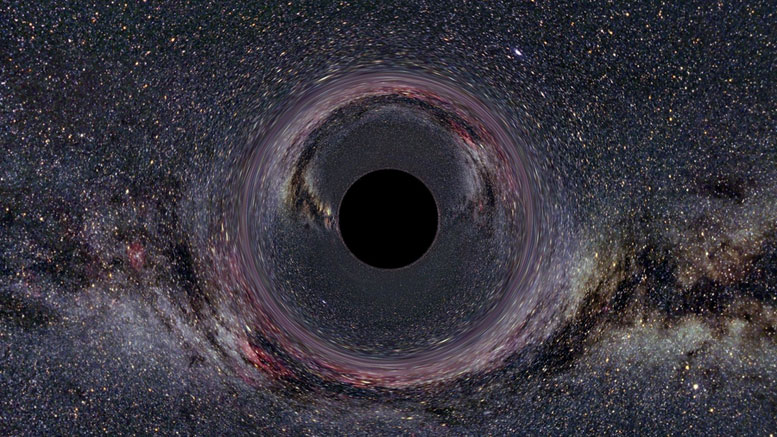
Astrophysicists have been hard at work trying to determine how black holes can come together and merge. A newly published study from the University of Birmingham provides a better understanding to this mystery of gravitational-wave astrophysics.
Using the twin LIGO instruments in Louisiana and Washington, international scientists detected gravitational waves for the first time on September 14, 2015. This discovery confirmed a major prediction of Albert Einstein’s 1915 general theory of relativity and opened an unprecedented new window onto the cosmos. However, scientists still do not know how such pairs of merging black holes form.
During its first sixteen weeks of taking data, the Advanced Laser Interferometer Gravitational-wave Observatory (aLIGO) has observed gravitational waves from two binary black hole mergers, GW150914 and GW151226, along with the statistically less significant binary black hole merger candidate LVT151012.
The new study, published in Nature Communications, details the results of an investigation into the formation of gravitational-wave sources with a newly developed toolkit named COMPAS (Compact Object Mergers: Population Astrophysics and Statistics).
In order for the black holes to merge within the age of the Universe by emitting gravitational waves, they must start out very close together by astronomical standards, no more than about a fifth of the distance between the Earth and the Sun. However, massive stars, which are the progenitors of the black holes that LIGO has observed, expand to be much larger than this in the course of their evolution. The key challenge, then, is how to fit such large stars within a very small orbit. Several possible scenarios have been proposed to address this.
Astrophysicists from the University of Birmingham, in collaboration with Professor Selma de Mink from the University of Amsterdam, have shown that all three observed events can be formed via the same formation channel: isolated binary evolution via a common-envelope phase.
In this channel, two massive progenitor stars start out at quite wide separations. The stars interact as they expand, engaging in several episodes of mass transfer. The latest of these is typically a common envelope – a very rapid, dynamically unstable mass transfer that envelops both stellar cores in a dense cloud of hydrogen gas. Ejecting this gas from the system takes energy away from the orbit. This brings the two stars sufficiently close together for gravitational-wave emission to be efficient, right at the time when they are small enough that such closeness will no longer put them into contact.
The whole process takes a few million years to form two black holes, with a possible subsequent delay of billions of years before the black holes merge and form a single black hole.
The simulations have also helped the scientists understand the typical properties of the stars that can go on to form such pairs of merging black holes and the environments where this can happen. For example, the team concluded that a merger of two black holes with significantly unequal masses would be a strong indication that the stars formed almost entirely from hydrogen and helium, with other elements contributing fewer than 0.1% of stellar matter (for comparison, this fraction is about 2% in the Sun).
First author Simon Stevenson, a Ph.D. student at the University of Birmingham, explained: “The beauty of COMPAS is that it allows us to combine all of our observations and start piecing together the puzzle of how these black holes merge, sending these ripples in spacetime that we were able to observe at LIGO.”
Senior author Professor Ilya Mandel added: “This work makes it possible to pursue a kind of ‘paleontology’ for gravitational waves. A paleontologist, who has never seen a living dinosaur, can figure out how the dinosaur looked and lived from its skeletal remains. In a similar way, we can analyze the mergers of black holes, and use these observations to figure out how those stars interacted during their brief but intense lives.”
Reference: “Formation of the first three gravitational-wave observations through isolated binary evolution” by Simon Stevenson, Alejandro Vigna-Gómez, Ilya Mandel, Jim W. Barrett, Coenraad J. Neijssel, David Perkins and Selma E. de Mink, 5 April 2017, Nature Communications.
DOI: 10.1038/ncomms14906
Never miss a breakthrough: Join the SciTechDaily newsletter.
Follow us on Google and Google News.