
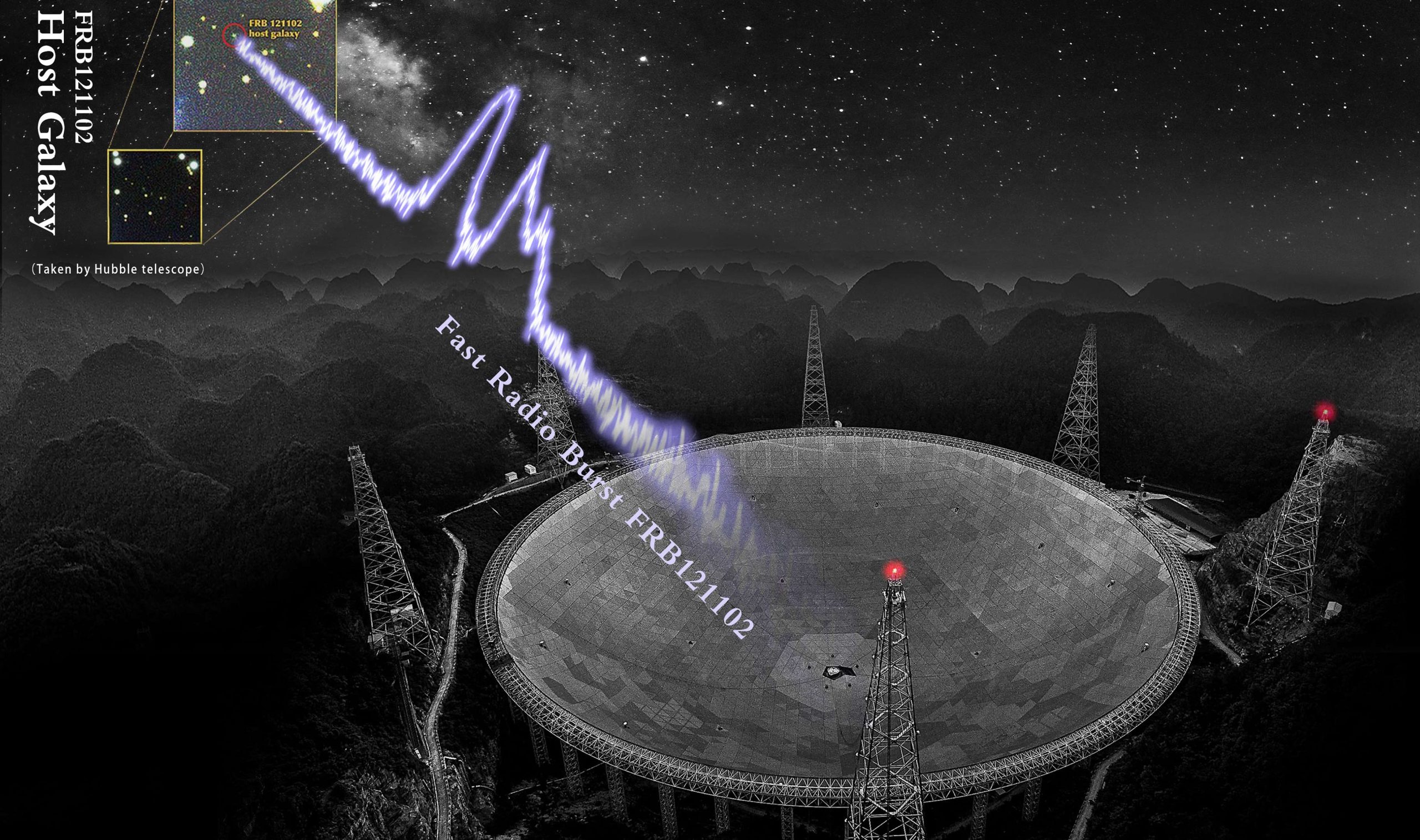
AST Telescope Captures Record-Breaking FRB Outburst
An international research team caught an extreme episode of cosmic explosions from Fast Radio Burst (FRB) 121102, using the Five-hundred-meter Aperture Spherical radio Telescope (FAST). A total of 1,652 independent bursts were detected within 47 days starting August 29, 2019 (UT). The researchers were led by Professor Di Li and Dr. Pei Wang from the National Astronomical Observatories of the Chinese Academy of Sciences (NAOC).
It is the largest set of FRB events so far, more than the number reported in all other publications combined. Such a burst set allows for the determination, for the first time, of the characteristic energy and energy distribution of any FRB, thus shedding light on the central engine powering FRBs.
These results were published in the journal Nature on October 13, 2021.
FRBs were first detected by astronomers in 2007. These cosmic explosions can be as short as one-thousandth of a second while producing one year’s worth of the Sun’s total energy output. The origin of FRBs is still unknown. Although even aliens have been considered in models for FRBs, natural causes are clearly favored by the observations. The recent focuses include exotic hyper-magnetized neutron stars, black holes, and cosmic strings left over from the Big Bang.
Scientists have found that a small fraction of FRBs repeat. This phenomenon facilitates follow-up studies, including localization and identification of FRBs’ host galaxies.
FRB 121102 is the first known repeater and the first well-localized FRB. Scientists have identified its origin in a dwarf galaxy. In addition, this FRB is clearly associated with a persistent radio source. Both clues are crucial to solving the cosmic mystery of FRBs. The behavior of FRB 121102 is hard to predict and commonly described as “seasonal.”
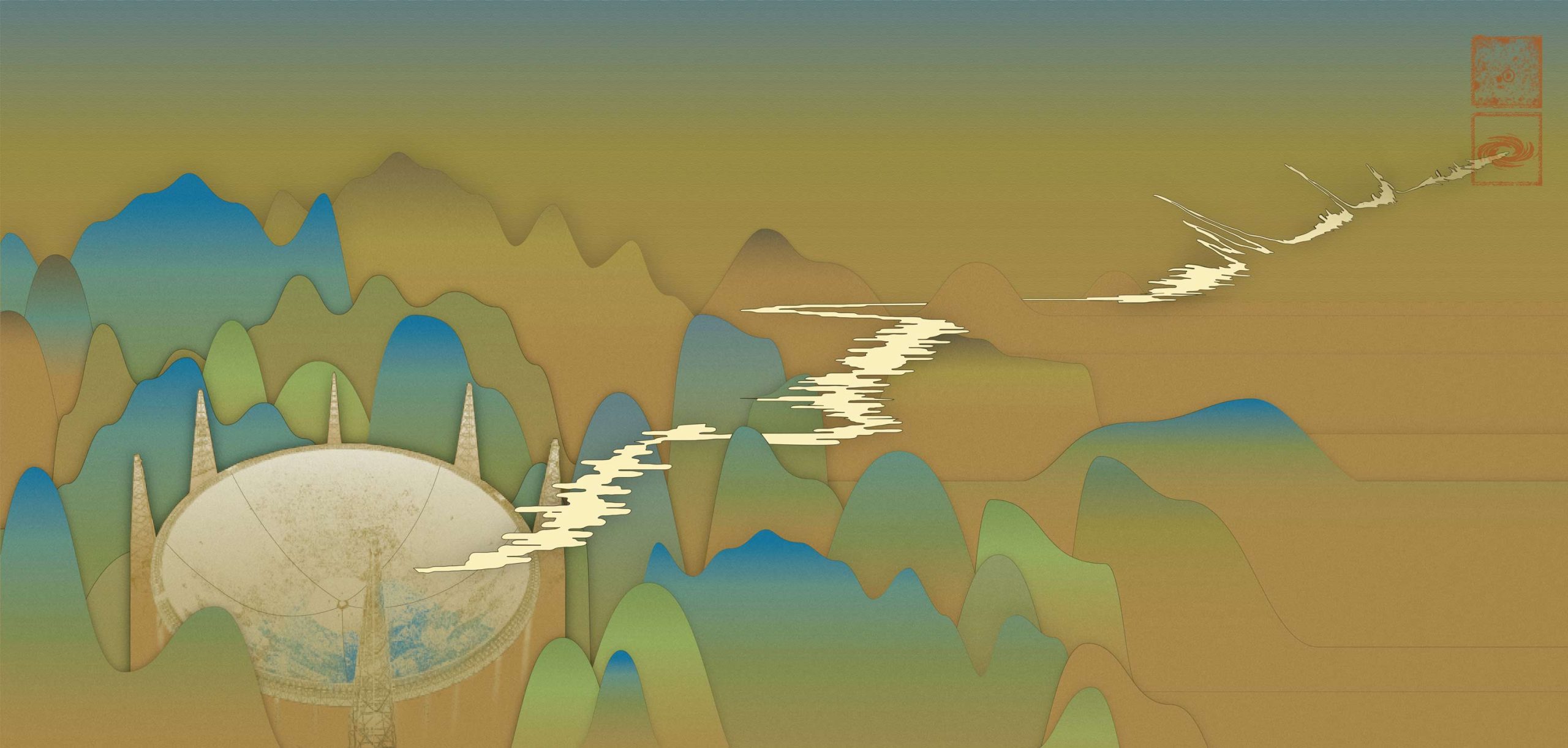
While testing the FAST FRB backend during the commissioning phase, the team noticed that FRB 121102 was acting up with frequent bright pulses. Between August 29 and October 29, 2019, 1,652 independent burst events were detected in a total of 59.5 hours. While the burst cadence varied during the series, 122 bursts were seen during the peak hour, corresponding to the highest event rate ever observed for any FRB.
Statistical Insights into Burst Energy
Such high cadence facilitates a statistical study of these FRB bursts. The researchers found a clear characteristic energy of E0= 4.8 × 1037 erg, below which the generation of the bursts became less efficient. The burst energy distribution can be adequately described as bimodal, namely, a log-normal function for low E bursts and a Lorentz function for high E bursts, implying that weaker FRB pulses may be stochastic in nature and the stronger ones involve a ratio between two independent quantities.
“The total energy of this burst set already adds up to 3.8% of what is available from a magnetar and no periodicity was found between 1 ms and 1000 s, both of which severely constrains the possibility that FRB 121102 comes from an isolated compact object,” said Dr. WANG.
More than six new FRBs have been discovered through the Commensal Radio Astronomy FAST Survey (CRAFTS, https://crafts.bao.ac.cn/), including one new 121102-like repeater. “As the world’s largest antenna, FAST’s sensitivity proves to be conducive to revealing intricacies of cosmic transients, including FRBs,” said Prof. LI.
This project has been part of a long-running collaboration since the commissioning phase of the FAST telescope. Major partner institutions include Guizhou Normal University, University of Nevada Las Vegas, Cornell University, Max-Planck-Institut fuer Radioastronomie, West Virginia University, CSIRO, University of California Berkeley, and Nanjing University.
Reference: “A bimodal burst energy distribution of a repeating fast radio burst source” by D. Li, P. Wang, W. W. Zhu, B. Zhang, X. X. Zhang, R. Duan, Y. K. Zhang, Y. Feng, N. Y. Tang, S. Chatterjee, J. M. Cordes, M. Cruces, S. Dai, V. Gajjar, G. Hobbs, C. Jin, M. Kramer, D. R. Lorimer, C. C. Miao, C. H. Niu, J. R. Niu, Z. C. Pan, L. Qian, L. Spitler, D. Werthimer, G. Q. Zhang, F. Y. Wang, X. Y. Xie, Y. L. Yue, L. Zhang, Q. J. Zhi and Y. Zhu, 13 October 2021, Nature.
DOI: 10.1038/s41586-021-03878-5
Never miss a breakthrough: Join the SciTechDaily newsletter.
Follow us on Google and Google News.
4 Comments
Lemme see… A discrete, isomorphic wave “signature” with a “possible” source “body”, 10 miles in diameter. I can understand why SETI is interested.
Hmm… maybe “they” are speaking GREEK… to us; “symbolically” speaking.
Hey. Yuh never know. Never say never and never say NO. It’s called SCIENTIFIC METHOD.
✋
If im honest the burst rate kinda looks like a wav form
It’s to my conclusion that we have just broken ground with an inconclusive journey into the vastness of our “UNIVERSE” LET ALONE,THE “(OVERWHELMING knowledge)” that space times are infinite,that given to the gravity ✨ of a “theory of an endless universe,especially governing “Black ⚫ Holes and Cryophysics along with the “Great Bang” theory, but we are only young children after all, in retrospect of what’s out there 🥶👽
This is 2023 and in looking at the chart the burst intense value was increased when coupling to a gravitational way.