
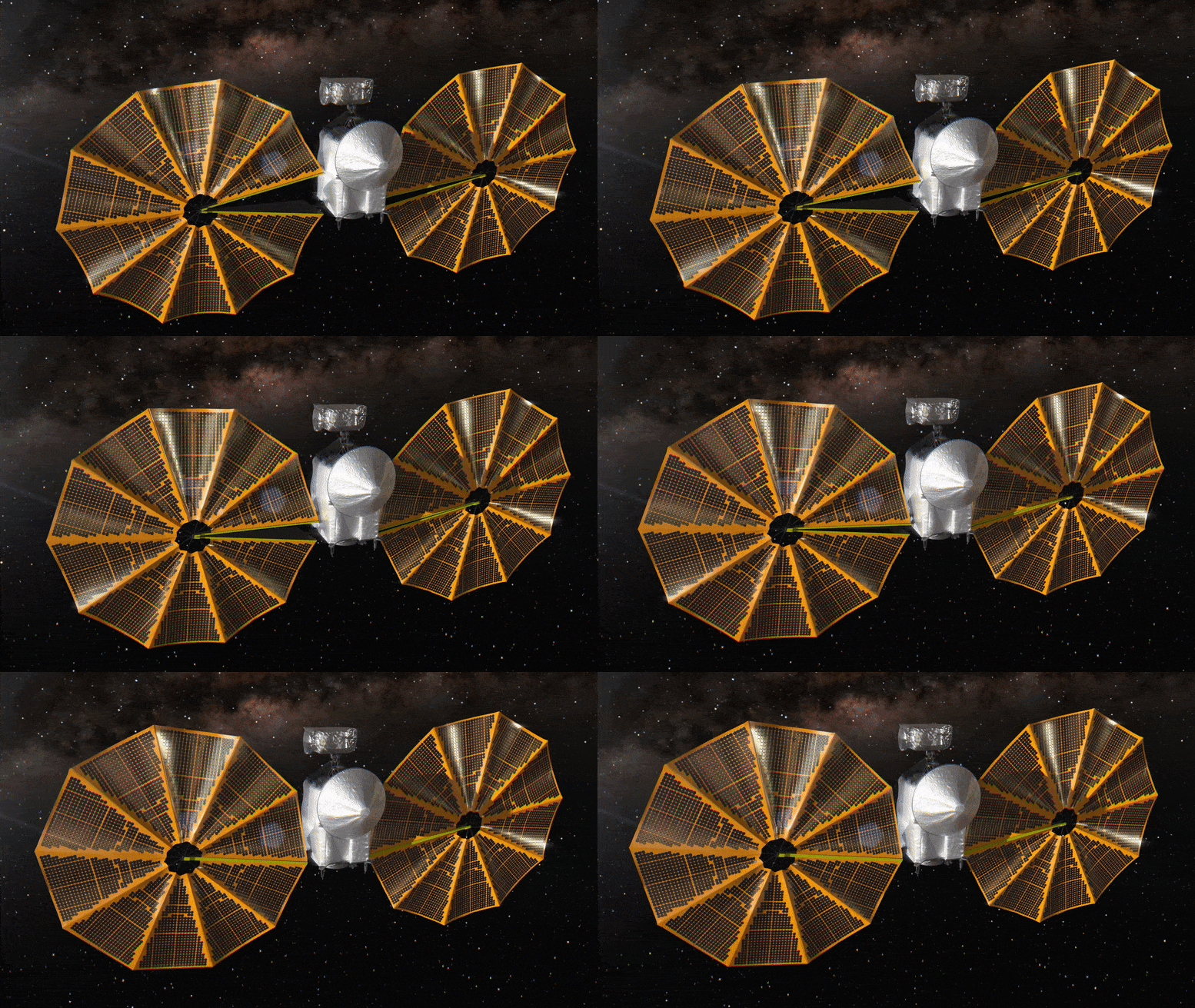
Where will you be and what will you be up to in August of 2027? What about March of 2033? NASA knows exactly where the Lucy spacecraft will be: flying by never-before-explored Trojan asteroids!
After launching in October 2021, the Lucy spacecraft will journey for 12 years, observing one main belt asteroid and seven Trojan asteroids. These asteroids are billions of years old and the remnants of planet formation, serving as ancient time capsules from our early solar system. Trapped in their stable orbits, the Trojans form two “swarms” that lead in front of and trail behind the planet Jupiter in its path around the Sun.
To follow along with the Lucy mission on its 12-year journey, NASA invites you to build your very own Lucy Time Capsule.
Where will you be and what will you be up to in August of 2027? What about March of 2033? The NASA Lucy mission invites you follow along with Lucy on this 12-year journey by building your very own #LucyTimeCapsule. What will you put in yours? Credit: NASA’s Goddard Space Flight Center
What objects, sounds, ideas, or words will serve as memories for you and your family to look back upon as Lucy carries out its mission into the next decade? What is “so” 2021? Will it be the baby shoes your little one just outgrew? Maybe you’ll print off the Trojan asteroid trading cards. What about your comfy sweatpants? A picture of your pet gerbil? But not your real pet gerbil! A new favorite recipe for lasagna? But not the actual lasagna! You get the idea.
What will you put in your Lucy Time Capsule?
Grab a reusable container with a top, like a shoebox, a tennis ball canister, or a freezer bag, and fill it up!
What will remind you of the year that Lucy launches?
Show NASA your Lucy TimCapsule!
Post a photo, drawing, video, or other description of your Lucy Time Capsule on social media (Twitter, Facebook or Instagram) and use the hashtag #LucyTimeCapsule. If a post catches NASA’s eye, we may re-share it on our social media accounts.
Words of Wisdom
Lucy is carrying a time capsule of its own in the form of a plaque, inscribed with quotes and poems from songwriters, authors and poets. After its 12-year mission, the spacecraft will continue orbiting the Sun, traveling between Earth and the Trojan asteroids for hundreds of thousands, if not millions, of years. The Lucy team placed the plaque on the spacecraft with hopes that our descendants may one day retrieve Lucy and learn of the early days of humanity’s exploration of the solar system.
What message or words of wisdom would you include in your Lucy Time Capsule for your future self and family to find? Write it down in a letter to yourself to capture your memories and messages. Tuck it into your shoebox, too. Or tape it to the outside, just like a plaque!

Revisit your Lucy Time Capsule and continue to add to it!
At each of the Lucy mission milestones and asteroid encounters, we’ll be taking a trip down memory lane, and invite you to join us. Peek back in your Lucy Time Capsule. How have you changed? How has the world changed? What has stayed the same? Where will you be for the next milestone?
While you’re in there, add something new to mark the occasion! Don’t forget to post your thoughts and additions to social media with the hashtag #LucyTimeCapsule.
Mark these Lucy Mission Milestone dates on your calendar:
- October 15, 2022 – Lucy has its first Earth flyby and gravity assist to pick up speed.
- December 12, 2024 – Lucy has its second Earth flyby and gravity assist, sending the spacecraft out toward the Trojan asteroids.
- April 20, 2025 – Lucy flies by the main belt asteroid (52246) Donaldjohanson.
- August 12, 2027 – Lucy has its first encounter with not one, but two(!), Trojan asteroids: Eurybates (3548) and its satellite, Queta.
- September 15, 2027 – Lucy flies by the Trojan asteroid Polymele (15094).
- April 18, 2028 – Lucy flies by the Trojan asteroid Leucus (11351).
- November 11, 2028 – Lucy flies by the Trojan asteroid Orus (21900) and then heads back toward Earth.
- December 25, 2030 – Lucy has its third Earth flyby and gravity assist and then heads out toward the Trojan asteroids trailing Jupiter.
- March 3, 2033 – Lucy flies by the binary pair Patroclus and Menoetius.
- 2033 and beyond – Lucy continues to orbit the Sun, passing through the alternating Trojan swarms for hundreds of thousands, if not millions, of years!
Never miss a breakthrough: Join the SciTechDaily newsletter.
Follow us on Google and Google News.
1 Comment
What is the propulsion system for Lucy? System design?