
Close Menu
    Facebook X (Twitter) Instagram
    SciTechDaily
    • Biology
    • Chemistry
    • Earth
    • Health
    • Physics
    • Science
    • Space
    • Technology
    Facebook X (Twitter) Pinterest YouTube RSS
    SciTechDaily
    Home»Space»Astronomers Reveal Farthest Stars in Milky Way Were Ripped from Another Galaxy
    Space

    Astronomers Reveal Farthest Stars in Milky Way Were Ripped from Another Galaxy

    By Harvard-Smithsonian Center for AstrophysicsJanuary 11, 2017No Comments3 Mins Read
    Facebook Twitter Pinterest Telegram LinkedIn WhatsApp Email Reddit
    Share
    Facebook Twitter LinkedIn Pinterest Telegram Email Reddit
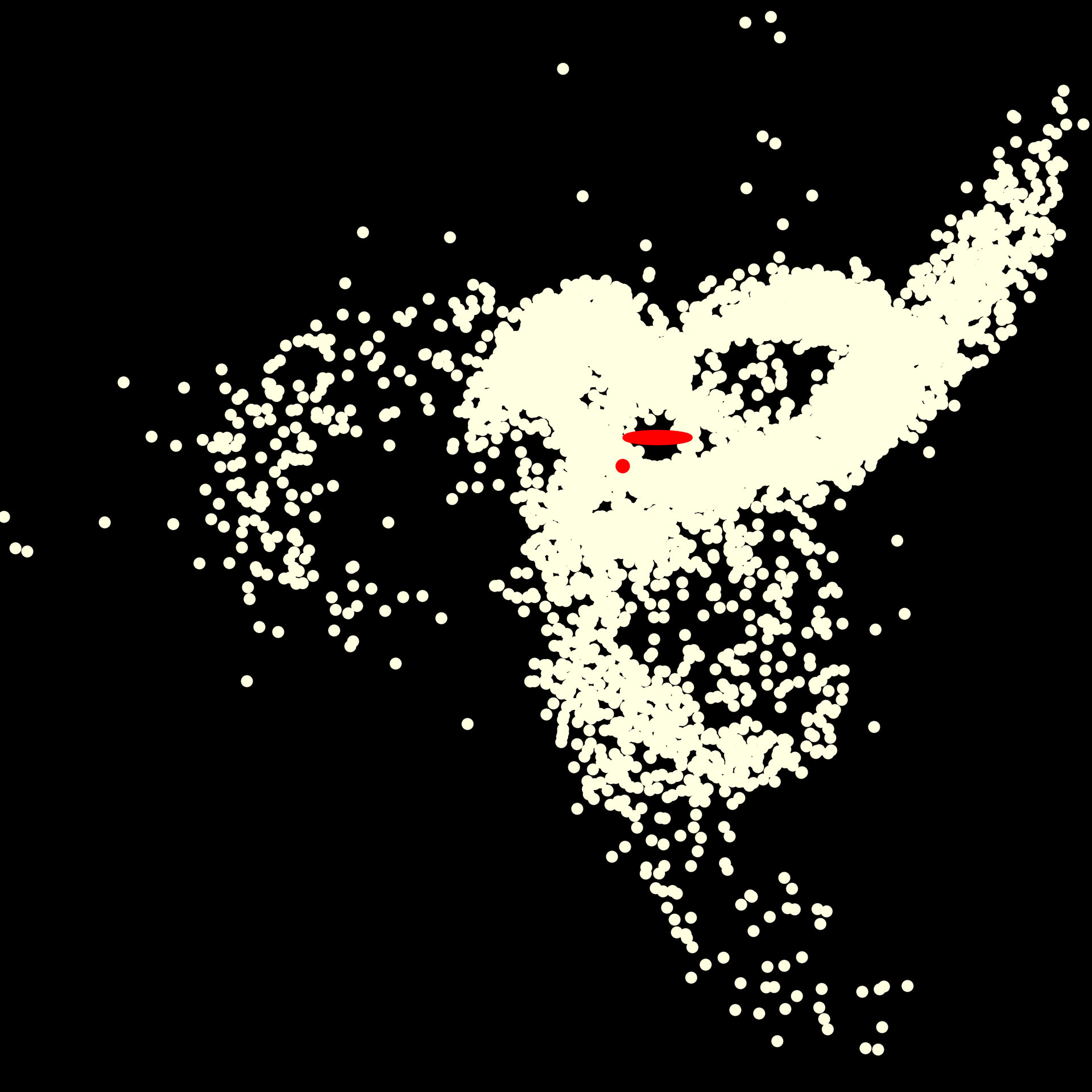
    Astronomers Reveal Stars in Milky Way Ripped from Another Galaxy
    In this computer-generated image, a red oval marks the disk of our Milky Way galaxy and a red dot shows the location of the Sagittarius dwarf galaxy. The yellow circles represent stars that have been ripped from the Sagittarius dwarf and flung far across space.

    New research reveals that five of the 11 farthest known stars in our galaxy were ripped from another galaxy – the Sagittarius dwarf.

    The 11 farthest known stars in our galaxy are located about 300,000 light-years from Earth, well outside the Milky Way’s spiral disk. New research by Harvard astronomers shows that half of those stars might have been ripped from another galaxy: the Sagittarius dwarf. Moreover, they are members of a lengthy stream of stars extending one million light-years across space, or 10 times the width of our galaxy.

    “The star streams that have been mapped so far are like creeks compared to the giant river of stars we predict will be observed eventually,” says lead author Marion Dierickx of the Harvard-Smithsonian Center for Astrophysics (CfA).

    The Sagittarius dwarf is one of dozens of mini-galaxies that surround the Milky Way. Over the age of the universe it made several loops around our galaxy. On each passage, the Milky Way’s gravitational tides tugged on the smaller galaxy, pulling it apart like taffy.

    Dierickx and her Ph.D. advisor, Harvard theorist Avi Loeb, used computer models to simulate the movements of the Sagittarius dwarf over the past 8 billion years. They varied its initial velocity and angle of approach to the Milky Way to determine what best matched current observations.


    This movie simulates several passages of the Sagittarius dwarf galaxy past the galactic center (GC) of the Milky Way over the course of 8 billion years. The blue and red particles represent dark matter and stars, respectively.

    “The starting speed and approach angle have a big effect on the orbit, just like the speed and angle of a missile launch affect its trajectory,” explains Loeb.

    At the beginning of the simulation, the Sagittarius dwarf weighed about 10 billion times the mass of our Sun, or about one percent of the Milky Way’s mass. Dierickx’s calculations showed that over time, the hapless dwarf lost about a third of its stars and a full nine-tenths of its dark matter. This resulted in three distinct streams of stars that reach as far as one million light-years from the Milky Way’s center. They stretch all the way out to the edge of the Milky Way halo and display one of the largest structures observable in the sky.

    Moreover, five of the 11 most distant stars in our galaxy have positions and velocities that match what you would expect of stars stripped from the Sagittarius dwarf. The other six do not appear to be from Sagittarius, but might have been removed from a different dwarf galaxy.

    Mapping projects like the Sloan Digital Sky Survey have charted one of the three streams predicted by these simulations, but not to the full extent that the models suggest. Future instruments like the Large Synoptic Survey Telescope, which will detect much fainter stars across the sky, should be able to identify the other streams.

    “More interlopers from Sagittarius are out there just waiting to be found,” says Dierickx.

    These findings have been accepted for publication in The Astrophysical Journal.

    Reference: “Predicted Extension of the Sagittarius Stream to the Milky Way Virial Radius” by Marion I. P. Dierickx and Abraham Loeb, 10 February 2017, The Astrophysical Journal.
    DOI: 10.3847/1538-4357/836/1/92
    arXiv: 1611.00089

    Never miss a breakthrough: Join the SciTechDaily newsletter.
    Follow us on Google and Google News.

    Astronomy Astrophysics Harvard-Smithsonian Center for Astrophysics
    Share. Facebook Twitter Pinterest LinkedIn Email Reddit

    Related Articles

    X-Ray Emission From Mysterious Dark Matter

    Analyzing Dust Storm Sequences on Mars

    Intriguing Remains of a Rare Stellar Explosion Discovered in Milky Way Center

    Puzzling Astrophysics of Quasars in the Early Universe

    Four Exoplanets – Including a Super-Earth Planet – Discovered by High School Students

    Massive Rotating Stars in the Pleiades Cluster

    Astronomers Discover First Cloudless, Jupiter-Like Planet – “Smoking Gun Evidence”

    Chandra X-ray Observatory Studies Extraordinary Magnetar [Video]

    Chandra Studies Extraordinary Magnetar: Fastest Spinning and Possibly the Youngest Magnetar Known

    Leave A Reply Cancel Reply

    • Facebook
    • Twitter
    • Pinterest
    • YouTube

    Don't Miss a Discovery

    Subscribe for the Latest in Science & Tech!

    Trending News

    First-of-Its-Kind Discovery: Homer’s Iliad Found Embedded in a 1,600-Year-Old Egyptian Mummy

    Beyond Inflammation: Scientists Uncover New Cause of Persistent Rheumatoid Arthritis

    A Simple Molecule Could Unlock Safer, Easier Weight Loss

    Scientists Just Built a Quantum Battery That Charges Almost Instantly

    Researchers Unveil Groundbreaking Sustainable Solution to Vitamin B12 Deficiency

    Millions of People Have Osteopenia Without Realizing It – Here’s What You Need To Know

    Researchers Discover Boosting a Single Protein Helps the Brain Fight Alzheimer’s

    World-First Study Reveals Human Hearts Can Regenerate After a Heart Attack

    Follow SciTechDaily
    • Facebook
    • Twitter
    • YouTube
    • Pinterest
    • Newsletter
    • RSS
    SciTech News
    • Biology News
    • Chemistry News
    • Earth News
    • Health News
    • Physics News
    • Science News
    • Space News
    • Technology News
    Recent Posts
    • After Decades, MIT Researchers Capture the First 3D Atomic View of a Mysterious Material
    • Your Favorite Fishing Spot Is Turning Brown – and the Fish Are Changing
    • 380-Million-Year-Old Fish Fossil Reveals Secrets of Life’s First Steps Onto Land
    • Mezcal “Worm” in a Bottle Mystery: DNA Testing Reveals a Surprise
    • Scientists Turn Red Lettuce Green, Unlocking Hidden Nutrients
    Copyright © 1998 - 2026 SciTechDaily. All Rights Reserved.
    • Science News
    • About
    • Contact
    • Editorial Board
    • Privacy Policy
    • Terms of Use

    Type above and press Enter to search. Press Esc to cancel.