
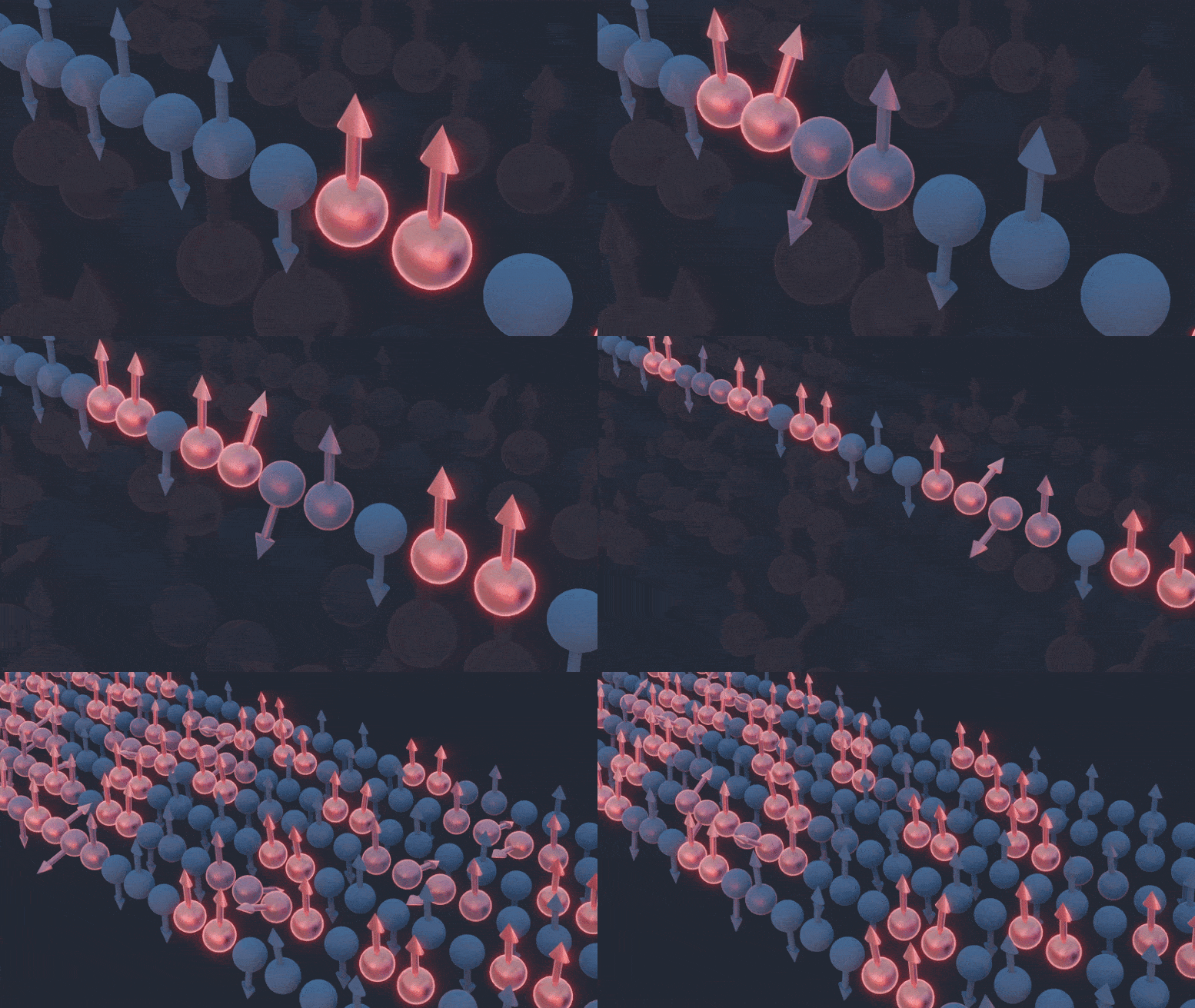
KPZ dynamics, once seen only in classical systems, are now confirmed in quantum spin chains at room temperature. This phenomenon bridges ballistic and diffusive transport, offering new opportunities for spintronics and quantum technologies.
Using complementary computing calculations and neutron scattering techniques, researchers from the Department of Energy’s Oak Ridge and Lawrence Berkeley national laboratories and the University of California, Berkeley, discovered the existence of an elusive type of spin dynamics in a quantum mechanical system.
The team successfully simulated and measured how magnetic particles called spins can exhibit a type of motion known as Kardar-Parisi-Zhang, or KPZ, in solid materials at various temperatures. Until now, scientists had not found evidence of this particular phenomenon outside of soft matter and other classical materials.
These findings, which were published in Nature Physics, show that the KPZ scenario accurately describes the changes in time of spin chains — linear channels of spins that interact with one another but largely ignore the surrounding environment — in certain quantum materials, confirming a previously unproven hypothesis.
“Seeing this kind of behavior was surprising, because this is one of the oldest problems in the quantum physics community, and spin chains are one of the key foundations of quantum mechanics,” said Alan Tennant, who leads a project on quantum magnets at the Quantum Science Center, or QSC, headquartered at ORNL.
Observing this unconventional behavior provided the team with insights into the nuances of fluid properties and other underlying features of quantum systems that could eventually be harnessed for various applications. A better understanding of this phenomenon could inform the improvement of heat transport capabilities using spin chains or facilitate future efforts in the field of spintronics, which saves energy and reduces noise that can disrupt quantum processes by manipulating a material’s spin instead of its charge.
Typically, spins proceed from place to place through either ballistic transport, in which they travel freely through space, or diffusive transport, in which they bounce randomly off impurities in the material – or each other – and slowly spread out.
But fluid spins are unpredictable, sometimes displaying unusual hydrodynamical properties, such as KPZ dynamics, an intermediate category between the two standard forms of spin transport. In this case, special quasiparticles roam randomly throughout a material and affect every other particle they touch.
From Coffee Rings to Quantum Spins
“The idea of KPZ is that, if you look at how the interface between two materials evolves over time, you see a certain kind of scaling akin to a growing pile of sand or snow, like a form of real-world Tetris where shapes build on each other unevenly instead of filling in the gaps,” said Joel Moore, a professor at UC Berkeley, senior faculty scientist at LBNL and chief scientist of the QSC.
Another everyday example of KPZ dynamics in action is the mark left on a table, coaster, or other household surface by a hot cup of coffee. The shape of the coffee particles affects how they diffuse. Round particles pile up at the edge as the water evaporates, forming a ring-shaped stain. However, oval particles exhibit KPZ dynamics and prevent this movement by jamming together like Tetris blocks, resulting in a filled-in circle.
KPZ behavior can be categorized as a universality class, meaning that it describes the commonalities between these seemingly unrelated systems based on the mathematical similarities of their structures in accordance with the KPZ equation, regardless of the microscopic details that make them unique.
To prepare for their experiment, the researchers first completed simulations with resources from ORNL’s Compute and Data Environment for Science, as well as LBNL’s Lawrencium computational cluster and the National Energy Research Scientific Computing Center, a DOE Office of Science user facility located at LBNL. Using the Heisenberg model of isotropic spins, they simulated the KPZ dynamics demonstrated by a single 1D spin chain within potassium copper fluoride.
“This material has been studied for almost 50 years because of its 1D behavior, and we chose to focus on it because previous theoretical simulations showed that this setting was likely to yield KPZ hydrodynamics,” said Allen Scheie, a postdoctoral research associate at ORNL.

The team then used the SEQUOIA spectrometer at the Spallation Neutron Source, a DOE Office of Science user facility located at ORNL, to examine a previously unexplored region within a physical crystal sample and to measure the collective KPZ activity of real, physical spin chains. Neutrons are an exceptional experimental tool for understanding complex magnetic behavior due to their neutral charge and magnetic moment and their ability to penetrate materials deeply in a nondestructive fashion.
High-Temperature Quantum Effects
Both methods revealed evidence of KPZ behavior at room temperature, a surprising accomplishment considering that quantum systems usually must be cooled to almost absolute zero to exhibit quantum mechanical effects. The researchers anticipate that these results would remain unchanged, regardless of variations in temperature.
“We’re seeing pretty subtle quantum effects surviving to high temperatures, and that’s an ideal scenario because it demonstrates that understanding and controlling magnetic networks can help us harness the power of quantum mechanical properties,” Tennant said.
This project began during the development of the QSC, one of five recently launched Quantum Information Science Research Centers competitively awarded to multi-institutional teams by DOE. The researchers had realized their combined interests and expertise perfectly positioned them to tackle this notoriously difficult research challenge.
Through the QSC and other avenues, they plan to complete related experiments to cultivate a better understanding of 1D spin chains under the influence of a magnetic field, as well as similar projects focused on 2D systems.
“We showed spin moving in a special quantum mechanical way, even at high temperatures, and that opens up possibilities for many new research directions,” Moore said.
Reference: “Detection of Kardar–Parisi–Zhang hydrodynamics in a quantum Heisenberg spin-1/2 chain” by A. Scheie, N. E. Sherman, M. Dupont, S. E. Nagler, M. B. Stone, G. E. Granroth, J. E. Moore and D. A. Tennant, 11 March 2021, Nature Physics.
DOI: 10.1038/s41567-021-01191-6
This work was funded by the DOE Office of Science. Additional support was provided by the Quantum Science Center, a DOE Office of Science National Quantum Information Science Research Center, and the Simons Foundation’s Investigator program.
Never miss a breakthrough: Join the SciTechDaily newsletter.
Follow us on Google and Google News.
1 Comment
ask yourself
i why are u red in the face when you are standing upright
ask yourself
ii why are u blue in the face when you are standing upside down
ask yourself
iii why does north become south
ask yourself
iv why does your face always point north
ask yourself
v why does a red arrow point upwards when it stands upright
ask yourself
vi why does a red arrow pointing upwards become blue when pointing downwards
ask yourself
vii why does a red arrow pointing polar north become red pointing polar south
ask yourself
why is upright always upright and upside down always upside down
ask yourself
why does rubbing up against the equator make you turn around