

New observations of the atomic structure of iron reveal it undergoes “twinning” under extreme stress and pressure.
Far below you lies a sphere of solid iron and nickel about as wide as the broadest part of Texas: the Earth’s inner core. The metal at the inner core is under pressure about 360 million times higher than we experience in our everyday lives and temperatures approximately as hot as the Sun’s surface.
Earth’s planetary core is thankfully intact. But in space, similar cores can collide with other objects, causing the crystalline materials of the core to deform rapidly. Some asteroids in our solar system are massive iron objects that scientists suspect are the remnants of planetary cores after catastrophic impacts.
Measuring what happens during the collision of celestial bodies or at the Earth’s core is obviously not very practical. As such, much of our understanding of planetary cores is based on experimental studies of metals at less extreme temperatures and pressures. But researchers at the Department of Energy’s SLAC National Accelerator Laboratory have now observed for the first time how iron’s atomic structure deforms to accommodate the stress from the pressures and temperatures that occur just outside of the inner core.
The results appear in Physical Review Letters, where they have been highlighted as an Editor’s Suggestion.
Coping With Stress
Most of the iron you encounter in your everyday life has its atoms arranged in nanoscopic cubes, with an iron atom at each corner and one in the center. If you squeeze these cubes by applying extremely high pressures, they rearrange into hexagonal prisms, which allow the atoms to pack in more tightly.
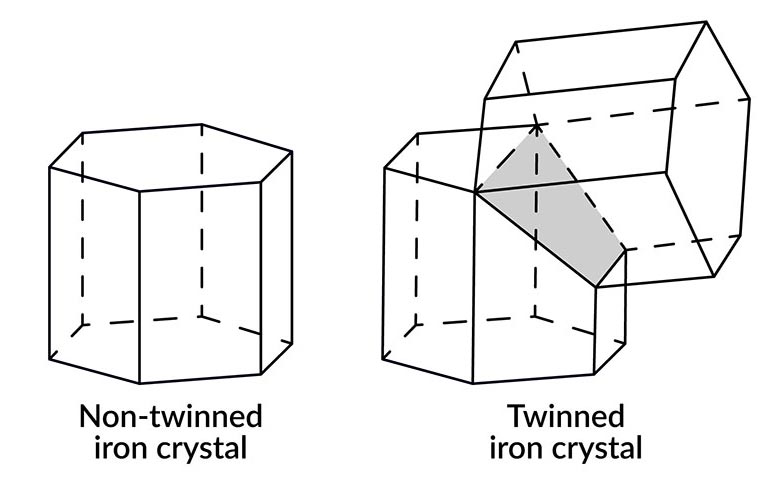
The group at SLAC wanted to see what would happen if you kept applying pressure to that hexagonal arrangement to mimic what happens to iron at the Earth’s core or during atmospheric reentry from space. “We didn’t quite make inner core conditions,” says co-author Arianna Gleason, a scientist in the High-Energy Density Science (HEDS) Division at SLAC. “But we achieved the conditions of the outer core of the planet, which is really remarkable.”
No one had ever directly observed iron’s response to stress under such high temperatures and pressures before, so the researchers didn’t know how it would respond. “As we continue to push it, the iron doesn’t know what to do with this extra stress,” says Gleason. “And it needs to relieve that stress, so it tries to find the most efficient mechanism to do that.”
The coping mechanism iron uses to deal with that extra stress is called “twinning.” The arrangement of atoms shunts to the side, rotating all the hexagonal prisms by nearly 90 degrees. Twinning is a common pressure response in metals and minerals — quartz, calcite, titanium and zirconium all undergo twinning.
“Twinning allows iron to be incredibly strong — stronger than we first thought — before it starts to flow plastically on much longer time scales,” Gleason said.
A Tale of Two Lasers
Reaching these extreme conditions required two types of lasers. The first was an optical laser, which generated a shock wave that subjected the iron sample to extremely high temperatures and pressures. The second was SLAC’s Linac Coherent Light Source (LCLS) X-ray free-electron laser, which allowed the researchers to observe the iron on an atomic level. “At the time, LCLS was the only facility in the world where you could do that,” says lead author Sébastien Merkel of the University of Lille in France. “It’s been a door opener for other similar facilities in the world.”
The team fired both lasers at a tiny sample of iron about the width of a human hair, hitting the iron with a shock wave of heat and pressure. “The control room is just above the experimental room,” Merkel says. “When you trigger the discharge, you hear a loud pop.”
As the shock wave hit the iron, researchers used the X-ray laser to observe how the shock changed the arrangement of the iron atoms. “We were able to make a measurement in a billionth of a second,” Gleason says. “Freezing the atoms where they are in that nanosecond is really exciting.”
The researchers collected these images and assembled them into a flipbook that showed iron deforming. Before the experiment was complete, they didn’t know if iron would respond too fast for them to measure or too slow for them to ever see. “The fact that the twinning happens on the time scale that we can measure it as an important result in itself,” Merkel says.
The Future Is Bright
This experiment serves as a bookend for understanding the behavior of iron. Scientists had gathered experimental data on the structure of iron at lower temperatures and pressures and used it to model how iron would behave at extremely high temperatures and pressures, but no one had ever experimentally tested those models.
“Now we can give a thumbs up, thumbs down on some of the physics models for really fundamental deformation mechanisms,” Gleason says. “That helps to build up some of the predictive capability we’re lacking for modeling how materials respond at extreme conditions.”
The study provides exciting insights into the structural properties of iron at extremely high temperatures and pressures. But the results are also a promising indicator that these methods could help scientists understand how other materials behave at extreme conditions, too.
“The future is bright now that we’ve developed a way to make these measurements,” Gleason says. “The recent X-ray undulator upgrade as part of the LCLS-II project allows higher X-ray energies — enabling studies on thicker alloys and materials that have lower symmetry and more complex X-ray fingerprints.”
The upgrade will also enable researchers to observe larger samples, which will give them a more comprehensive view of iron’s atomic behavior and improve their statistics. Plus, “we’re going to get more powerful optical lasers with the approval to proceed with a new flagship petawatt laser facility, known as MEC-U,” says Gleason. “That’ll make future work even more exciting because we’ll be able to get to the Earth’s inner core conditions without any problem.”
Reference: “Femtosecond Visualization of hcp-Iron Strength and Plasticity under Shock Compression” by Sébastien Merkel, Sovanndara Hok, Cynthia Bolme, Dylan Rittman, Kyle James Ramos, Benjamin Morrow, Hae Ja Lee, Bob Nagler, Eric Galtier, Eduardo Granados, Akel Hashim, Wendy L Mao, and Arianna E Gleason, 9 November 2021, Physical Review Letters.
DOI: 10.1103/PhysRevLett.127.205501
Researchers at Los Alamos National Laboratory (LANL) contributed to this study. Funding was provided by the University of Lille, an LANL Reines Laboratory Directed Research and Development grant, and the DOE Office of Science, including Gleason’s DOE Early Career Award in Fusion Energy Sciences. LCLS is a DOE Office of Science user facility.
Never miss a breakthrough: Join the SciTechDaily newsletter.
Follow us on Google and Google News.