
Close Menu
    Facebook X (Twitter) Instagram
    SciTechDaily
    • Biology
    • Chemistry
    • Earth
    • Health
    • Physics
    • Science
    • Space
    • Technology
    Facebook X (Twitter) Pinterest YouTube RSS
    SciTechDaily
    Home»Chemistry»Method Developed to Manipulate Fundamental Architecture of Polymers
    Chemistry

    Method Developed to Manipulate Fundamental Architecture of Polymers

    By Florida State UniversityOctober 27, 2019No Comments3 Mins Read
    Facebook Twitter Pinterest Telegram LinkedIn WhatsApp Email Reddit
    Share
    Facebook Twitter LinkedIn Pinterest Telegram Email Reddit
    Researcher Changes Fundamental Architecture of Polymers
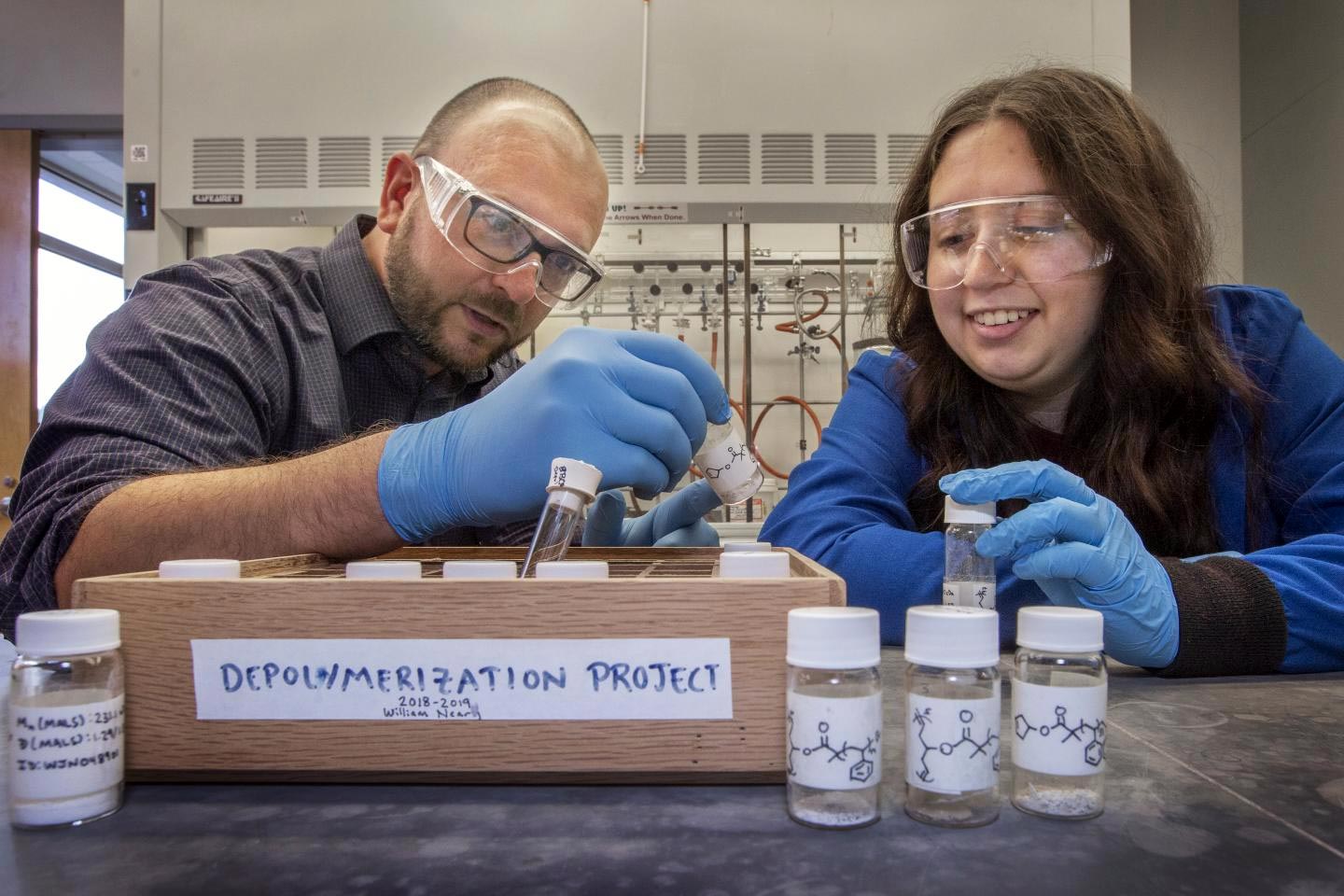
    Assistant Professor Justin Kennemur and graduate student Taylor Isais are co-authors on a new study on how to change the fundamental structure of a polymer. Credit: Bruce Palmer/FSU Photography Services

    A Florida State University research team has developed methods to manipulate polymers in a way that changes their fundamental structure, paving the way for potential applications in cargo delivery and release, recyclable materials, shape-shifting soft robots, antimicrobials, and more.

    “We are making a polymer completely change its architecture through a chemical response,” said FSU Assistant Professor of Chemistry Justin Kennemur. “In nature this happens too. Think of how a caterpillar becomes a butterfly. The cellular machinery changes the design of natural biopolymers and hence their properties. That’s what we’re doing with synthetic polymers.”

    The research is published in the Journal of the American Chemical Society.

    Polymers are materials made of large molecular chains composed of chemically similar repeating units. They touch almost every part of everyday life and include materials like plastics, rubbers and gels and natural biological structures such as DNA and proteins.

    In the big picture, Kennemur is working to develop high-performance polymers with super-elastic and super-soft properties that could be used as joint or cartilage replacements. To do that, he and his team are exploring the boundaries of how existing polymers respond to stimuli and can be reorganized for better performance.

    Polymers that spontaneously “unzip” or deteriorate in response to an external stimulus have gained traction from scientists for their potential use in a variety of applications. However, this spontaneous deteriorating — called depolymerization — often makes them difficult to assemble in the first place.

    Kennemur refined a process to both create the polymer and cause it to break down, completely changing its structure.

    Kennemur and his team developed a thermodynamic strategy where they synthesize the macromolecules at a lower temperature — about -15 to 0 degrees Celsius (5 to 32 degrees Fahrenheit) — and then stabilize the polymer before warming it up. At warmer temperatures, the materials could depolymerize with a triggering event — the introduction of a catalytic amount of the element ruthenium — which causes an unzipping of the polymer.

    “We’ve really invested in leveraging fundamental thermodynamic principles in polymer science, and we use this to transform the molecules into a variety of possible shapes and chemistries,” Kennemur said. “It’s a way to recycle these materials, but it’s also a way to get them to respond and change their architecture. There are a lot of fun possibilities with this.”

    ###

    Kennemur’s work is funded by the National Science Foundation’s CAREER program. Former FSU graduate student William Neary and current graduate student Taylor Isais are co-authors of the study.

    Reference: “Depolymerization of Bottlebrush Polypentenamers and Their Macromolecular Metamorphosis” by William J. Neary, Taylor A. Isais and Justin G. Kennemur, 12 August 2019, Journal of the American Chemical Society.
    DOI: 10.1021/jacs.9b05560

    Never miss a breakthrough: Join the SciTechDaily newsletter.
    Follow us on Google and Google News.

    Florida State University Polymers
    Share. Facebook Twitter Pinterest LinkedIn Email Reddit

    Related Articles

    Degradable Polymers Synthesized by MIT Chemists – Can Break Down in the Body

    Turning Plastic Trash Into Treasure: Upcycling Plastic Into High-Quality Liquid Products

    Unique Particles – With Stickiness of Gecko Feet – Formed by Harnessing Chaos

    New Material Captures Carbon Dioxide and Efficiently Converts It to Useful Organic Materials

    Super Durable, Flexible, Water-Repelling Material Inspired by Porcupinefish

    Scientists to Communicate Polymers More Easily With New Notation System

    Storing Secret Messages in Light-Sensitive Polymers

    Chemists Edge Closer to Using Ribosome to Create Designer Polymers

    MIT Researchers Develop New Strategy for Stronger Polymers

    Leave A Reply Cancel Reply

    • Facebook
    • Twitter
    • Pinterest
    • YouTube

    Don't Miss a Discovery

    Subscribe for the Latest in Science & Tech!

    Trending News

    Could Low Vitamin D Be Making Your Pain Worse?

    Scientists Discover Once-Weekly Workout That Melts Belly Fat Surprisingly Effectively

    Scientists Just Tested a Thruster Powerful Enough for Human Missions to Mars

    Doctors Say Your Ice Pack Might Be Making Injuries Worse

    Scientists Discover 43-Foot Sea Reptile Twice the Size of a Great White Shark

    Bees and Birds Are Drinking Alcohol From Flowers

    Scientists Discover How Obesity May Trigger Alzheimer’s Disease

    Scientists Confirm Alcohol Causes Widespread Health Damage

    Follow SciTechDaily
    • Facebook
    • Twitter
    • YouTube
    • Pinterest
    • Newsletter
    • RSS
    SciTech News
    • Biology News
    • Chemistry News
    • Earth News
    • Health News
    • Physics News
    • Science News
    • Space News
    • Technology News
    Recent Posts
    • Scientists Discover Sperm Seem To Bypass a Fundamental Law of Physics
    • The Secret Behind Indigenous Andeans’ “Digestive Superpower” May Be Potatoes
    • Archaeologists Discover Mysterious Artificial Island Older Than Stonehenge in Scotland
    • Magnon Breakthrough Could Shrink Quantum Computers to the Size of a Penny
    • NASA Finds a “Goldilocks” Giant Planet Wrapped in Methane
    Copyright © 1998 - 2026 SciTechDaily. All Rights Reserved.
    • Science News
    • About
    • Contact
    • Editorial Board
    • Privacy Policy
    • Terms of Use

    Type above and press Enter to search. Press Esc to cancel.