
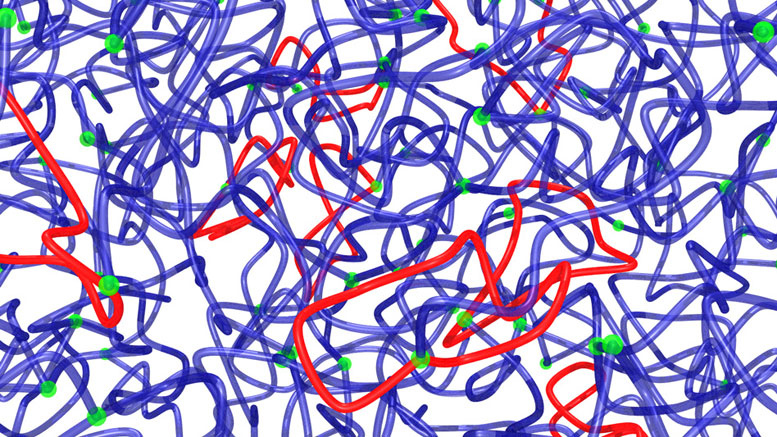
A team of engineers at MIT have found a new strategy for reducing the number of loops in a polymer. The method could offer an easy way for manufacturers of industrially useful materials such as plastics or gels to strengthen their materials.
Plastic, rubber, and many other useful materials are made of polymers — long chains arranged in a cross-linked network. At the molecular level, these polymer networks contain structural flaws that weaken them.
Several years ago, MIT scientists were the first to measure certain types of these defects, called “loops,” which are caused when a chain in the polymer network binds to itself instead of another chain. Now, the same team has found a simple way to reduce the number of loops in a polymer network and thus strengthen materials made from polymers.
To achieve this, the scientists simply add one of the components of the polymer network very slowly to a large quantity of the second component. Using this approach, they were able to cut the number of loops in half, in a variety of different polymer network structures. This could offer an easy way for manufacturers of industrially useful materials such as plastics or gels to strengthen their materials.
“Just by changing how fast you add one component to the other, you can improve the mechanical properties,” says Jeremiah A. Johnson, the Firmenich Career Development Associate Professor of Chemistry at MIT and the senior author of the paper.
MIT graduate student Yuwei Gu is the first author of the paper, which appears in the Proceedings of the National Academy of Science.
Other authors are MIT associate professor of chemical engineering Bradley Olsen; MIT graduate student Ken Kawamoto; former MIT postdocs Mingjiang Zhong and Mao Chen; Case Western Reserve University Assistant Professor Michael Hore; Case Western Reserve graduate student Alex Jordan; and former MIT visiting professor and Case Western Reserve Associate Professor LaShanda Korley.
Controlling loops
In 2012, Johnson’s group devised the first way to measure the number of loops in a polymer network and validated those results with theoretical predictions from Olsen. The scientists found that the loops can make up about 9 percent to nearly 100 percent of the network, depending on the concentration of polymer chains in the starting material and other factors.
A few years later, Johnson and Olsen developed a way to calculate how much these loops weaken a material. In their latest work, they set out to reduce loop formation, and to achieve this without changing the composition of the materials.
“The goal we set for ourselves was to take the same set of precursors for a material that one would normally use, and, using the exact same precursors under the same conditions and at the same concentration, make a material with fewer loops,” Johnson says.
In this paper, the team first focused on a type of polymer structure known as a star polymer network. This material has two different building blocks: a star with four identical arms, known as “B4,” and a chain known as “A2.” Each molecule of A2 attaches to the end of one of the B4 arms. However, during the typical synthesis process, when everything is mixed together at once, some of the A2 chains end up binding to two of the B4 arms, forming a loop.
They found that if they added B4 very slowly to a solution of A2, each of the B4arms would quickly react with a single molecule of A2, so there was less opportunity for A2 to form loops.
After a few hours of slowly adding half of the B4 solution, they added the second half all at once, and the star-shaped subunits joined together to form a cross-linked network. This material, the researchers found, had about half as many loops as the same material produced using the traditional synthesis process.
Depending on how many loops were in the original material, this “slow then fast” strategy can improve the material’s strength by as much as 600 percent, Johnson says.
“This very simple ingenious and powerful approach, based on slow crosslinker addition, diminishes the intramolecular cyclization and significantly increases mechanical properties of polymeric networks,” says Krzysztof Matyjaszewski, a professor of chemistry at Carnegie Mellon University who was not involved in the research.
Better products
The researchers also tried this technique with four other types of polymer network synthesis reactions. They were not able to measure the number of loops for all of those types of polymers, but they did find similar improvements in the strength of the materials.
This approach could potentially help to improve the strength of any material made from a gel or other cross-linked polymer, including plastics, membranes for water purification, adhesives made of epoxy, or hydrogels such as contact lenses.
Johnson’s lab is now working on applying this strategy to a variety of materials, including gels used to grow cells for tissue engineering.
The research was funded by the National Science Foundation.
Reference: “Semibatch monomer addition as a general method to tune and enhance the mechanics of polymer networks via loop-defect control” by Yuwei Gu, Ken Kawamoto, Mingjiang Zhong, Mao Chen, Michael J. A. Hore, Alex M. Jordan, LaShanda T. J. Korley, Bradley D. Olsen and Jeremiah A. Johnson, 24 April 2017, PNAS.
DOI: 10.1073/pnas.1620985114
Never miss a breakthrough: Join the SciTechDaily newsletter.
Follow us on Google and Google News.