
Close Menu
    Facebook X (Twitter) Instagram
    SciTechDaily
    • Biology
    • Chemistry
    • Earth
    • Health
    • Physics
    • Science
    • Space
    • Technology
    Facebook X (Twitter) Pinterest YouTube RSS
    SciTechDaily
    Home»Space»Hubble Image of the Week – Spiral Galaxy NGC 5917
    Space

    Hubble Image of the Week – Spiral Galaxy NGC 5917

    By ESA/Hubble & NASAMay 1, 2017No Comments2 Mins Read
    Facebook Twitter Pinterest Telegram LinkedIn WhatsApp Email Reddit
    Share
    Facebook Twitter LinkedIn Pinterest Telegram Email Reddit
    New Hubble Image of Spiral Galaxy NGC 5917
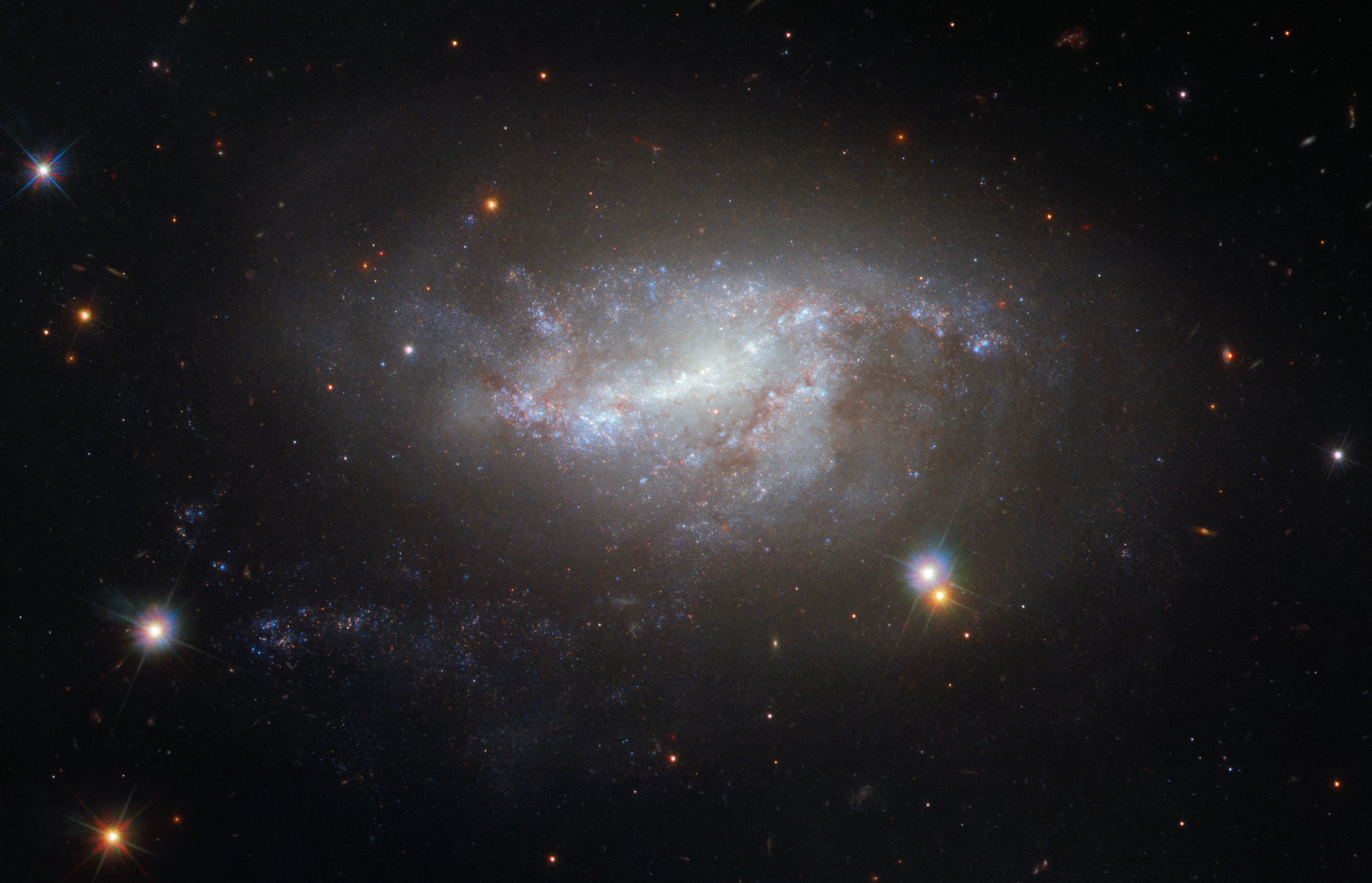
    Spiral galaxy NGC 5917. Credit: NASA/ESA/Hubble

    This newly released Hubble image of the week shows spiral galaxy NGC 5917, which is located in the constellation Libra.

    This image from Hubble’s Wide Field Camera 3 shows a spiral galaxy NGC 5917, perhaps best known for its intriguing interactions with its neighboring galaxy MCG-01-39-003 (not visible here, but located off the bottom right of the frame — as seen here).

    Mass is often confused with weight, but they are very different things. Mass is the very substance of an object and is something one always has, no matter the location. If you fly to the Moon and experience low-gravity conditions, your mass has not changed at all. What has actually changed is your weight, because weight is a force caused by the gravitational attraction of another massive body. Gravity is how objects with mass “talk” to one another. People do weigh less on the Moon, but not because they have lost any body mass — the mass of the Moon is less than that of the Earth, so it exerts a smaller gravitational pull on them.

    Understanding mass is vital when it comes to understanding why objects behave the way they do in space. Without mass “talking” via gravity, the planets would not orbit the Sun, and galaxies would not interact as NGC 5917 does with its neighbor. Galaxy interactions can lead to very interesting effects; the galaxies can steal mass — in form of stars, dust, and gas — from one another, distort and warp one another’s shape, or trigger immense waves of new star formation. Sometimes, a galactic duo interact so strongly that they end up colliding and merging completely. Unfortunately, if NGC 5917 is destined to merge with its celestial neighbor, it will happen much too far into the future for us to enjoy the spectacle.

    Never miss a breakthrough: Join the SciTechDaily newsletter.
    Follow us on Google and Google News.

    Astronomy Hubble Space Telescope
    Share. Facebook Twitter Pinterest LinkedIn Email Reddit

    Related Articles

    A Morphing Spiral Galaxy Amongst Friends

    Hubble Views Magnificent Lopsided Galaxy NGC 2276

    Hubble Captures Fantastic Detail of Eponymous Spiral Galaxy NGC 691

    Spectacular Image Captured by Hubble Shows a Strangely Contorted Spiral Galaxy

    A Distant Spiral in Virgo: Extraordinary Detail Seen in a Galaxy 150 Million Light-Years Away From Earth

    Magnetic Monsters: Hubble Tracks Down Location of Mysterious Radio Signals From Intergalactic Space

    A Menagerie of Galaxies: Hubble Captures a Cluster With Galaxies of All Shapes and Sizes

    How Habitable Are Planets That Orbit Red Dwarfs – The Most Common Type of Stars in the Galaxy?

    Cosmic Silver Lining: Hubble Spots V565 Surrounded by Four Prominent Diffraction Spikes

    Leave A Reply Cancel Reply

    • Facebook
    • Twitter
    • Pinterest
    • YouTube

    Don't Miss a Discovery

    Subscribe for the Latest in Science & Tech!

    Trending News

    Massive Study Warns Marijuana Use in Teens Is Linked to Serious Mental Illness

    Scientists Discover a Completely Unexpected Way T Cells Kill Cancer

    Scientists Just Found the Solar System’s Original “Planet Factory”

    Study Warns Widely Used Food Preservatives Linked to High Blood Pressure and Heart Disease

    New Treatment Could Reverse Osteoarthritis Within Weeks

    Physicists Have Measured “Negative Time” in Bizarre Quantum Experiment

    The Deadly Tapeworm Spreading Across America Has Reached the Pacific Northwest

    Could Low Vitamin D Be Making Your Pain Worse?

    Follow SciTechDaily
    • Facebook
    • Twitter
    • YouTube
    • Pinterest
    • Newsletter
    • RSS
    SciTech News
    • Biology News
    • Chemistry News
    • Earth News
    • Health News
    • Physics News
    • Science News
    • Space News
    • Technology News
    Recent Posts
    • Scientists Discover Mysterious Creature Living in the Great Salt Lake – and It Exists Nowhere Else on Earth
    • It’s Alive? Surprising Discovery Changes What We Know About Fog
    • Simple Family Routines May Be the Secret to a Smoother Start at School
    • Brain Study Overturns Long-Held Beliefs About How Humans Learn Speech
    • Ancient Goose Fossil Challenges Long-Held Theories About New Zealand Birds
    Copyright © 1998 - 2026 SciTechDaily. All Rights Reserved.
    • Science News
    • About
    • Contact
    • Editorial Board
    • Privacy Policy
    • Terms of Use

    Type above and press Enter to search. Press Esc to cancel.