
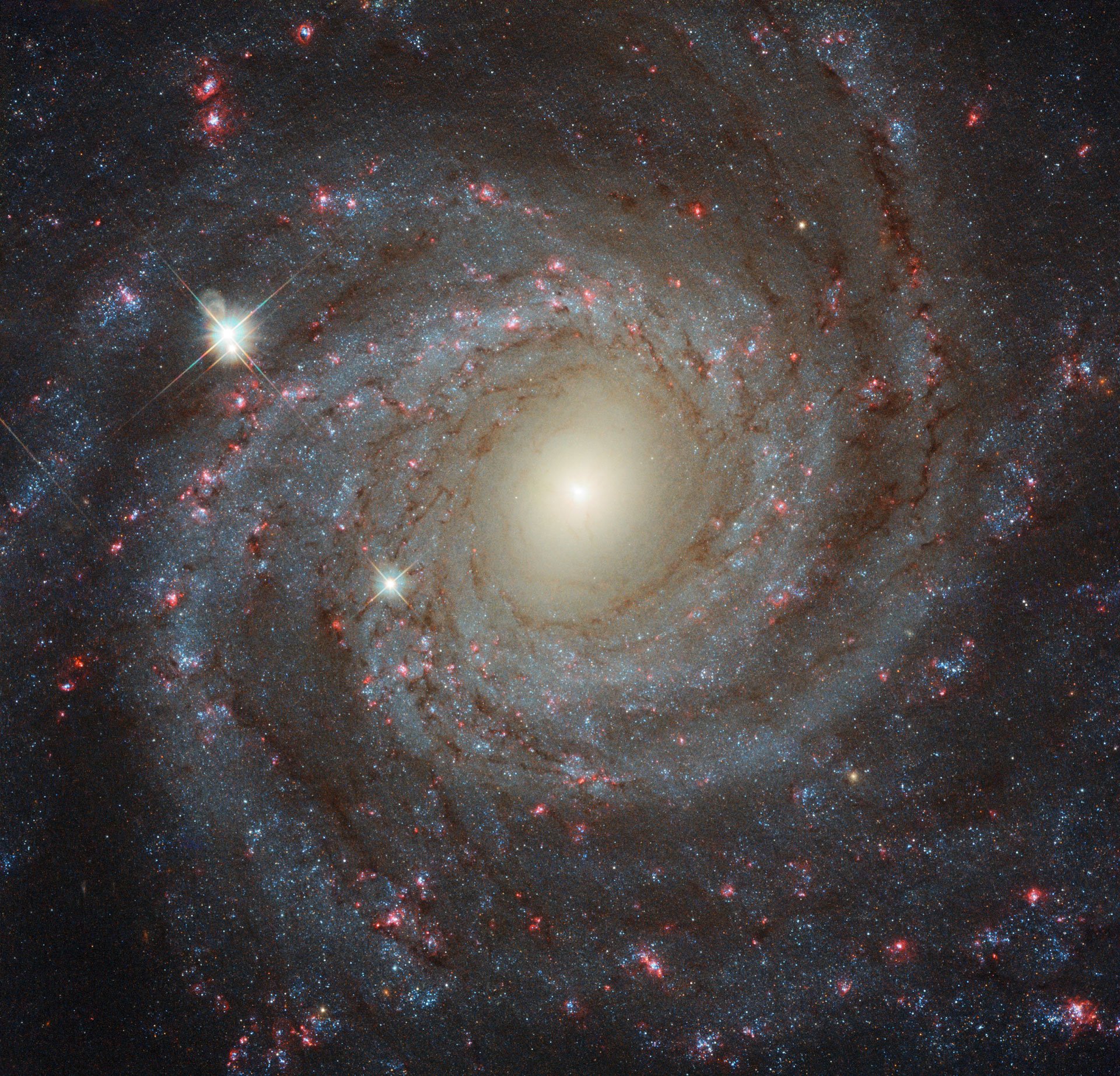
Beauty, grace, mystery — this magnificent spiral galaxy has all the qualities of a perfect galactic Valentine. Captured by the NASA/ESA Hubble Space Telescope, the galaxy NGC 3344 presents itself face-on, allowing astronomers a detailed look at its intricate and elegant structure. And Hubble’s ability to observe objects over a wide range of different wavelengths reveals features that would otherwise remain invisible.
Spiral galaxies are some of the most spectacular sights in the sky, but to an observer, they do not all look the same. Some are seen edge-on, giving astronomers an excellent idea of the galaxy’s vertical structure; others are seen at an angle, providing a hint of the size and structure of the spiral arms; while others are seen face-on, showcasing their arms and bright core in all their beauty.
Approximately 20 million light-years away in the constellation of Leo Minor (the Lion Cub), NGC 3344 is seen from a breathtaking face-on perspective. Half the size of the Milky Way, it is classified as a weakly barred spiral galaxy. The central bar is just visible in this image, taken with Hubble’s Wide Field Camera 3: an elongated lane of stars, trailing through the nucleus of the galaxy. Astronomers estimate that two-thirds of all spiral galaxies are barred, including our own Milky Way.
Our eyes detect only visible light, but on board Hubble are a variety of instruments that together detect many different wavelengths of light. This means that Hubble is able to observe galaxies over a wide range of wavelengths to reveal features that would otherwise remain invisible to our eyes. This episode of the Hubblecast explores the meaning of the colors in the spiral galaxy NGC 3344. Credit: ESO
Hubble’s capacity to observe celestial objects in different wavelengths allows us to see more than just the spiral arms sweeping out loosely around the center in a gorgeous whorl. This image is a composite of images taken through different filters, ranging from near ultraviolet to optical and near-infrared. Together they show a more complete picture of the galaxy than the human eye alone could possibly see.
The swirling spiral arms are the birthplace of new stars, whose high temperatures make them shine blue, resulting in them being easily identifiable in this image. Clouds of dust and gas distributed through the spiral arms — glowing red in this image — are reservoirs of material for even more stars. The bright jewel-like stars on the left of the picture, however, are much closer to Earth — they belong to our own galaxy and just happened to photobomb this Hubble image.
This video zooms in on the spiral galaxy NGC 3344, about 20 million light-years away from the Earth. The footage begins with a view of the night sky in the direction of the constellation of Leo Minor, as seen from the ground. It then zooms through observations from the Digitized Sky Survey 2, and ends with a view of the galaxy obtained with the NASA/ESA Hubble Space Telescope. Credit: ESA/Hubble, NASA, Digitized Sky Survey 2. Acknowledgment: Davide De Martin Music: Astral Electronic
While its face-on orientation reveals much about NGC 3344’s detailed structure, this galaxy is still enigmatic; astronomers have noticed that some of its outer stars are moving in a strange way. Often, the high concentration of stars in the center of a galaxy can affect the movements of the outer stars, but this does not seem to be the case in NGC 3344. Astronomers suspect that these weirdly behaving outer stars may actually have been stolen from another galaxy, after a close encounter that took place long ago.
This video shows what the galaxy NGC 3344 looks like in different wavelengths of light. Astronomers collect light of different wavelengths to find out different types of information about astronomical objects. Credit: NASA & ESA
The location of NGC 3344 is also intriguing. Our galaxy is part of the Local Group, which is made up of approximately 40 other galaxies, with the Andromeda Galaxy being the largest member. But NGC 3344 is not part of a local galactic neighborhood like we are. It is actually part of a small spur that leads off the larger Virgo Supercluster — a gargantuan collection of several thousand galaxies.
But it stands out from these thousands of galaxies because of its beauty, which highlights to us the elegance of the Universe.
This video pans over NASA/ESA Hubble Space Telescope observations of the spiral galaxy NGC 3344 that lies about 20 million light-years away. The galaxy is seen face-on, allowing us to see its spiral arms and the bright core. Because of the many filters used to create this image — ranging from the ultraviolet to the near-infrared — the bright young stars glowing blue and the red regions of dense gas and dust are visible. Credit: ESA/Hubble Music: Astral Electronic
Never miss a breakthrough: Join the SciTechDaily newsletter.
Follow us on Google and Google News.
1 Comment
You can believe us cuz we’ve got the artist’s impressions to prove it.