
Close Menu
    Facebook X (Twitter) Instagram
    SciTechDaily
    • Biology
    • Chemistry
    • Earth
    • Health
    • Physics
    • Science
    • Space
    • Technology
    Facebook X (Twitter) Pinterest YouTube RSS
    SciTechDaily
    Home»Space»New Simulations of Magnetic Reconnection in the Sun
    Space

    New Simulations of Magnetic Reconnection in the Sun

    By Lei Ni, Harvard-Smithsonian Center For AstrophysicsFebruary 18, 2018No Comments3 Mins Read
    Facebook Twitter Pinterest Telegram LinkedIn WhatsApp Email Reddit
    Share
    Facebook Twitter LinkedIn Pinterest Telegram Email Reddit
    New Simulations of Magnetic Reconnection in Hot Ionized Gas
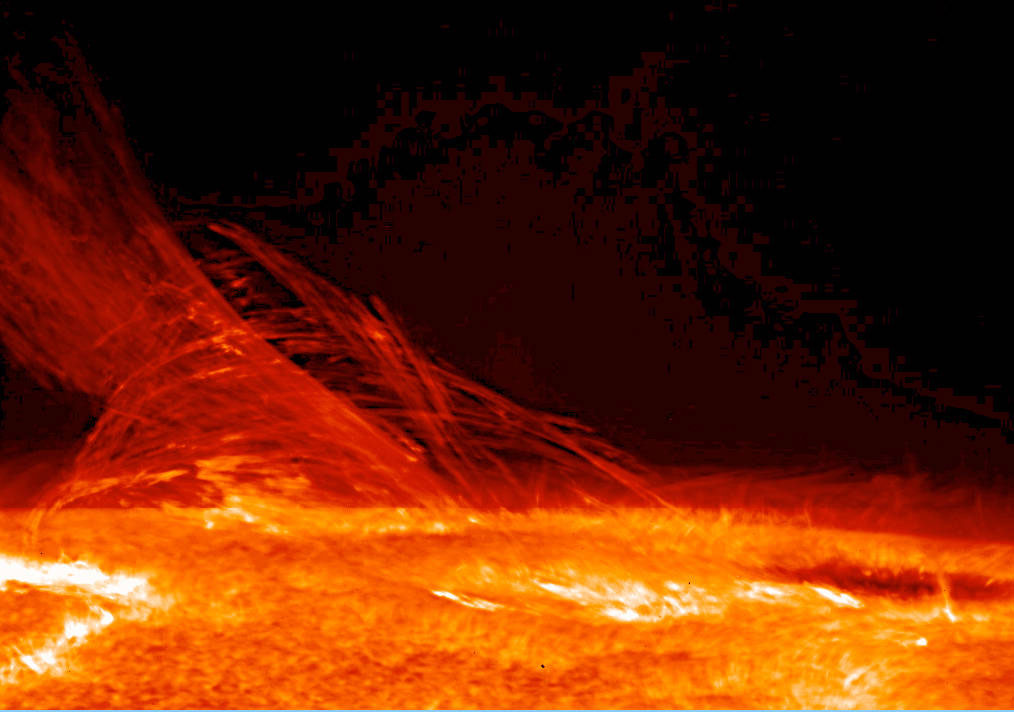
    An ultraviolet picture of the sun’s chromosphere, the thin layer of solar atmosphere sandwiched between the visible surface, the photosphere, and the corona. Astronomers have developed a simulation to address magnetic reconnection in the chromosphere. The image was taken by the Hinode spacecraft. JAXA/NASA

    The Sun glows with a surface temperature of about 5,500 degrees Celsius (9,900 degrees Fahrenheit). On the other hand, its hot outer layer, the corona, has a temperature of over a million degrees and ejects a wind of charged particles at a rate equivalent to about one-millionth of the moon’s mass each year. Some of these particles bombard the Earth, producing auroral glows and occasionally disrupting global communications. In between these two regions of the Sun is the chromosphere. Within this complex interface zone, only a few thousand kilometers deep, the density of the gas drops with height by a factor of about one million, and the temperature increases. Almost all of the mechanical energy that drives solar activity is converted into heat and radiation within this interface zone.

    Charged particles are produced by the high temperatures of the gas, and their motions produce powerful, dynamic magnetic fields. Those field lines can sometimes break apart forcefully, but the movement of the underlying charged particles often leads them to reconnect. There are two important, longstanding, and related questions about the hot solar wind: how is it heated, and how does the corona produce the wind? Astronomers suspect that magnetic reconnection in the chromosphere plays a key role.

    CfA astronomer Nicholas Murphy and his three colleagues have completed complex new simulations of magnetic reconnection in hot ionized gas like that present in the solar chromosphere. (The lead author on the study, Lei Ni, was a visitor to the CfA.) The scientists include for the first time the effects of incompletely ionized gas in lower temperature regions, certain particle-particle effects, and other details of the neutral and ionized gas interactions. They find that the neutral and ionized gas is well-coupled throughout the reconnection region, and conclude that reconnection can often occur in the cooler portions of the zone. They also note that new, high-resolution solar telescopes are capable of studying smaller and smaller regions of low ionization for which their results are particularly applicable.

    Reference: “Magnetic Reconnection in Strongly Magnetized Regions of the Low Solar Chromosphere” by Lei Ni, Vyacheslav S. Lukin, Nicholas A. Murphy and Jun Lin, 11 January 2018, The Astrophysical Journal.
    DOI: 10.3847/1538-4357/aa9edb

    Never miss a breakthrough: Join the SciTechDaily newsletter.
    Follow us on Google and Google News.

    Astronomy Astrophysics Harvard-Smithsonian Center for Astrophysics Sun
    Share. Facebook Twitter Pinterest LinkedIn Email Reddit

    Related Articles

    Spacecraft Enters the Sun’s Blistering Hot Corona for the First Time in History

    A “Living Catalog” of Solar Stream Interactions

    New Research Helps Explain Why the Sun’s Magnetic Field Reverses Every Eleven Years

    VLA Provides New Insights into Solar Flares

    Small-Scale Jets from the Solar Chromosphere Are Possible Sources of the Solar Wind

    Sun’s Loops are Tapered, Wider at the Top and Narrower at the Ends

    New Observations Help Astronomers Learn How Young Stars Accrete Material and Grow

    TW Hydrae Provides Insight About the Birth of Our Sun

    New Model Advances the Understanding of How Solar Wind Works

    Leave A Reply Cancel Reply

    • Facebook
    • Twitter
    • Pinterest
    • YouTube

    Don't Miss a Discovery

    Subscribe for the Latest in Science & Tech!

    Trending News

    Largest-Ever Study Finds Medicinal Cannabis Ineffective for Anxiety, Depression, PTSD

    250-Million-Year-Old Egg Solves One of Evolution’s Biggest Mysteries

    Living With Roommates Might Be Changing Your Gut Microbiome Without You Knowing

    Century-Old Cleaning Chemical Linked to 500% Increased Risk of Parkinson’s Disease

    What if Your Memories Never Happened? Physicists Take a New Look at the Boltzmann Brain Paradox

    One of the Universe’s Largest Stars May Be Getting Ready To Explode

    Scientists Discover Enzyme That Could Supercharge Ozempic-Like Weight Loss Drugs

    Popular Sweetener Linked to DNA Damage – “It’s Something You Should Not Be Eating”

    Follow SciTechDaily
    • Facebook
    • Twitter
    • YouTube
    • Pinterest
    • Newsletter
    • RSS
    SciTech News
    • Biology News
    • Chemistry News
    • Earth News
    • Health News
    • Physics News
    • Science News
    • Space News
    • Technology News
    Recent Posts
    • Challenging the Narrative: New Study Shows U.S. Life Expectancy Is Rising Across All States
    • Mystery Illness Kills 5 in Burundi As Doctors Scramble for Answers
    • Bone-Strengthening Discovery Could Reverse Osteoporosis
    • The Most Elusive Number in Physics Just Got Even More Mysterious
    • Scientists Uncover Hidden Trigger Behind Stem Cell Aging
    Copyright © 1998 - 2026 SciTechDaily. All Rights Reserved.
    • Science News
    • About
    • Contact
    • Editorial Board
    • Privacy Policy
    • Terms of Use

    Type above and press Enter to search. Press Esc to cancel.