
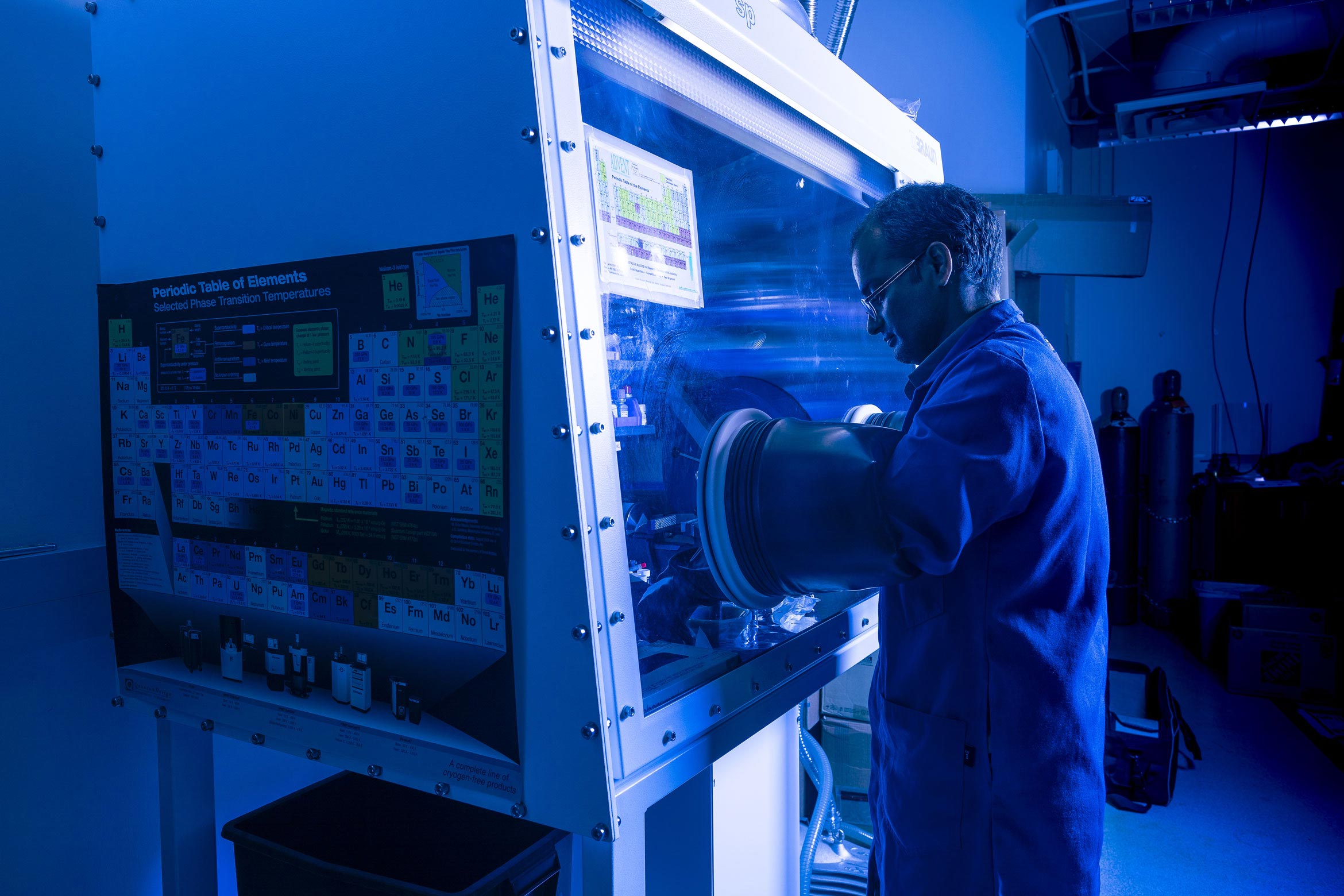
A new study reveals how intertwined forms of frustration in quantum materials can give rise to unconventional magnetic states.
Research led by UC Santa Barbara materials professor Stephen Wilson aims to uncover the basic physical principles behind unusual states of matter while also creating materials capable of supporting properties important for future quantum applications.
In a study published in the journal Nature Materials, Wilson and his colleagues describe a new way to take advantage of a phenomenon known as frustration of long-range order within a material. By harnessing this effect, the team demonstrates how unconventional magnetic states can be deliberately created, with possible implications for quantum technologies.
At the same time, Wilson emphasized, “This is fundamental science aimed at addressing a basic question. It’s meant to probe what physics may be possible for future devices.”
The research examines how multiple forms of frustration can emerge in solid materials. One example is geometric frustration, which occurs when the magnetic moments inside a material cannot arrange themselves into a single, stable pattern. Instead of forming an orderly structure, the moments remain in a constantly competing and fluctuating state.
“You can think of magnetism as being derived from tiny bar magnets sitting at the atomic sites in a crystal lattice,” Wilson said. “Those bar magnets are what we call magnetic dipole moments, and they can interact and orient themselves relative to one another in specific ways, depending on the details of a material, to minimize their energy or, said another way, to realize their ground state.”
The ground state represents the lowest possible energy configuration of a system. At absolute zero temperature, any physical system occupies this state.
Geometry and Competing Interactions
“If those magnetic moments interact in a way that wants them to point antiparallel to one another, we call that antiferromagnetism,” Wilson added. “If they want to interact in this antiferromagnetic way, and if they are sitting on atoms forming a square network, then each moment can be antiparallel to its neighbors. The moments are ‘happy,’ and that is the ground state.”
The situation changes when the same interactions occur in a different arrangement. “In a different network, however, such as a triangle, not every moment can point opposite to its neighbors,” Wilson said. “They compete with one another, or are ‘frustrated,’ because they don’t know which way to point to realize the ground state of the system. The moments seek equilibrium but are frustrated from achieving it by the geometry of the space they occupy.”
Comparable forms of frustration can also arise from other properties of electrons, including their electric charge. When two nearby ions attempt to share an electron across a chemical bond, they can form an atomic dimer. As with magnetic interactions, dimer formation can be hindered by certain lattice structures, such as triangular lattices or honeycomb networks.
When this happens, the result can be a frustrated network of bonds that responds strongly to external strain. Applying strain can help ease the frustration by allowing the bonds to rearrange. Wilson’s study focuses on a particularly rare class of materials in which both magnetic frustration and bond frustration occur together within the same system.
Wilson described this discovery as “exciting” because it suggests a way to influence one frustrated system by modifying the other. Over the past six or seven years, scientists have shown that frustrated magnetic states can be deliberately created using materials made from triangular arrangements of lanthanide elements, which are found near the bottom of the periodic table.
Toward Functional Control of Quantum States
“In principle, this triangular lattice network of properly chosen lanthanide moments can cause a special kind of intrinsically quantum disordered state to arise,” Wilson said. “One thing we tried to do in this project was to functionalize that exotic state by embedding it in a crystal lattice that has an additional degree of bond frustration.”
While there are many different “flavors” of quantum disordered magnetism, in principle, Wilson noted, “Some states can host long-range entanglement of spins, which is of interest in the realm of quantum information. Gaining control over those states via applying a strain in the frustrated bond network would be exciting.”
If you have two highly frustrated layers that are both very sensitive to perturbations, like strain, or, in the magnetic case, a magnetic field, then the question is whether you can couple the two together, because when one is biased and decides to order, it can potentially couple to the second one and alter it.
“It’s a way of imparting in things a functionality or response to other things to which it would otherwise not respond,” Wilson explained. “So, in principle, one can engineer large ferroic responses. You can apply a bit of strain, which induces magnetic order, or you can apply a bit of magnetic field and induce changes to the structure.
“Again, in principle, if you can find a quantum disordered ground state that hosts long-range entanglement, the question then becomes whether you can access that entanglement by, for instance, coupling to another layer, such as bond frustration.”
Wilson also wants to discover whether, through this process, it is possible to realize different types of intertwined order. “Basically, you could have different types of order that get nucleated because of the proximity of these two frustrated lattices,” he said. “That’s the big-picture idea.”
Reference: “Interleaved bond frustration in a triangular lattice antiferromagnet” by S. J. Gomez Alvarado, J. R. Chamorro, D. Rout, J. Hielscher, Sarah Schwarz, Caeli Benyacko, M. B. Stone, V. Ovidiu Garlea, A. R. Jackson, G. Pokharel, R. Gomez, B. R. Ortiz, Suchismita Sarker, L. Kautzsch, L. C. Gallington, R. Seshadri and Stephen D. Wilson, 22 October 2025, Nature Materials.
DOI: 10.1038/s41563-025-02380-x
Never miss a breakthrough: Join the SciTechDaily newsletter.
Follow us on Google and Google News.
2 Comments
In principle, if you can find a quantum disordered ground state that hosts long-range entanglement, the question then becomes whether you can access that entanglement by, for instance, coupling to another layer, such as bond frustration.
VERY GOOD.
Please ask researchers to think deeply:
1. Is quantum a cat that is both dead and alive?
2. Is quantum entanglement related to topological entanglement?
This Unusual Material Uses Frustration To Unlock New Quantum Behavior. Why do you Uses Frustration? Physics needs more people and publications who truly care about physics, rather than so-called peer-reviewed publications (including the Proceedings of the National Academy of Sciences, Physical Review Letters, Science, Nature, Science Bulletin, etc.) that are severely poisoned and polluted by pseudoscience and pseudo academia.
Are these science?
Example 1
Two sets of cobalt-60 are manually rotated in opposite directions, and even without detection, people around the world know that they will not be symmetrical because these two objects are not mirror images of each other at all. However, a group of so-called physicists and so-called academic publications do not believe it. They conducted experiments and the results were indeed asymmetric, but they still firmly believed that these two objects were mirror images of each other, and the asymmetry was due to a violation of the previous natural laws (CP violation). In the history of science, there can never be a dirtier and uglier operation and explanation than this.
—— Excerpted from https://scitechdaily.com/what-happens-when-light-gains-extra-dimensions/#comment-947619.
Example 2
Please see how the so-called “mystery of θ – τ” is explained: θ and τ are completely identical in all measurable physical properties such as mass, lifetime, charge, spin, etc. However, experimental observations have shown that the θ meson decays into two π mesons, while the τ meson decays into three π mesons, making it difficult for physicists to explain why they are so similar. Physicist Martin Block proposed a highly challenging idea: θ and τ are the same particle, but in weak interactions, parity is not conserved. An easy to understand explanation is the following analogy:: There are two boxes of apples with identical weight, color, and taste. However, when one box is opened, there are two apples, while when the other box is opened, there are three apples. This confuses the old farmer who buys apples. He circled around the orchard and came up with a highly challenging idea: these two boxes of apples are not from the same tree, so they are the same.
—— Excerpted from https://scitechdaily.com/what-happens-when-light-gains-extra-dimensions/#comment-947686.
Everyone who has a reverence for natural laws and regulations deserves respect.