
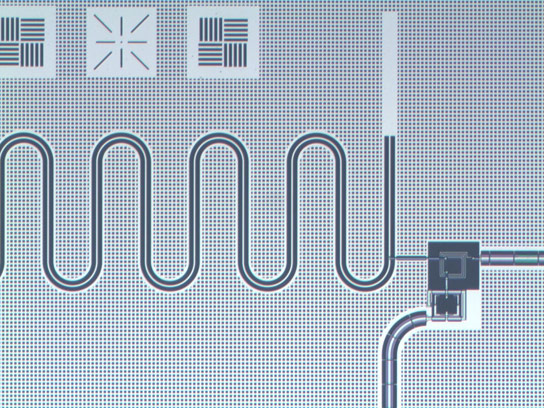
In a newly published study, physicists at UC Santa Barbara used a switch to manipulate light on superconducting chips, providing a new understanding in the quantum realm.
Physicists at UC Santa Barbara are manipulating light on superconducting chips, and forging new pathways to building the quantum devices of the future – including super-fast and powerful quantum computers.
The science behind tomorrow’s quantum computing and communications devices is being conducted today at UCSB in what some physicists consider to be one of the world’s top laboratories in the study of quantum physics. A team in the lab of John Martinis, UCSB professor of physics, has made a discovery that provides new understanding in the quantum realm and the findings are published this week in Physical Review Letters.
“As one crucial step of achieving controllable quantum devices, we have developed an unprecedented level of manipulating light on a superconducting chip,” said first author Yi Yin. Yin worked on the project when she was a postdoctoral fellow in the Martinis Lab from 2009 to 2012. She relocated to her native China last fall, where she is now a professor at Zhejiang University in the city of Hangzhou.
“In our experiment, we caught and released photons in and from a superconducting cavity by incorporating a superconducting switch,” said Yin. “By controlling the switch on and off, we were able to open and close a door between the confined cavity and the road where photons can transmit. The on/off speed should be fast enough with a tuning time much shorter than the photon lifetime of the cavity.”
She explained that not only can the switch be in an on/off state, it also can be opened continuously, like a shutter. In that way, the research team was able to shape the released photons in different wave forms – a key element for the next step they want to accomplish: controlled photon transfer between two distant cavities.
Co-author Yu Chen, also a postdoctoral fellow in the Martinis lab, said that this way of moving information around – sending and catching information – is one of the most important features of this research. “In optics, people imagine sending information from Earth to a satellite and then back – really remote quantum communication,” he said.
“The shutter controls the release of this photon,” said Chen. “You need to perfectly transfer a bit of information, and this shutter helps you to do that.”
Co-author Jim Wenner, a graduate student in the Martinis lab, explained another application. “Another one, again with communication, would be providing ways to transmit signals in a secure manner over long distances,” said Wenner.
He said that, instead of another shutter, Yin used classical electronics to drive the photon. She then captured the signal in the superconducting cavity, in an area called the meander, or the resonator. Then the shutter controlled the release of the photon.
Wenner explained that the resonator, a superconducting cavity, is etched on the flat, superconducting chip – which is about one-quarter of an inch square. It is chilled to a temperature of about minus-273.12 degrees Celsius.
Yin completed her B.S. in physics at the University of Science and Technology in China, before going to Harvard University to earn a Ph.D. in physics. Of the time she spent at UCSB, Yin said: “The Martinis group is one of the best groups in the field of superconducting quantum devices in the world, which strongly attracted me to find the opportunity to work here.
“The whole group is a very young, energetic, and creative team, with the strong leadership and support of Professor John Martinis. I am very happy to have learned the advanced techniques and to have studied the exotic quantum devices of this group.” She credits the support of the entire UCSB team, especially important technique support from co-authors Yu Chen, Daniel Sank, Peter O’Malley, Ted White, and Jim Wenner.
Reference: “Catch and Release of Microwave Photon States” by Yi Yin, Yu Chen, Daniel Sank, P. J. J. O’Malley, T. C. White, R. Barends, J. Kelly, Erik Lucero, Matteo Mariantoni, A. Megrant, C. Neill, A. Vainsencher, J. Wenner, Alexander N. Korotkov, A. N. Cleland and John M. Martinis, 4 March 2013, Physical Review Letters.
DOI: 10.1103/PhysRevLett.110.107001
In addition to Martinis, the other co-authors from UCSB are Rami Barends, Julian Kelly, Anthony Megrant, Charles Neill, Amit Vainsencher, and Andrew Cleland. Additional contributors are Erik Lucero, now with the IBM T.J. Watson Research Center; Matteo Mariantoni, now with the University of Waterloo, Waterloo, Canada; and Alexander N. Korotkov, with the University of California, Riverside.
Never miss a breakthrough: Join the SciTechDaily newsletter.
Follow us on Google and Google News.