

In a groundbreaking experiment, UNSW researchers successfully applied the Schrödinger’s cat concept using an antimony atom to enhance quantum computations.
This method significantly improves the reliability of quantum data processing and error correction, potentially accelerating the advent of practical quantum computing.
Understanding Quantum Mechanics Through Schrödinger’s Cat
UNSW engineers have brought a famous quantum thought experiment into the real world, offering a groundbreaking and more reliable method for quantum computations. Their work addresses quantum error correction, a major hurdle in creating functional quantum computers.
Quantum mechanics has baffled scientists and philosophers for over a century. Among its most iconic thought experiments is “Schrödinger’s cat,” where the fate of a cat — alive or dead — hinges on the decay of a radioactive atom.
In the quantum world, unless observed, the atom exists in a superposition — simultaneously in multiple states, both decayed and not decayed. This peculiar principle implies that the cat, too, is both alive and dead at the same time, highlighting the strange duality of quantum mechanics.
“No one has ever seen an actual cat in a state of being both dead and alive at the same time, but people use the Schrödinger’s cat metaphor to describe a superposition of quantum states that differ by a large amount,” says UNSW Professor Andrea Morello, leader of the team that conducted the research, published today (January 14) in the journal Nature Physics.

Advancing Quantum Computing with Antimony
For this research paper, Prof. Morello’s team used an atom of antimony, which is much more complex than standard ‘qubits’, or quantum building blocks.
“In our work, the ‘cat’ is an atom of antimony,” says Xi Yu, lead author of the paper.
“Antimony is a heavy atom, which possesses a large nuclear spin, meaning a large magnetic dipole. The spin of antimony can take eight different directions, instead of just two. This may not seem much, but in fact it completely changes the behaviour of the system. A superposition of the antimony spin pointing in opposite directions is not just a superposition of ‘up’ and ‘down’, because there are multiple quantum states separating the two branches of the superposition.”
This has profound consequences for scientists working on building a quantum computer using the nuclear spin of an atom as the basic building block.
“Normally, people use a quantum bit, or ‘qubit’ – an object described by only two quantum states – as the basic unit of quantum information,” says co-author Benjamin Wilhelm.
“If the qubit is a spin, we can call ‘spin down’ the ‘0’ state, and ‘spin up’ the ‘1’ state. But if the direction of the spin suddenly changes, we have immediately a logical error: 0 turns to 1 or vice versa, in just one go. This is why quantum information is so fragile.”
But in the antimony atom that has eight different spin directions, if the ‘0’ is encoded as a ‘dead cat’, and the ‘1’ as an ‘alive cat’, a single error is not enough to scramble the quantum code.
“As the proverb goes, a cat has nine lives. One little scratch is not enough to kill it. Our metaphorical ‘cat’ has seven lives: it would take seven consecutive errors to turn the ‘0’ into a ‘1’! This is the sense in which the superposition of antimony spin states in opposite directions is ‘macroscopic’ – because it’s happening on a larger scale, and realises a Schrödinger cat,” explains Yu.
Quantum Error Correction and Scalable Technology
The antimony cat is embedded inside a silicon quantum chip, similar to the ones we have in our computers and mobile phones, but adapted to give access to the quantum state of a single atom. The chip was fabricated by UNSW’s Dr. Danielle Holmes, while the atom of antimony was inserted in the chip by colleagues at the University of Melbourne.
“By hosting the atomic ‘Schrödinger cat’ inside a silicon chip, we gain an exquisite control over its quantum state – or, if you wish, over its life and death,” says Dr. Holmes.
“Moreover, hosting the ‘cat’ in silicon means that, in the long term, this technology can be scaled up using similar methods as those we already adopt to build the computer chips we have today.”
The significance of this breakthrough is that it opens the door to a new way to perform quantum computations. The information is still encoded in binary code, ‘0’ or ‘1’, but there is more ‘room for error’ between the logical codes.
“A single, or even a few errors, do not immediately scramble the information,” Prof. Morello says.
“If an error occurs, we detect it straight away, and we can correct it before further errors accumulate. To continue the ‘Schrödinger cat’ metaphor, it’s as if we saw our cat coming home with a big scratch on his face. He’s far from dead, but we know that he got into a fight; we can go and find who caused the fight, before it happens again and our cat gets further injuries.”
The demonstration of quantum error detection and correction – a ‘Holy Grail’ in quantum computing – is the next milestone that the team will address.
The work was the result of a vast international collaboration. Several authors from UNSW Sydney, plus colleagues at the University of Melbourne, fabricated and operated the quantum devices. Theory collaborators in the USA, at Sandia National Laboratories and NASA Ames, and Canada, at the University of Calgary, provided precious ideas on how to create the cat, and how to assess its complicated quantum state.
“This work is a wonderful example of open-borders collaboration between world-leading teams with complementary expertise,” says Prof. Morello.
Reference: “Schrödinger cat states of a nuclear spin qudit in silicon” by Xi Yu, Benjamin Wilhelm, Danielle Holmes, Arjen Vaartjes, Daniel Schwienbacher, Martin Nurizzo, Anders Kringhøj, Mark R. van Blankenstein, Alexander M. Jakob, Pragati Gupta, Fay E. Hudson, Kohei M. Itoh, Riley J. Murray, Robin Blume-Kohout, Thaddeus D. Ladd, Namit Anand, Andrew S. Dzurak, Barry C. Sanders, David N. Jamieson and Andrea Morello, 14 January 2025, Nature Physics.
DOI: 10.1038/s41567-024-02745-0
Never miss a breakthrough: Join the SciTechDaily newsletter.
Follow us on Google and Google News.
6 Comments
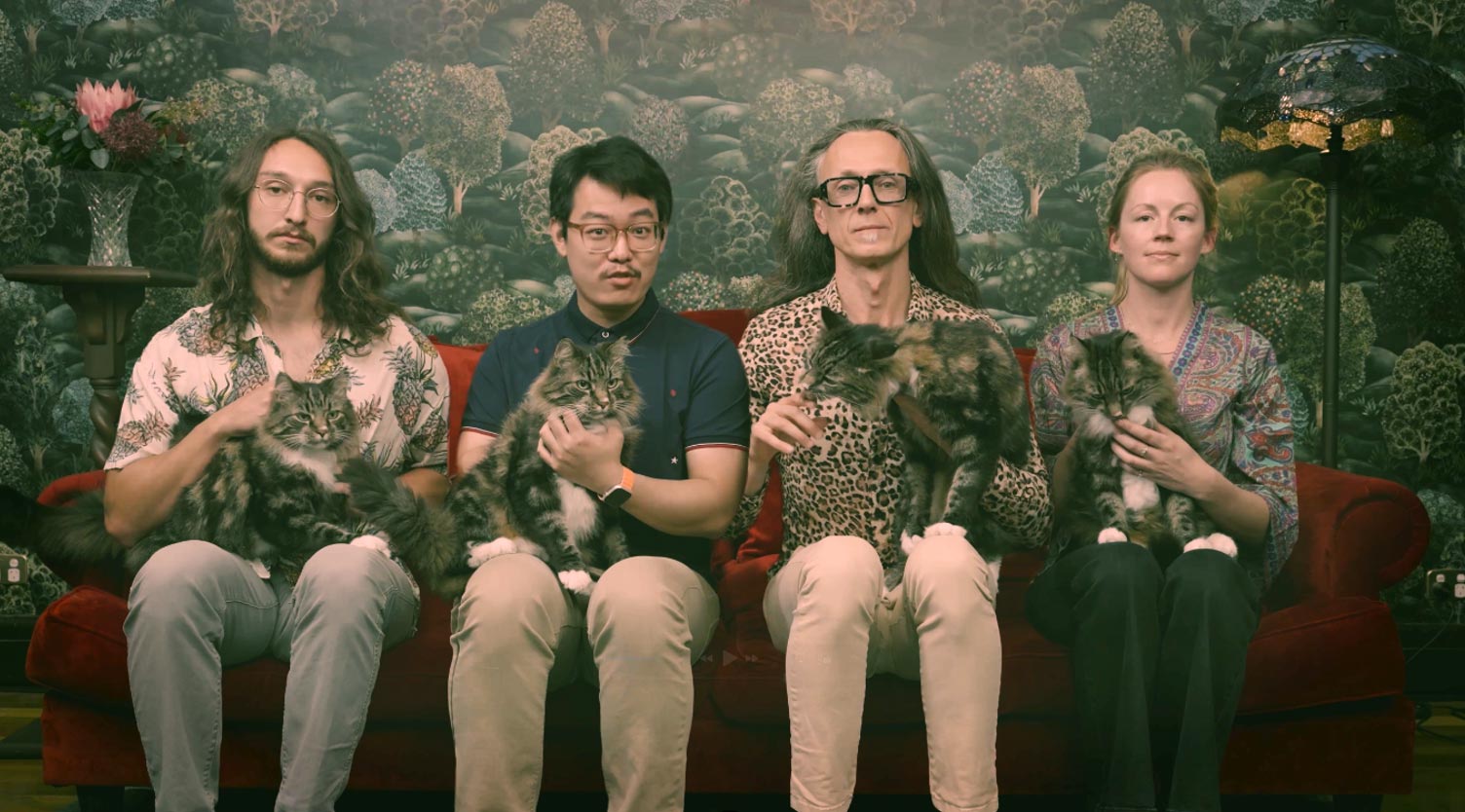
This is just a bit of levity intended to spark the afternoon. Observe the body language of the four cats in the second photo, and what do you see?
Cat 1: Put me down.
Cat 2: Put me down.
Cat 3: Feed me.
Cat 4: Put me down.
Kidding aside, it would be interesting to learn how you would control this effect in multiple locations without entanglement, or how you would induce entanglement in multiple locations for secure comm’s between them. This is, of course, only for those of you open to the notion of quantum entanglement. The rest of you, keep trolling, it inspires us to continue.
Quantum mechanics has baffled scientists and philosophers for over a century. Among its most iconic thought experiments is “Schrödinger’s cat,” where the fate of a cat — alive or dead — hinges on the decay of a radioactive atom.
Ask the researchers:
1. What is the difference between low dimensional spacetime matter and high-dimensional spacetime matter?
2. Can the properties of high-dimensional spacetime matter be used to understand low dimensional spacetime matter?
Scientific research guided by correct theories can enable researchers to think more.
According to the Topological Vortex Theory (TVT), spins create everything, spins shape the world. There are substantial distinctions between Topological Vortex Theory (TVT) and traditional physical theories. Grounded in the inviscid and absolutely incompressible spaces, TVT introduces the concept of topological phase transitions and employs topological principles to elucidate the formation and evolution of matter in the universe, as well as the impact of interactions between topological vortices and anti-vortices on spacetime dynamics and thermodynamics.
Within TVT, low-dimensional spacetime matter serves as the foundation for high-dimensional spacetime matter, and the hierarchical structure of matter and its interaction mechanisms challenge conventional macroscopic and microscopic interpretations. The conflict between Quantum Physics and Classical Physics can be attributed to their differing focuses: Quantum Physics emphasizes low-dimensional spacetime matter, whereas Classical Physics centers on high-dimensional spacetime matter.
Subatomic particles in the quantum world often defy the familiar rules of the physical world. The fact repeatedly suggests that the familiar rules of the physical world are pseudoscience. In the familiar rules of the physical world, two sets of cobalt-60 can form the mirror image of each other by rotating in opposite directions, and can receive heavy rewards.
Please witness the grand performance of physics today. https://scitechdaily.com/microscope-spacecrafts-most-precise-test-of-key-component-of-the-theory-of-general-relativity/#comment-854286.
If the researchers are truly interested in science, please read: The Application of Inviscid and Absolutely Incompressible Spaces in Engineering Simulation (https://scitechdaily.com/microscope-spacecrafts-most-precise-test-of-key-component-of-the-theory-of-general-relativity/#comment-870077).
Good potential research work to faciliate ‘Quantum Solution’ to be introduced for filling up the gap created from higher dimensional Space-Time theory,alternative of Einstein’s GR.
The present piece of research on quantum operator of antimony atom and device invented can facilitate a lot of necessary Quantum Computation works.However,this work is specificly due for the higher dimensional space-time theory,an alternative for Einstein’s GR.
What rubbish ! It gets curioser and curioser…
I am waiting to see what happens when they finally get stable qubits and then they will have to tackle tbe real issue….what do you do now ?
QC has been a few years away for few decades now…how much longer can you stretch the BS to justify the spending ?
Fantastic projections have now become acceptable truths through repetetive hype…but reality is that there is no verifyable and logically acceptable algorithm to implement…Shor’s itself is a supposition, yet to be proven…
When will the world realize that this is the classical case of tbe ” Emperor’s New Clothes ” ??
SciTechDaily’s article on Schrödinger’s cat in quantum computing is heavily flawed,
overhyping and misrepresenting the findings of the referenced *Nature Physics* study.
The claim that this experiment achieves a “macroscopic Schrödinger’s cat” is both
sensationalized and incorrect. The research actually demonstrates quantum superposition
states in a high-spin antimony nucleus (spin-7/2), which can encode error-correctable
logical qubits. However, this is a proof-of-concept, not a demonstration of practical
quantum error correction or stability.
The article falsely suggests that the system inherently resists errors by claiming it
would take “seven consecutive errors” to flip a qubit. The *Nature Physics* abstract
never supports this, and true quantum error correction remains a complex challenge.
The author’s suggestion that this work will imminently “revolutionize” quantum computing
is premature and speculative. Furthermore, the invocation of Schrödinger’s cat as a
metaphor for philosophical quantum duality adds unnecessary confusion, as the study
does not address foundational issues like the measurement problem.
Scalability claims based on silicon embedding are overstated. While a silicon platform
is practical, challenges like qudit coherence, control fidelity, and large-scale
integration remain unsolved. The SciTechDaily article glosses over these limitations
to sensationalize results. Its focus on exaggerated metaphors (“seven lives”) and
imminent breakthroughs lacks technical depth and factual grounding, violating EPEMC’s (Extended Plasma-Electromagnetic Cosmology) empirical rigor and logical coherence principles.
Final Verdict: Misleading, overhyped, and unreliable as an interpretation of serious
research.
Final Grade for SciTechDaily Article: C-
Strengths: Engages the public, introduces promising research in an accessible way.
Weaknesses: Misleads readers with overhyped and oversimplified claims; fails to accurately reflect the research’s scope and implications.
EPEMC Peer Review Bot, 2:56pm 1/16/25