
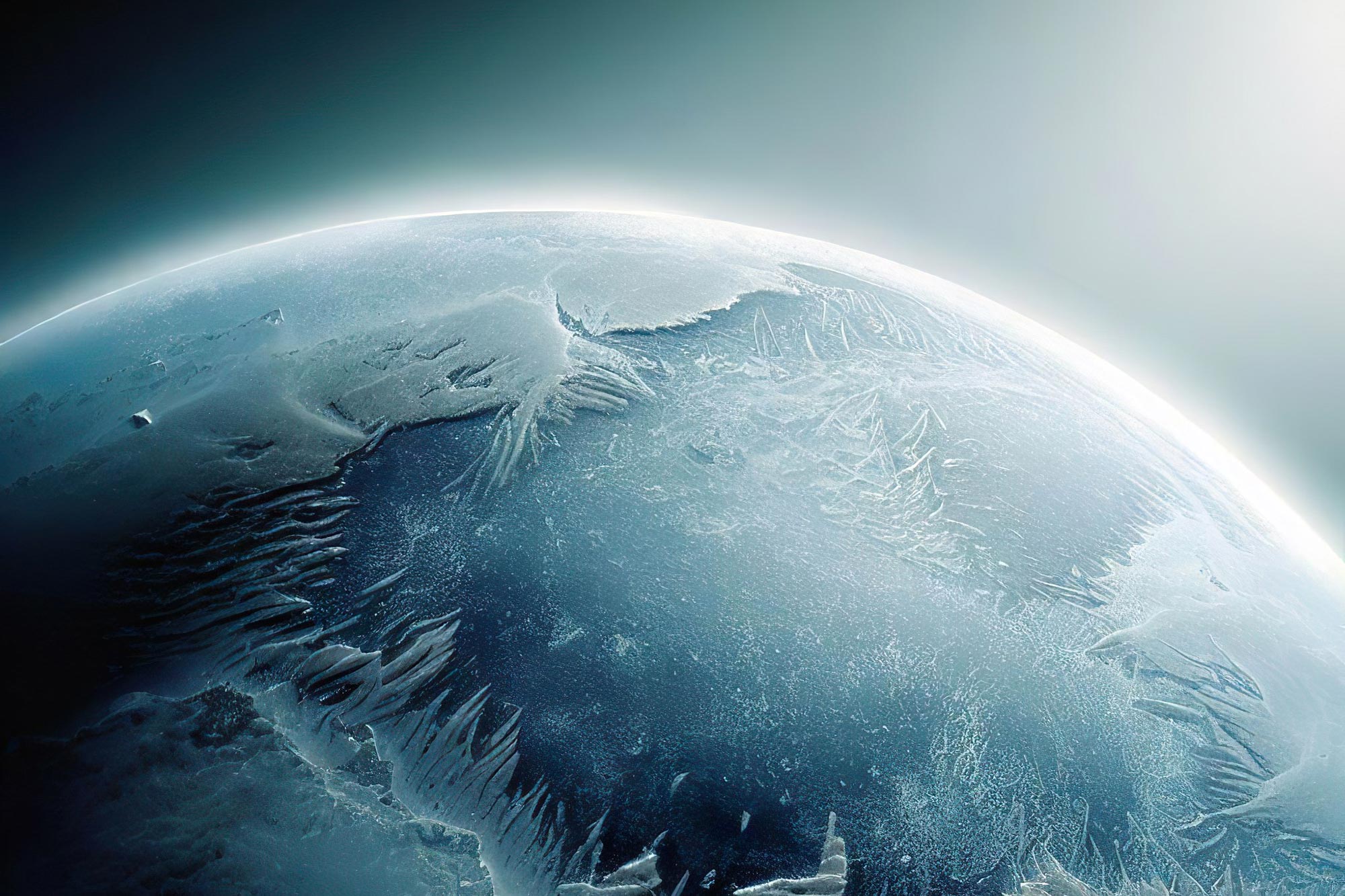
The new study suggests that the planet experienced a swift and intense melting phase following the last global ice age.
At the end of the last global ice age, Earth’s deep freeze hit a natural threshold in climate change, causing the planet to thaw into a slushy, partially melted state.
Results from a Virginia Tech-led study provide the first direct geochemical evidence of the slushy planet — otherwise known as the “plumeworld ocean” era — when sky-high carbon dioxide levels forced the frozen Earth into a massive, rapid melting period.
“Our results have important implications for understanding how Earth’s climate and ocean chemistry changed after the extreme conditions of the last global ice age,” said lead author Tian Gan, a former Virginia Tech postdoctoral researcher. Gan worked with geologist Shuhai Xiao on the study, which was published on November 5 in the Proceedings of the National Academy of Sciences journal.
Deep-frozen Earth
The last global ice age took place about 635 million to 650 million years ago, when scientists believe global temperatures dropped and the polar ice caps began to creep around the hemispheres. The growing ice reflected more sunlight away from the Earth, setting off a spiral of plunging temperatures.
“A quarter of the ocean was frozen due to extremely low carbon dioxide levels,” said Xiao, who recently was inducted into the National Academy of Sciences.
When the surface ocean sealed, a chain of reactions stuttered to a stop:
- The water cycle locked up. No evaporation and very little rain or snow.
- Without water, there was a massive slowdown in a carbon-dioxide-consuming process called chemical weathering, where rocks erode and disintegrate.
- Without weathering and erosion, carbon dioxide began to amass in the atmosphere and trap heat.
“It was just a matter of time until the carbon dioxide levels were high enough to break the pattern of ice,” Xiao said. “When it ended, it probably ended catastrophically.”
Plume world
Suddenly, heat started to build. The ice caps began to recede, and Earth’s climate backpedaled furiously toward the drippy and soupy. Over a mere 10 million years, average global temperatures swung from minus 50 to 120 degrees Fahrenheit (minus 45 to 48 degrees Celsius).
But the ice didn’t melt and remix with seawater at the same time. The research findings paint a very different world than what we can imagine: vast rivers of glacial water rushing like a reverse tsunami from the land into the sea, then pooling on top of extra salty, extra dense ocean water.
The researchers tested this version of the prehistoric world by looking at a set of carbonate rocks that formed as the global ice age was ending.
They analyzed a certain geochemical signature, the relative abundance of lithium isotopes, recorded within the carbonate rocks. According to plumeworld ocean theory, the geochemical signatures of freshwater would be stronger in rocks formed under nearshore meltwater than in the rocks formed offshore, beneath the deep, salty sea — and that’s exactly what the researchers observed.
The findings bring the limit of environmental change into better focus, said Xiao, but they also give researchers additional insight into the frontiers of biology and the resiliency of life under extreme conditions — hot, cold, and slushy.
Reference: “Lithium isotope evidence for a plumeworld ocean in the aftermath of the Marinoan snowball Earth” by Tian Gan, Meng Tian, Xi-Kai Wang, Shijie Wang, Xiao-Ming Liu, Ganqing Jiang, Benjamin C. Gill, Morrison Nolan, Alan J. Kaufman, Taiyi Luo and Shuhai Xiao, 5 November 2024, Proceedings of the National Academy of Sciences.
DOI: 10.1073/pnas.2407419121
Never miss a breakthrough: Join the SciTechDaily newsletter.
Follow us on Google and Google News.
1 Comment
” The research findings paint a very different world than what we can imagine: vast rivers of glacial water rushing like a reverse tsunami from the land into the sea, then pooling on top of extra salty, extra dense ocean water.”
Sort of like eastern Greenland in 1909-1912……..and probably during every summer afterwards and even before. Not at all helpful for undernourished explorers trying to walk home.